In 501, each player starts a Leg: One game within a match, with one winner. A match, or a set, is won by winning a number of legs. All terms on 501 points and subtracts the score of every Visit: A player's turn of up to three darts. In a game that counts down, its total is taken from the score the player has left. All terms of three darts. The leg is won by the first player to reach exactly zero, and the last dart must land in a Double: The narrow outer ring of the dartboard. A dart in it scores twice the number of its segment. All terms or the Bull: The centre of the dartboard. The bull scores 50 and counts as double 25; the ring around it, the outer bull, scores 25. All terms. A visit that goes below zero, leaves 1, or reaches zero without a double is a Bust: With a double finish, a visit that goes below zero, leaves 1, or reaches zero without a double. It does not count: the score stays as it was before the visit. All terms and does not count.
This page goes through those rules as the Playing and Tournament Rules of the World Darts Federation (WDF), twentieth revised edition (2018), set them, and shows each one on a MaestroScores scoreboard with the 501 Double out: The rule that the last dart of a leg must land in a double or the bull and bring the score to exactly zero. All terms (WDF) rules chosen.
Starting on 501: a straight start
Every leg starts on the same total. The WDF rules let the event choose it, as long as it is a fixed odd number such as 501, 701 or 1001. The start is Straight start: The start of a leg under the WDF rules: the first dart that lands inside the outer double wire already counts, with no double needed. All terms: the first dart of the leg that lands inside the outer double wire already counts. A board with the WDF rules starts every leg on 501, and its Start chip switches the match to 701 or 1001 before the first dart.
Each visit is up to three darts, and its score is taken from what the player has left. A dart scores only if it stays in the board until the visit is over, and a dart that bounces out or falls out is not thrown again. The scoreboard must show the score each player still needs, clearly, in front of the players. On MaestroScores every screen shows the score left beside each name, and the Classic Scoreboard also shows each player's Three-dart average: A player's average score for a visit of three darts: the points scored, divided by the darts thrown, times three. All terms.
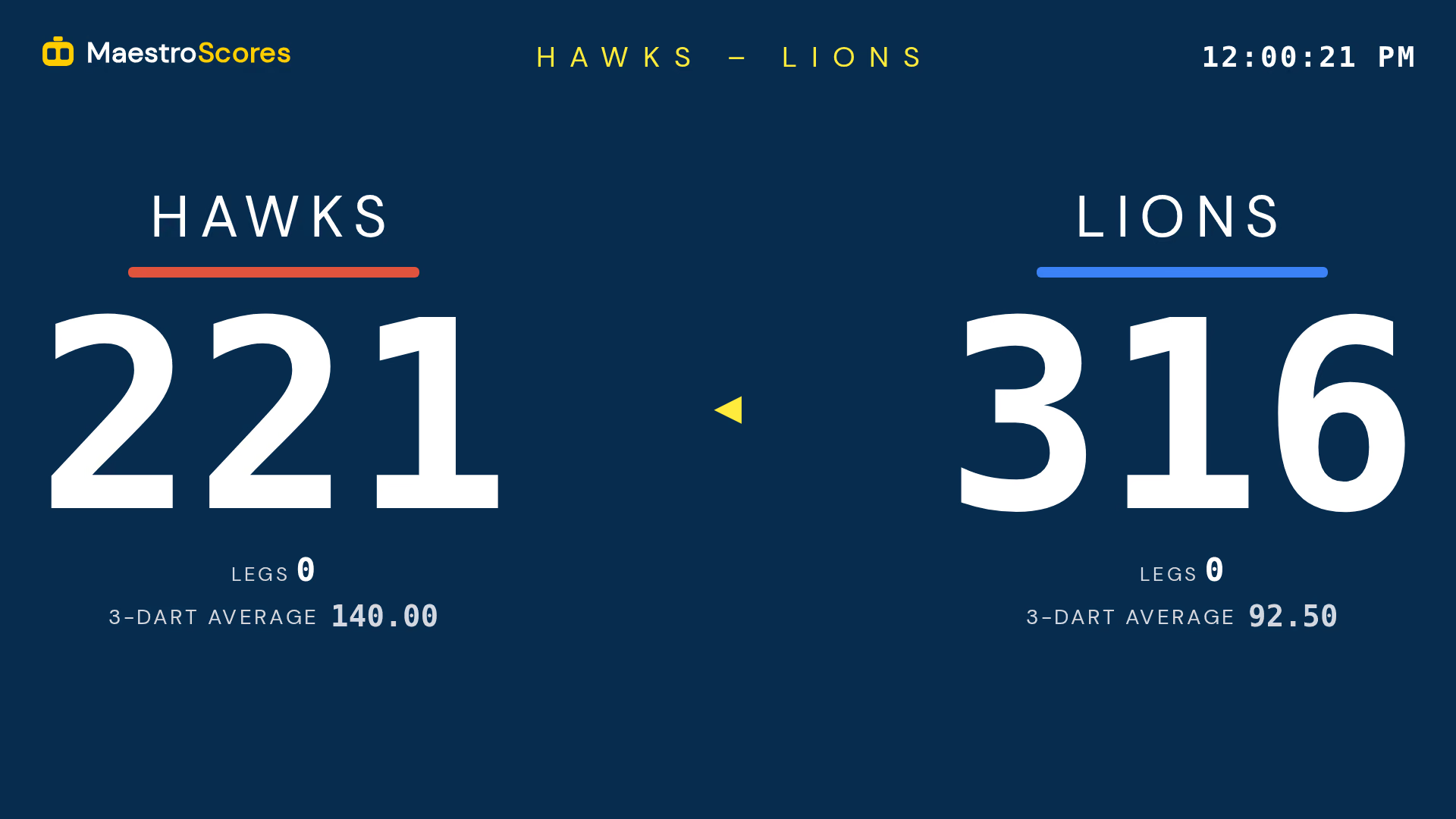

The ruleEvery leg starts on the same fixed total, and each visit is taken from what the player has left.
The double out: finishing on a double or the bull
To win the leg, a player must reach exactly zero with a dart in the double ring or in the bull. The double needed is half the score left: a player on 32 needs double 16, and a player on 50 can Finish: Bringing the score to exactly zero to win the leg, also called a checkout. A player is on a finish when the score left can be finished with the darts still in hand. All terms on the bull, which counts as double 25. The first player to finish wins the leg, and a dart thrown after the finish does not count.
The referee and the caller never name the double a player needs: they call 32, not double 16. MaestroScores does not name it either. The board marks the player who is on a finish, without saying which double.
On the board you enter the visit that finishes the leg like any other visit. The board ends the leg when the score reaches zero, counts it, and puts both players back on 501.
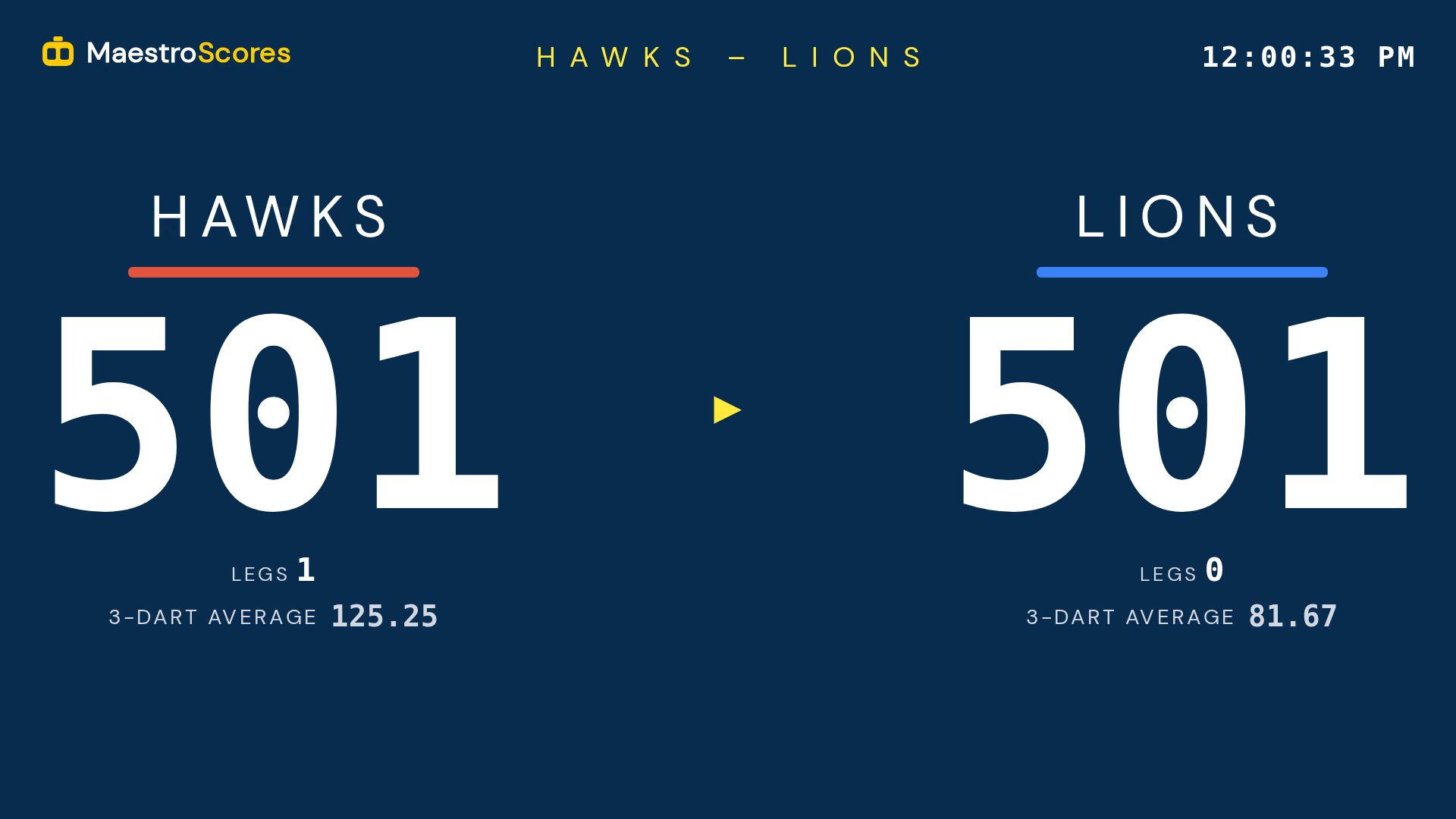

The ruleA leg is won on exactly zero, with the last dart in a double or the bull.
Bust: when a visit does not count
A visit is bust when it scores more points than the player has left, when it reaches exactly zero without a double, or when it leaves 1, which no double can finish. A bust visit does not count: the score stays as it was before the visit, and the throw passes to the other player.
On the board you enter a visit that goes below zero or leaves 1 as it was scored. The board sees the bust by itself, keeps the score as it was, and the screens show Bust. Enter a visit that reaches zero without a double as 0: the board cannot see where the darts landed.
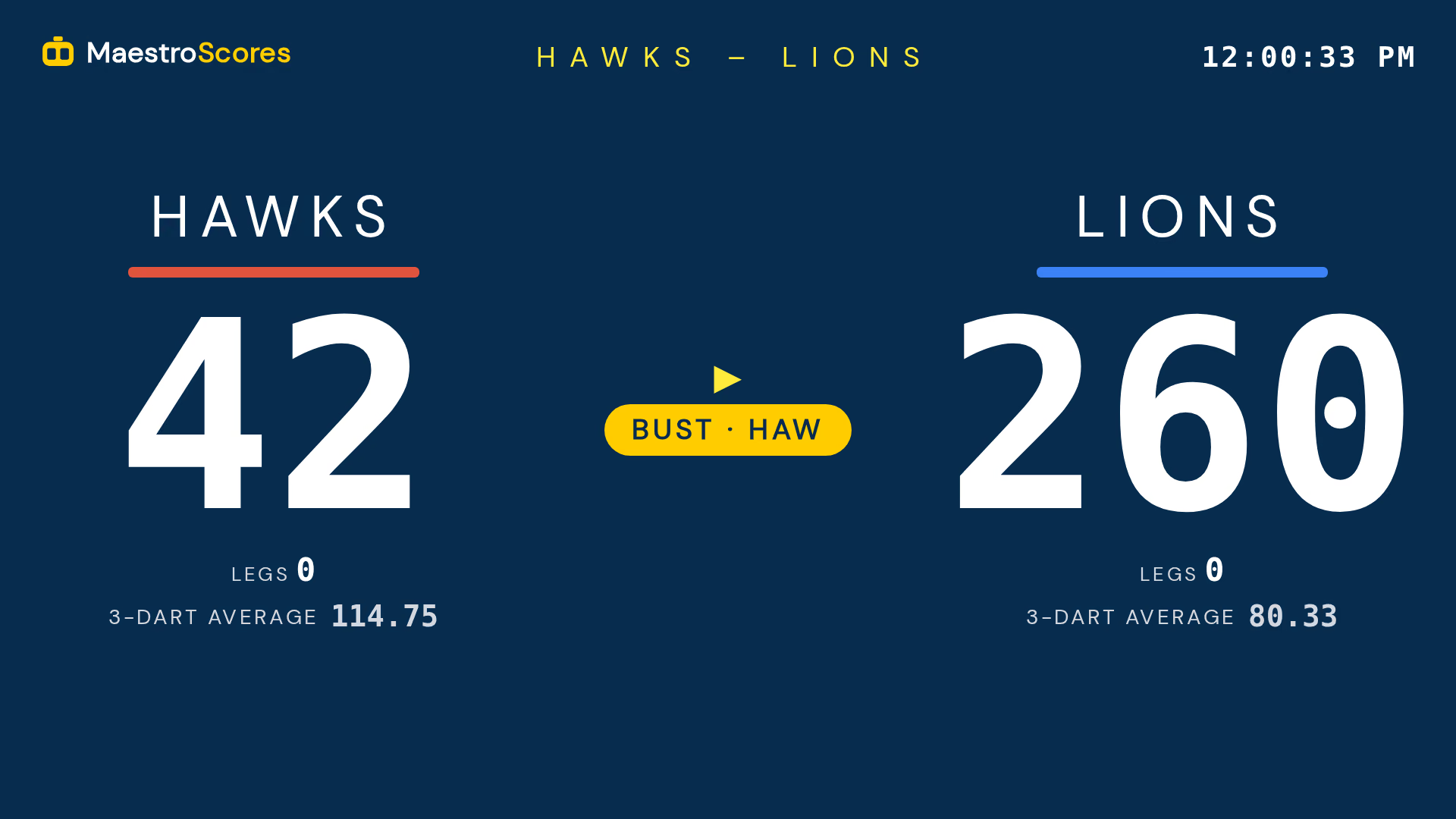

The ruleA visit that goes below zero, leaves 1 or reaches zero without a double is bust: the score stays as it was.
Legs and sets: the best of an odd number
A leg is the smallest part of a match, with one winner. A match, or a set, is the Best of: A match or set played as the best of an odd number of legs goes to the first player to win more than half of them; the legs left are not played. All terms an odd number of legs: the first player to win more than half of them wins it, and the legs left are not played. So a match of best of 5 legs is won by the first player to win 3.
Who throws first is decided by a Bull throw: Before the match each player throws one dart at the bull, and the player nearer the centre throws first. All terms before the match: each player throws one dart at the bull, and the player whose dart is nearer the centre throws first. The players then take turns to start a leg, so the winner of the bull throw starts the first leg and every odd-numbered leg.
A long match is divided Set: A group of legs within a long match. Each set is the best of an odd number of legs, and the match is the best of an odd number of sets. All terms. Each set is the best of an odd number of legs, and the match is the best of an odd number of sets. The winner of the bull throw throws first in every odd-numbered set, so each set starts with the other player. The World Championship of the Professional Darts Corporation (PDC) plays every set as the best of 5 legs, and its deciding set must be won by 2 clear legs, with a sudden-death leg at 5-5.
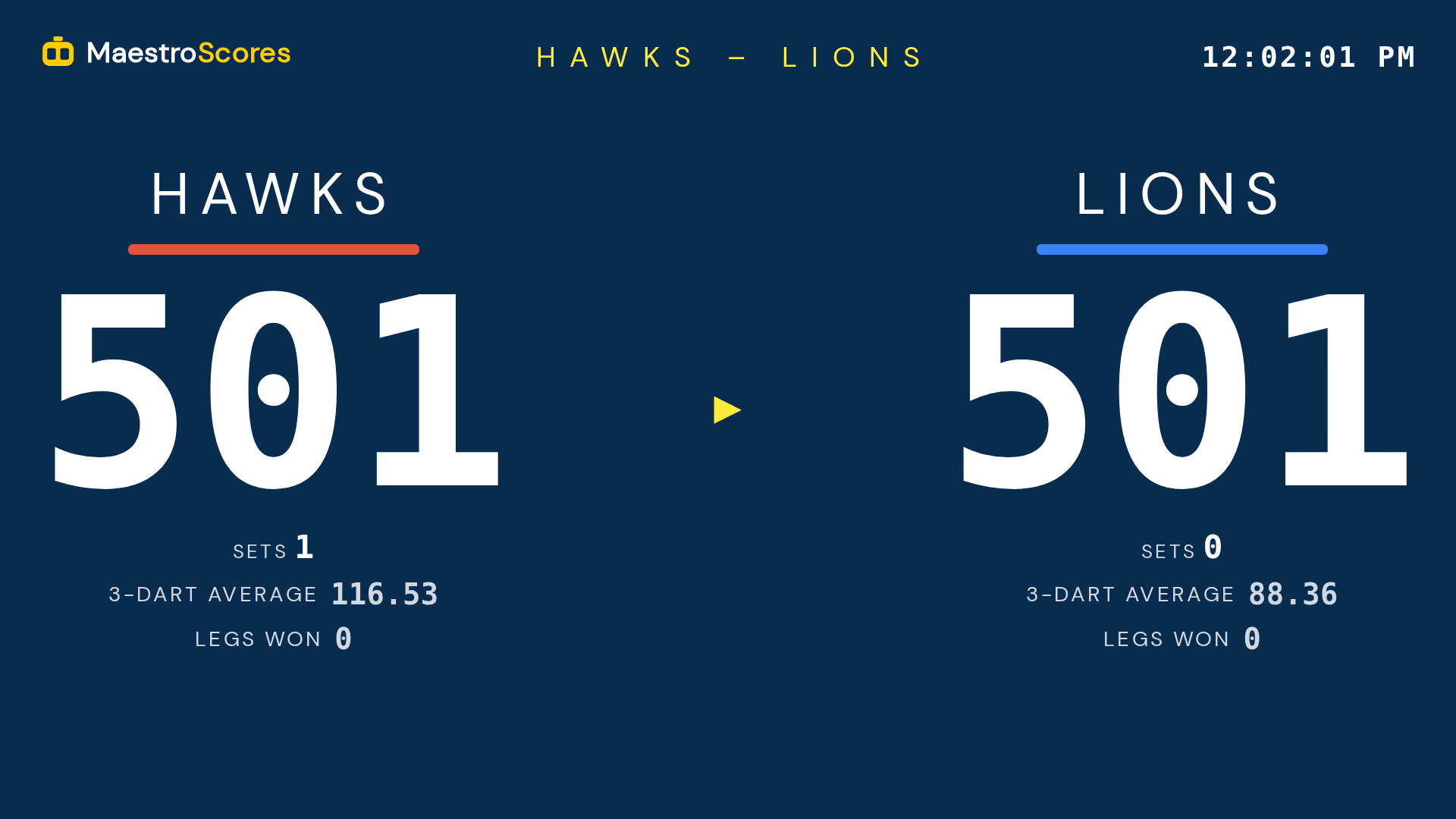

The ruleA set goes to the first player to win more than half of its legs, and the next set starts with the other player.
| Match or set | Legs to win |
|---|---|
| Best of 5 legs | 3 |
| Best of 7 legs | 4 |
| Best of 9 legs | 5 |
| Best of 11 legs | 6 |
| Best of 13 legs | 7 |
How the board keeps a 501 match
On MaestroScores you tap the player who won the bull throw, then enter each visit's total on your phone, on the number pad or with the keys for common totals. The board subtracts each visit, sees a bust, ends the leg at zero, counts the legs, and passes the first throw of each leg to the player whose turn it is. If you enter a wrong total, Undo takes the visit back.
A board with the WDF rules plays legs, first to 3 on a new board, and you can choose first to 4, 5, 6 or 7 legs when you create it. For a match of sets, choose the Sets (PDC) rules. The Scoreboard on a TV and the Scorebug on a stream show the same score at the same moment.
FAQ
How do you finish in 501 darts?
You must reach exactly zero with your last dart in a double or the bull. A player on 40 needs double 20, and a player on 50 can finish on the bull.
What happens if you go below zero in 501?
The visit is bust and does not count. The score stays as it was before the visit, and the other player throws next.
Can you finish on 1 in darts?
No. A score of 1 cannot be finished with a double, so a visit that leaves 1 is a bust, and the score goes back to what it was before the visit.
How many legs are in a set of darts?
The event decides, but a set is always the best of an odd number of legs. The PDC World Championship plays every set as the best of 5 legs.
Do you need a double to start in 501?
Not under the WDF rules, which play a straight start: the first dart inside the outer double wire counts. In double-in, double-out 501, scoring starts only with a double.
Keep 501 score on a board
Create a darts board, choose the 501 rules you play, enter each visit on your phone, and open the Scoreboard link on any screen in the room.
Darts terms
- Best of
- A match or set played as the best of an odd number of legs goes to the first player to win more than half of them; the legs left are not played.
- Bull
- The centre of the dartboard. The bull scores 50 and counts as double 25; the ring around it, the outer bull, scores 25.
- Bull throw
- Before the match each player throws one dart at the bull, and the player nearer the centre throws first.
- Bust
- With a double finish, a visit that goes below zero, leaves 1, or reaches zero without a double. It does not count: the score stays as it was before the visit.
- Closed number
- In cricket, a number on which a player has three marks. Further hits on it score for that player while the opponent has it open; once both have closed it, nobody scores on it.
- Cork
- Soft-tip darts' throw at the bull: each player throws one dart, and the player nearer the centre wins. It decides who throws first in the first leg, and a leg the round limit leaves undecided.
- Double
- The narrow outer ring of the dartboard. A dart in it scores twice the number of its segment.
- Double in
- A rule under which a player's scoring starts only with a dart in a double; darts thrown before it score nothing.
- Double out
- The rule that the last dart of a leg must land in a double or the bull and bring the score to exactly zero.
- Finish
- Bringing the score to exactly zero to win the leg, also called a checkout. A player is on a finish when the score left can be finished with the darts still in hand.
- Leg
- One game within a match, with one winner. A match, or a set, is won by winning a number of legs.
- Marks
- In cricket, the hits a player has on a number: a single gives one mark, a double two and a treble three; on the bull the outer ring gives one and the centre two.
- Oche
- The raised line the players throw from, at the throwing distance from the dartboard. A player's feet must stay behind it while throwing.
- Open finish
- A finish on any dart: the leg ends when the score reaches exactly zero, whatever the ring.
- Round
- One visit by each player. A soft-tip leg has a round limit: the most rounds it may last, as the tournament sets it.
- Set
- A group of legs within a long match. Each set is the best of an odd number of legs, and the match is the best of an odd number of sets.
- Soft-tip
- Darts with plastic tips, thrown at an electronic board that counts the score. Its legs have a round limit, and the cork decides what the limit leaves open.
- Straight start
- The start of a leg under the WDF rules: the first dart that lands inside the outer double wire already counts, with no double needed.
- Three-dart average
- A player's average score for a visit of three darts: the points scored, divided by the darts thrown, times three.
- Treble
- The narrow inner ring of the dartboard. A dart in it scores three times the number of its segment.
- Visit
- A player's turn of up to three darts. In a game that counts down, its total is taken from the score the player has left.