The Mercy rule: Also called the run rule: it ends a game early when one team leads by a set number of runs after a set number of innings. All terms, also called the run rule, ends a baseball game early when one team leads by a set number of Run: Baseball's point: a runner who touches first, second, third and home base before the third out scores one run. No run counts on a play whose third out is a force out or the batter put out before first base. All terms after a set number of Inning: The part of a game in which both teams bat once. The visiting team bats in the top of the inning, the home team in the bottom. All terms. Under NCAA college rules, for example, a game may be stopped after seven innings when one team leads by 10 runs or more. MLB has no mercy rule: its games are played to the end.
This page plays the NCAA 10-run rule through on a MaestroScores scoreboard, under the 2027 and 2028 NCAA Baseball Rules, and then shows the run rule of Korean high school baseball, Japanese adult rubber-ball baseball and Little League.
What the mercy rule is
A run rule sets a lead and an inning: once a team leads by that many runs after that inning, the game is over, and the team ahead wins. It is called the mercy rule, the run rule, or the 10-run rule when the lead is 10 runs; in Japan and Korea such a game is a called game. The NCAA and Little League rules count complete innings, so the trailing team still has its turn at bat. When the home team is the one ahead, half an inning less is enough, because it would not bat again.
The NCAA 10-run rule: a lead of 10 after seven innings
In college baseball the 10-run rule is not automatic. It applies by conference rule, or when both coaches agree before the game, and then a game may be stopped after seven innings if one team leads by at least 10 runs. Here Hawks, the visiting team, lead 9-0 and score again in the top of the seventh. A 10-run lead in the top of the inning does not end the game yet: Lions still bat in the bottom of the seventh.
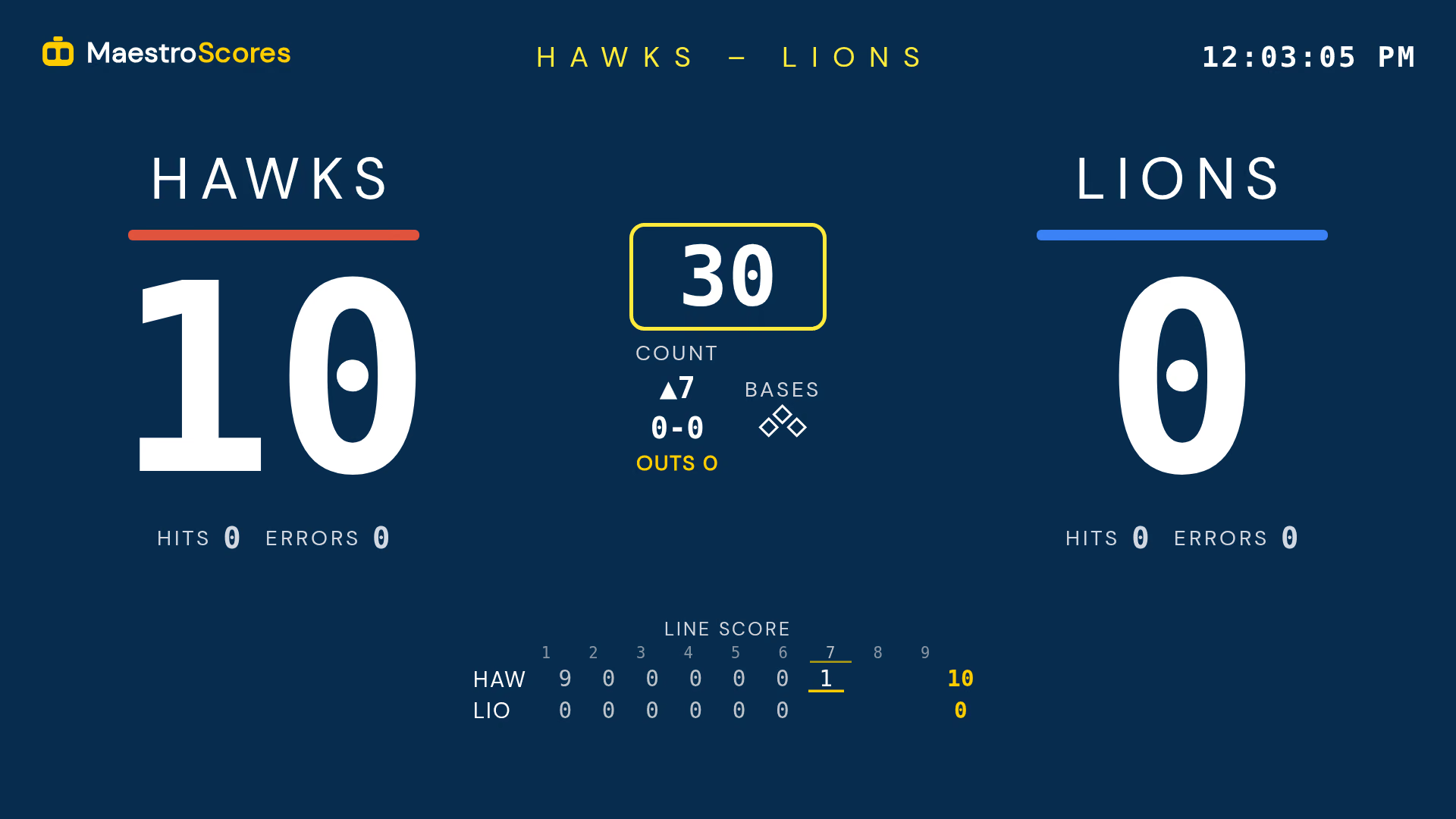

The ruleA 10-run lead in the top of an inning does not end the game: the home team still bats.
The board asks, and Final ends the game
Lions do not score in the bottom of the seventh, so Hawks still lead by 10 when the inning ends, and the run rule applies. The board does not end the game here by itself: it asks the scorekeeper whether to end it. Press Final to end the game, or Play on to keep playing.
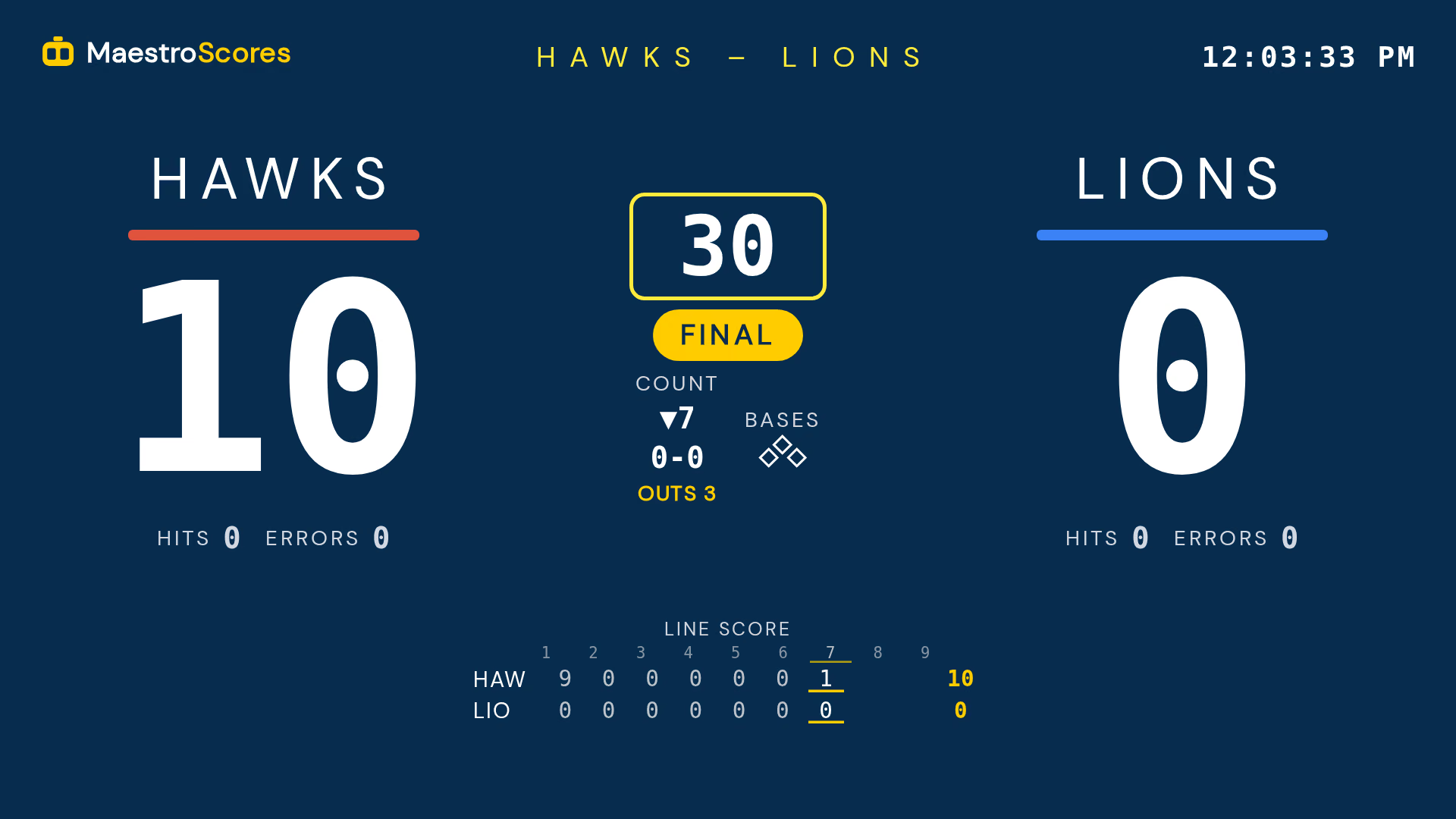

The ruleUnder the NCAA 10-run rule a lead of 10 runs after seven innings may end the game: the scorekeeper ends it with Final.
When the home team reaches the lead: the game ends at once
The home team does not need all of its last inning. Under the NCAA rule a home team that leads by 10 after the top of the seventh may end the game there, and a home team that reaches a 10-run lead during its half of the seventh or a later inning ends the game the moment that run scores. On the board, that run ends the game by itself.
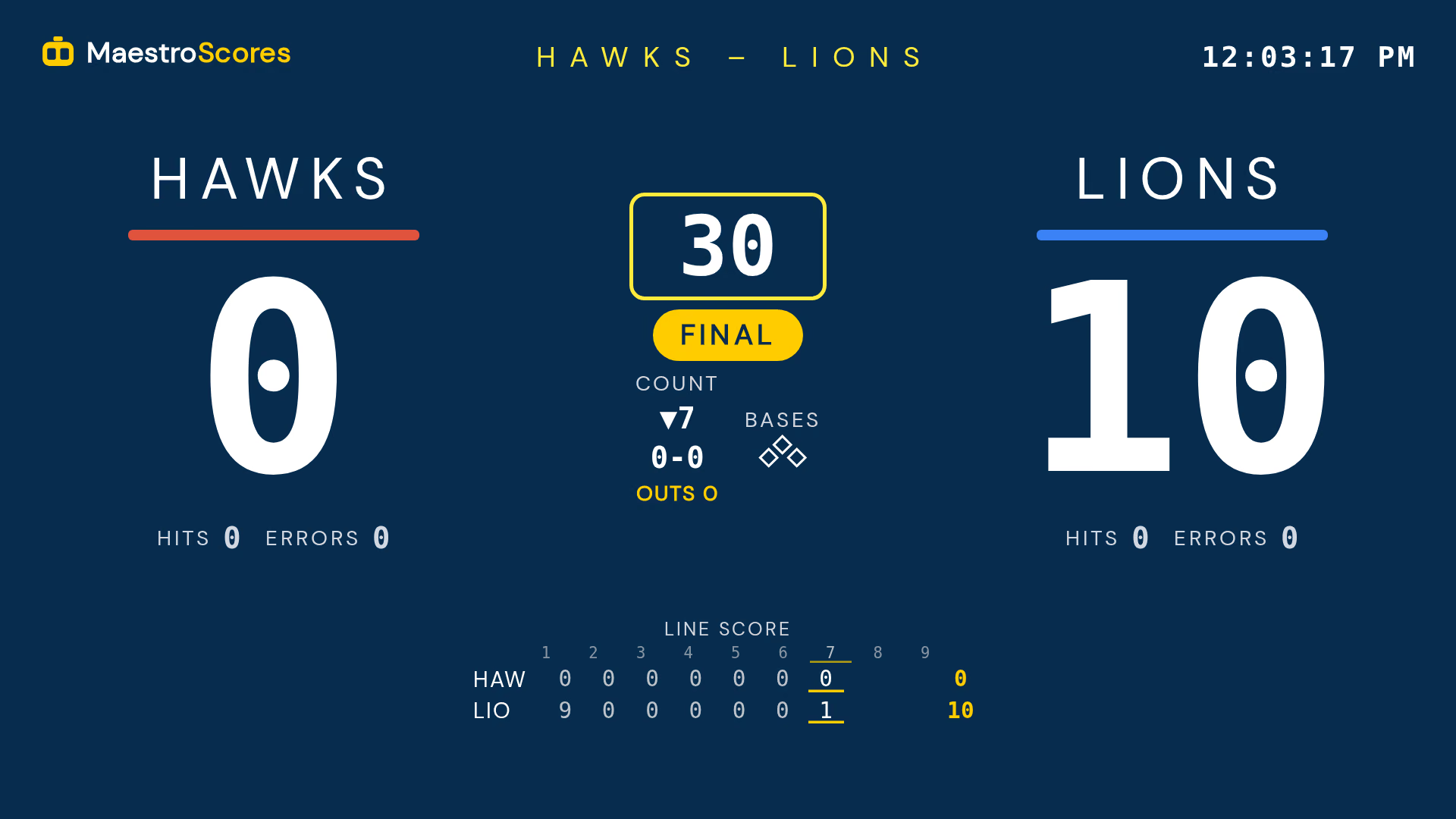

The ruleA home team that reaches a 10-run lead in its half of the seventh or a later inning ends the game with that run.
Korean high school baseball: 10 runs from the 5th, 7 from the 7th
The national high school tournaments of the Korea Baseball Softball Association (KBSA) call a game when one team leads by 10 runs from the 5th inning, or by 7 runs from the 7th inning. The rule applies up to the quarter-finals; the semi-finals and the final are played to the end. Here Hawks lead 7-0 when the seventh inning ends.
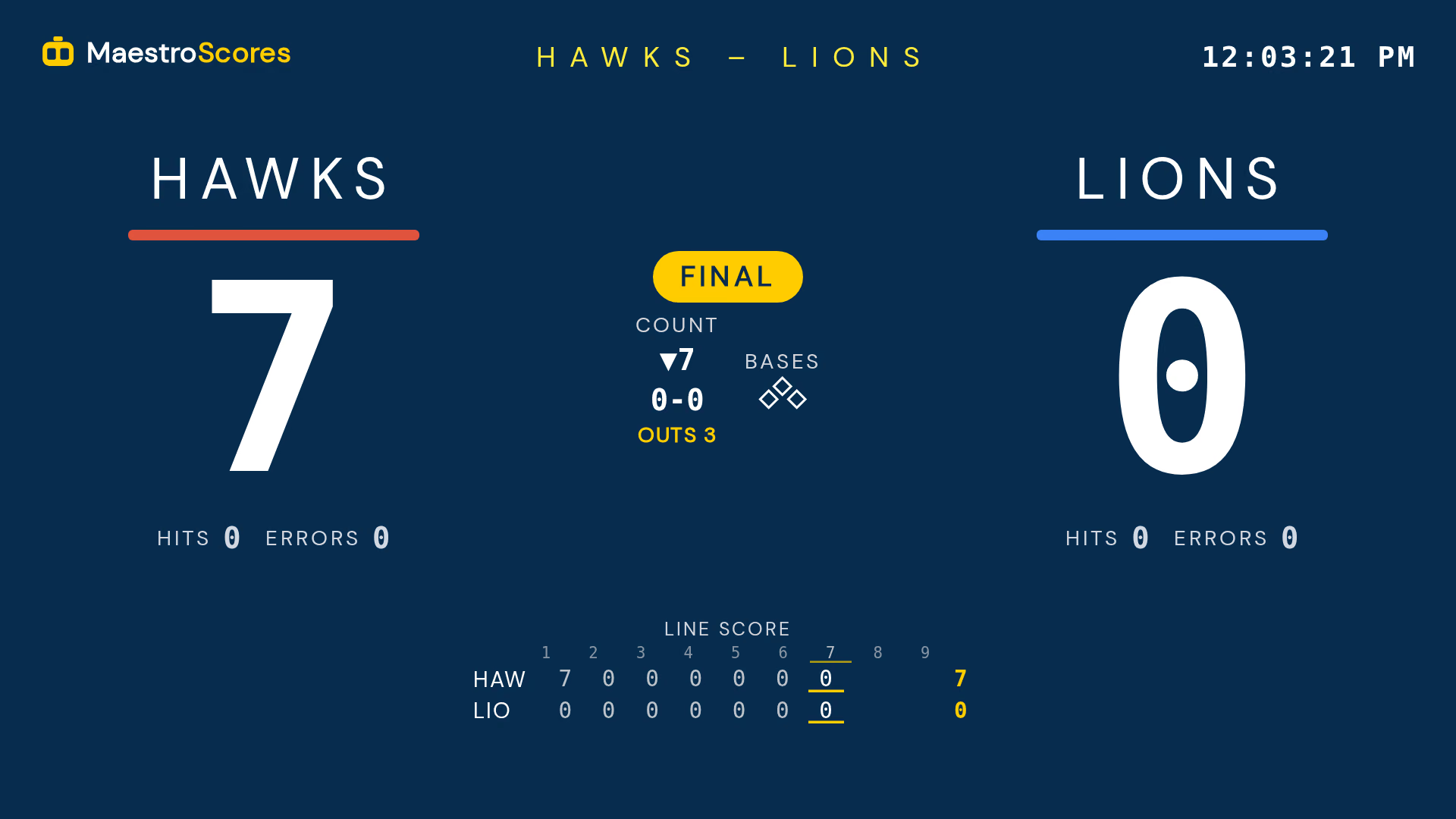

The ruleIn KBSA high school tournaments up to the quarter-finals, a lead of 10 runs from the 5th inning, or 7 runs from the 7th, calls the game.
The run rule in other rulebooks
Each rulebook sets its own lead and inning. In Japan, the prefectural rounds of rubber-ball baseball for adults, here under the Toyama federation's rules, call a game at a lead of 7 runs from the 5th inning, the final included. Little League ends a game at a lead of 15 runs after 3 innings, or 10 runs after 4. In the regular season each local league chooses whether to use the run rule, and may add an 8-run rule after 5 innings; the 15- and 10-run rules are mandatory in the International Tournament. A Little League home team that reaches the run rule's lead in its own half ends the game the moment that run scores, and when a Home run: A hit on which the batter scores, most often a fair ball out of the playing field. Every runner on base scores too. All terms with runners on base ends it by the 10-run rule, all of its runs count.
| Rules | Lead | When |
|---|---|---|
| NCAA, by conference rule or both coaches' agreement | 10 runs | after 7 innings |
| KBSA high school tournaments, up to the quarter-finals | 10 runs, or 7 runs | from the 5th inning, or from the 7th |
| Japanese rubber-ball baseball for adults, prefectural rounds | 7 runs | from the 5th inning |
| Little League (Majors), optional for local leagues in the regular season | 15 runs, or 10 runs; 8 runs as a regular-season option | after 3 innings, or after 4; after 5 for the 8 runs |
| MLB | no run rule | the game is played to the end |
How the board keeps the run rule
The run rule comes with the rules you choose when you create the board. The NCAA rules carry it as an option you switch on; the Korean high school, Japanese adult and Little League rules have it on, and the MLB rules have none. When a lead reaches the rule at the end of a Half-inning: One team's turn at bat, the top or the bottom of an inning. It ends with the third out. All terms, the board asks whether to end the game, and the game ends only when you press Final. A home team that reaches the lead during its own half under the NCAA rule ends the game with that run, without a question.
FAQ
What is the mercy rule in baseball?
A rule that ends a game early when one team leads by a set number of runs after a set inning. It is also called the run rule, or the 10-run rule when the lead is 10 runs.
What is the 10-run rule in college baseball?
By conference rule or the agreement of both coaches before the game, an NCAA game may be stopped after seven innings when one team leads by 10 runs or more. Without that agreement the game is played to the end.
Does MLB have a mercy rule?
No. A Major League game is played to the end of its nine innings, or on into extra innings when it is tied, whatever the score.
Does the trailing team always get to bat?
Under the NCAA and Little League rules, yes. When the visiting team takes a big lead in the top of an inning, the home team still bats in the bottom; only a home team that is ahead needs none or only part of its half.
Does the mercy rule apply in a final?
It depends on the rules: in Korean high school tournaments it applies up to the quarter-finals, and the semi-finals and the final are played to the end. In the Japanese prefectural rounds of adult rubber-ball baseball it applies in every game, the final included.
Keep the run rule on a board
Create a baseball board, choose the rules you play with their run rule, tap each pitch, out and run on your phone, and the board asks when the rule is reached.
Baseball terms
- Ball
- A pitch outside the strike zone that the batter does not swing at. Four balls are a walk.
- Bases loaded
- Runners on first, second and third base, so a walk forces in a run.
- Bunt
- A ball the batter does not swing at but meets with the bat on purpose and taps slowly into the infield. A bunt that goes foul with two strikes is strike three.
- Count
- The balls and strikes on the batter, said with the balls first; a full count is three balls and two strikes. It starts again with each new batter.
- Days of rest
- The calendar days a Little League pitcher must wait before pitching again, set by the number of pitches thrown in a day.
- Double
- A hit on which the batter reaches second base safely.
- Error
- A fielder's misplay that lets a batter reach base or a runner move up when ordinary play would have put him out or held him. The E on a scoreboard counts a team's errors.
- Extra innings
- Innings played when the score is level after the last regulation inning, until the visiting team leads at the end of a completed inning or the home team scores the winning run.
- Force out
- An out made by touching the base a runner has to move to because the batter became a runner. No run counts on a play whose third out is a force out.
- Foul ball
- A batted ball that settles in foul territory, outside the foul lines. It is a strike with fewer than two strikes; with two strikes it leaves the count as it is, unless it is a bunt or a foul tip the catcher catches.
- Foul tip
- A batted ball that goes sharp and direct from the bat to the catcher and is caught. A caught foul tip is a strike, so with two strikes it is strike three.
- Half-inning
- One team's turn at bat, the top or the bottom of an inning. It ends with the third out.
- Hit
- A fair ball on which the batter reaches base safely, without the help of a fielding error. The H on a scoreboard counts a team's hits.
- Home run
- A hit on which the batter scores, most often a fair ball out of the playing field. Every runner on base scores too.
- Inning
- The part of a game in which both teams bat once. The visiting team bats in the top of the inning, the home team in the bottom.
- League age
- The age Little League counts a player by for the whole season. It sets a pitcher's daily pitch limit and days of rest.
- Line score
- Each team's runs inning by inning, in a row, with the total at the end.
- Mercy rule
- Also called the run rule: it ends a game early when one team leads by a set number of runs after a set number of innings.
- Out
- A batter or runner put out, on a strikeout, a caught fly ball, a tag or a force play. Three outs end a team's half-inning.
- Pitch count
- The number of pitches a pitcher has thrown. In Little League it is held to a daily limit and sets the days of rest.
- Pitch timer
- The countdown a pitcher has for each pitch, also called the pitch clock. Under MLB's rules a pitcher who is late is charged with a ball, and a batter who is late with a strike.
- Regulation game
- A game that counts, with its result: one played to its end, or one called early, for rain or darkness for example, once enough innings have been played.
- Run
- Baseball's point: a runner who touches first, second, third and home base before the third out scores one run. No run counts on a play whose third out is a force out or the batter put out before first base.
- Strike
- A pitch the batter swings at and misses, a pitch through the strike zone, or a foul ball with fewer than two strikes. Three strikes put the batter out.
- Strikeout
- Strike three: the batter is out.
- Walk
- Ball four: the batter takes first base, and a runner forced by the batter moves up one base.
- Walk-off
- The run that wins the game for the home team in the bottom of the last inning or of an extra inning. The game ends the moment it scores.
- 2027 and 2028 NCAA Baseball Rulesncaaorg.s3.amazonaws.com
- 대한야구소프트볼협회: 2026 신세계 이마트배 전국고교야구대회 운영규정korea-baseball.com
- 富山県軟式野球連盟: 一 般 の 部uyakyu.spo-uozu.com
- What is the Little League® Run Rule?littleleague.org
- The 8, 10, and 15-Run Rules: What Parents Need to Knowlittleleague.org