A baseball scoreboard tells the story of a game in a few rows: the Run: Baseball's point: a runner who touches first, second, third and home base before the third out scores one run. No run counts on a play whose third out is a force out or the batter put out before first base. All terms of each Inning: The part of a game in which both teams bat once. The visiting team bats in the top of the inning, the home team in the bottom. All terms, the totals of runs, Hit: A fair ball on which the batter reaches base safely, without the help of a fielding error. The H on a scoreboard counts a team's hits. All terms and Error: A fielder's misplay that lets a batter reach base or a runner move up when ordinary play would have put him out or held him. The E on a scoreboard counts a team's errors. All terms, and the situation of the moment, that is Count: The balls and strikes on the batter, said with the balls first; a full count is three balls and two strikes. It starts again with each new batter. All terms, the Out: A batter or runner put out, on a strikeout, a caught fly ball, a tag or a force play. Three outs end a team's half-inning. All terms and the runners on base. With MaestroScores, the scorekeeper keeps all of it on a phone in the dugout or the press box, and a screen beside the field and a live stream show it at once. It runs in the browser, with nothing to install and no account.
This guide explains what a baseball scoreboard shows, how the board follows the game, how Extra innings: Innings played when the score is level after the last regulation inning, until the visiting team leads at the end of a completed inning or the home team scores the winning run. All terms and the Pitch timer: The countdown a pitcher has for each pitch, also called the pitch clock. Under MLB's rules a pitcher who is late is charged with a ball, and a batter who is late with a strike. All terms work, and which rules you can choose.
What a baseball scoreboard shows
The top of a baseball scoreboard is the Line score: Each team's runs inning by inning, in a row, with the total at the end. All terms: one column for each inning and the runs each team scored in it, followed by R, H and E, the totals of runs, hits and errors. Below it, the board shows what is happening now. MaestroScores keeps all of it:
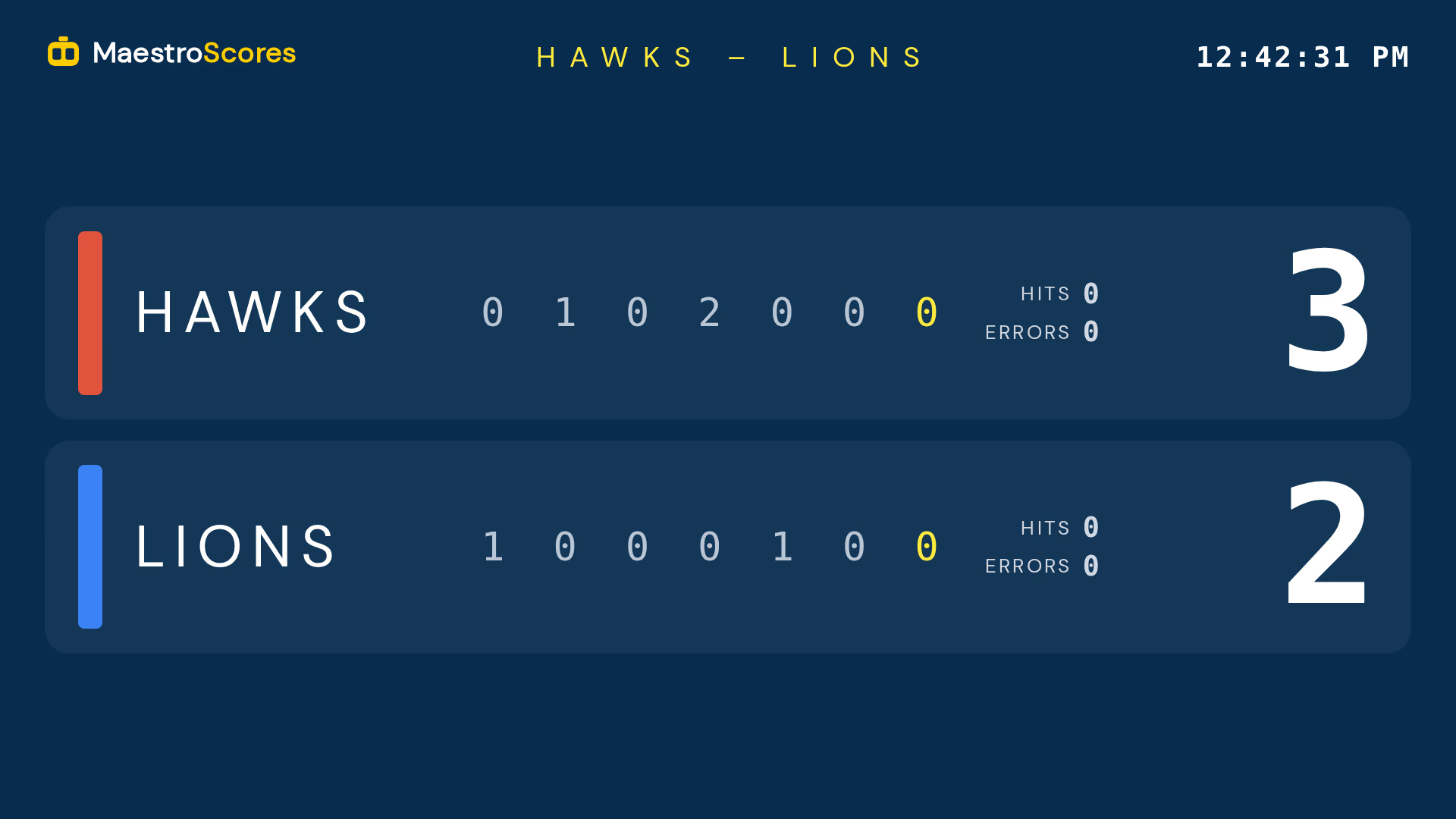
- The line score, with the runs of every inning
- Runs, hits and errors for each team
- The inning, and whether it is the top or the bottom
- The count of Ball: A pitch outside the strike zone that the batter does not swing at. Four balls are a walk. All terms and Strike: A pitch the batter swings at and misses, a pitch through the strike zone, or a foul ball with fewer than two strikes. Three strikes put the batter out. All terms
- The outs in the Half-inning: One team's turn at bat, the top or the bottom of an inning. It ends with the third out. All terms
- The runners on first, second and third base
- The Pitch count: The number of pitches a pitcher has thrown. In Little League it is held to a daily limit and sets the days of rest. All terms, and the pitch clock where the rules use one
How the baseball scoreboard follows the game
The scorekeeper records each pitch and each play, and the board keeps the rest in order. A Foul ball: A batted ball that settles in foul territory, outside the foul lines. It is a strike with fewer than two strikes; with two strikes it leaves the count as it is, unless it is a bunt or a foul tip the catcher catches. All terms with two strikes leaves the count as it is. At the third out the half-inning ends: the count and the bases clear, the runs go into the line score, and the next half-inning starts at the top or the bottom.
Every tap is saved before any screen shows it, and Undo takes back the last one exactly. If the phone's battery runs out, the scorekeeper opens the same link on another phone and the game continues from the last pitch.
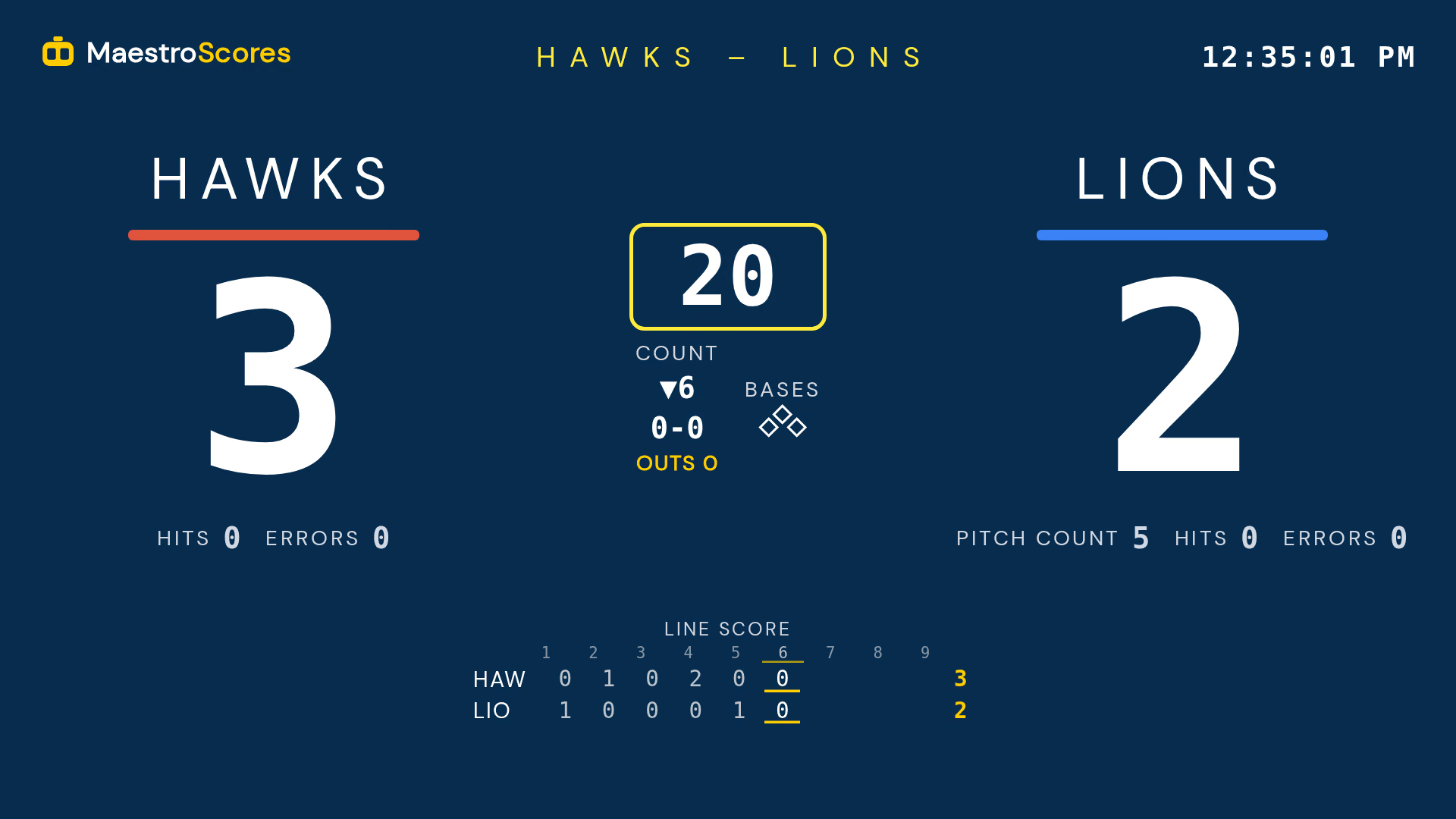

TipA foul with two strikes changes nothing; the third out clears the count and the bases.
Extra innings and the pitch clock
A Regulation game: A game that counts, with its result: one played to its end, or one called early, for rain or darkness for example, once enough innings have been played. All terms under the WBSC Official Rules of Baseball has six, seven or nine innings, as each competition sets, and a tied game goes on until it is decided. From the tenth inning of a nine-inning WBSC game, each half-inning starts with runners on first and second base and nobody out. Under the 2026 Official Baseball Rules of MLB, each half-inning after the ninth starts with a runner on second base.
The WBSC rules also use a pitch clock of 20 seconds, but only with no runners on base, for the whole game including extra innings. The board starts extra innings with the runners its rule set places on base, and it runs the pitch clock only when that rule set uses one, with its length and the bases on which it applies.
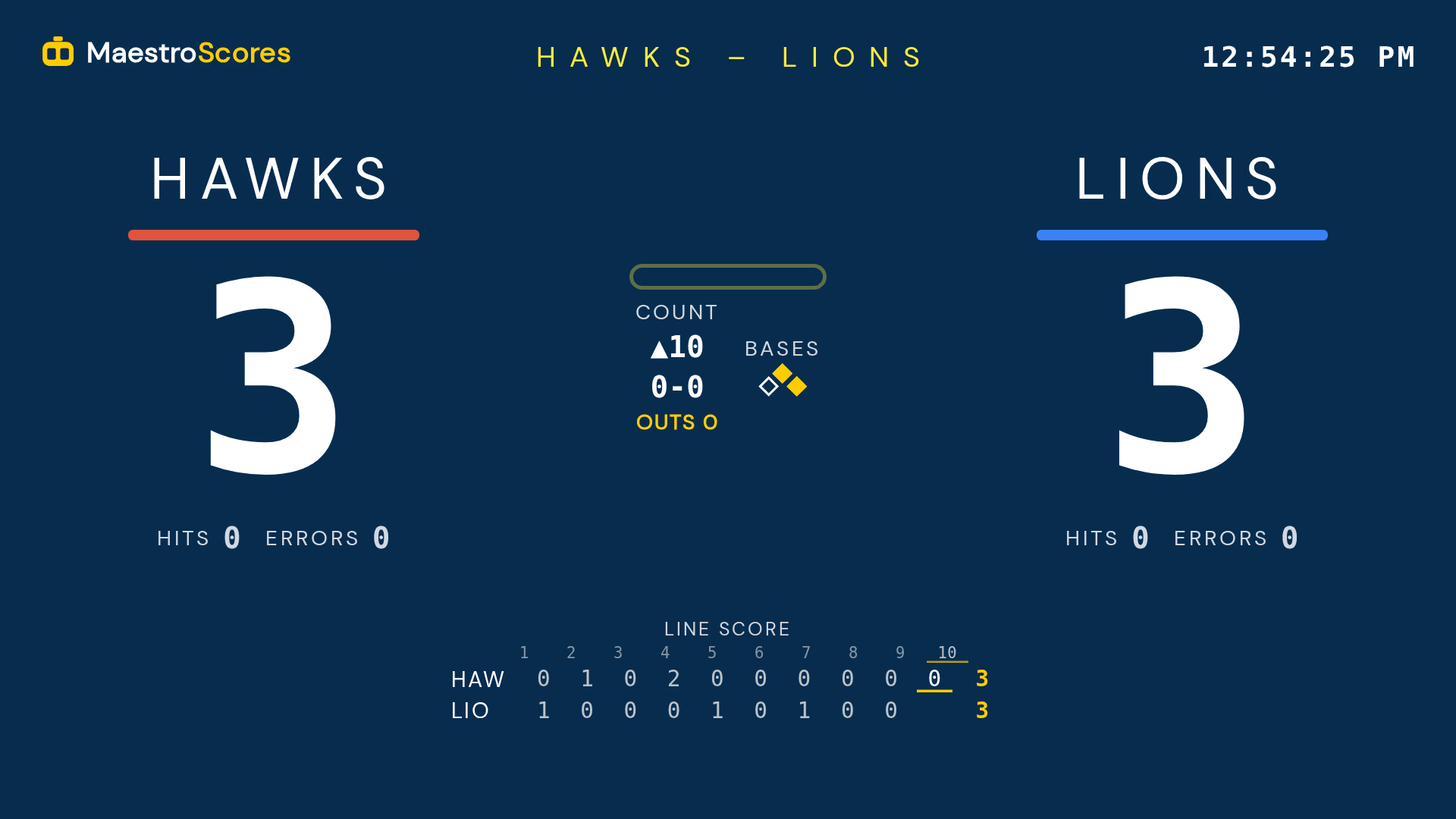

TipFrom the tenth inning of a nine-inning WBSC game, each half-inning starts with runners on first and second base and nobody out.
Choose the baseball rules you play
A new board starts on the rules usual where you create it; in Japan, for example, it starts on Japanese rubber-ball baseball for adults. You can choose another rule set when you create the board, from the WBSC international rules and MLB to NPB in Japan, the KBO in Korea, the CPBL in Taiwan, NCAA baseball, Little League (Majors), Japanese high school baseball, Japanese rubber-ball baseball for adults and under-12 teams, and Korean high school baseball. Each rule set names its rulebook and the date it was checked; the WBSC rule set follows the WBSC Official Rules of Baseball 2025-2026 and was checked on 20 October 2026.
Screens for the field and the stream
Every board has a Scoreboard screen with the line score: open its link in a TV's browser beside the field or in the clubhouse, or connect a laptop to a TV or a projector. Display links only show the game; nobody who opens one can change the score.
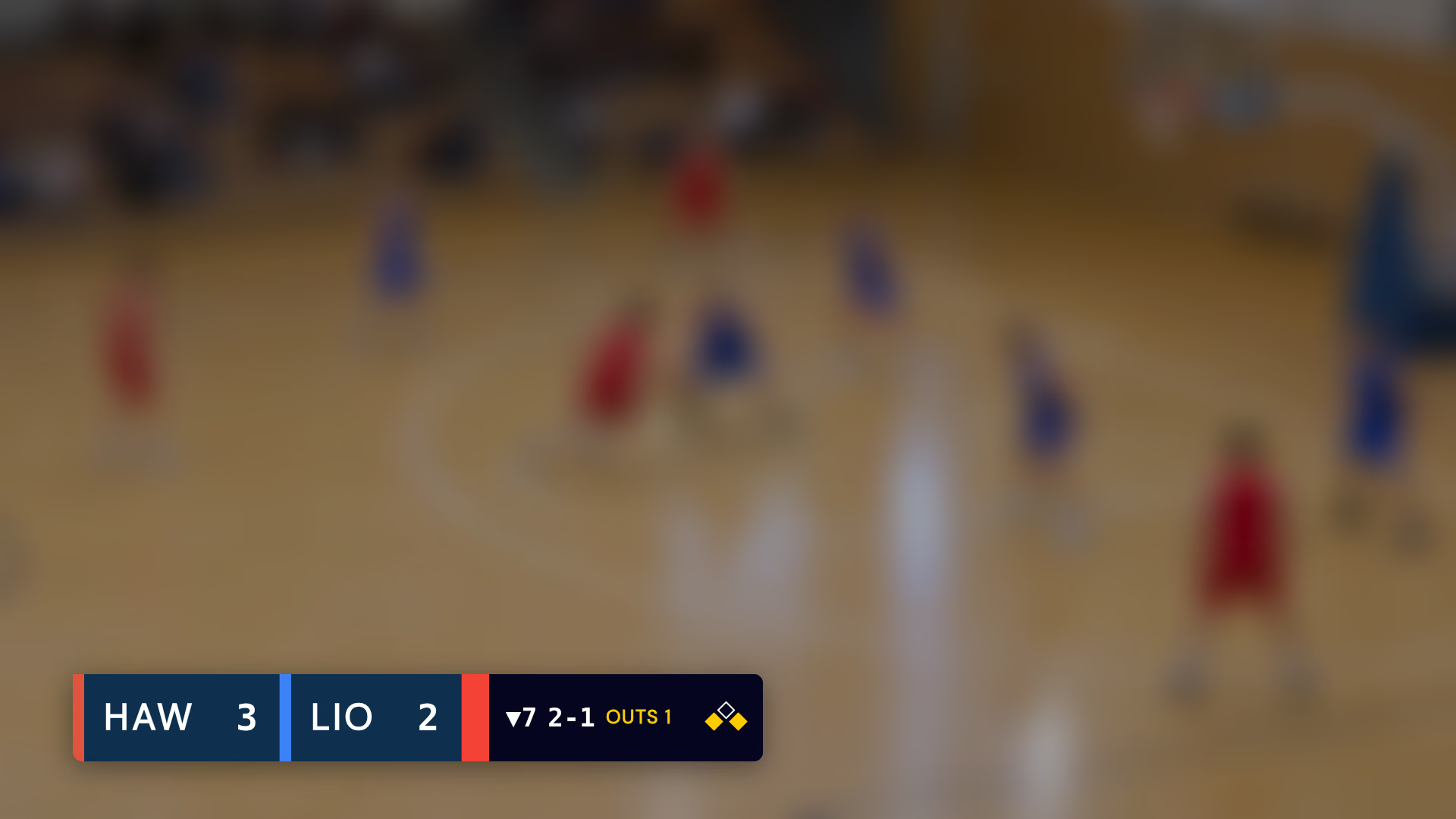
For a live stream, use the Scorebug screen, a small bar with the score and the game situation on a transparent page. In OBS Studio, add a Browser source and paste the Scorebug link as its URL; the transparent background stays transparent, so only the bar covers the video.
FAQ
What do R, H and E mean on a baseball scoreboard?
R is the runs a team has scored, H the hits it has made and E the errors its fielders have made. They follow the runs of each inning in the line score.
Does the scoreboard show the count and the bases?
Yes. The board shows the balls, the strikes and the outs, and which of first, second and third base has a runner, on the Scoreboard screen and on the Scorebug for a stream.
How do extra innings work on the scoreboard?
A tied game continues into extra innings. Under the WBSC rules each extra half-inning of a nine-inning game starts with runners on first and second; under the MLB rules, with a runner on second. The board places those runners for you.
Is there a baseball scoreboard app to download?
No download is needed. MaestroScores runs in the browser on a phone, a tablet, a laptop or a smart TV, and every screen opens its own link.
Is the baseball scoreboard free?
Yes. MaestroScores is free to use, and you need no account to create a board or to open its screens.
Set up your baseball scoreboard
Create a board with baseball already chosen, pick the rules your league plays, and open the Scoreboard link on the screen beside the field.
Baseball terms
- Ball
- A pitch outside the strike zone that the batter does not swing at. Four balls are a walk.
- Bases loaded
- Runners on first, second and third base, so a walk forces in a run.
- Bunt
- A ball the batter does not swing at but meets with the bat on purpose and taps slowly into the infield. A bunt that goes foul with two strikes is strike three.
- Count
- The balls and strikes on the batter, said with the balls first; a full count is three balls and two strikes. It starts again with each new batter.
- Days of rest
- The calendar days a Little League pitcher must wait before pitching again, set by the number of pitches thrown in a day.
- Double
- A hit on which the batter reaches second base safely.
- Error
- A fielder's misplay that lets a batter reach base or a runner move up when ordinary play would have put him out or held him. The E on a scoreboard counts a team's errors.
- Extra innings
- Innings played when the score is level after the last regulation inning, until the visiting team leads at the end of a completed inning or the home team scores the winning run.
- Force out
- An out made by touching the base a runner has to move to because the batter became a runner. No run counts on a play whose third out is a force out.
- Foul ball
- A batted ball that settles in foul territory, outside the foul lines. It is a strike with fewer than two strikes; with two strikes it leaves the count as it is, unless it is a bunt or a foul tip the catcher catches.
- Foul tip
- A batted ball that goes sharp and direct from the bat to the catcher and is caught. A caught foul tip is a strike, so with two strikes it is strike three.
- Half-inning
- One team's turn at bat, the top or the bottom of an inning. It ends with the third out.
- Hit
- A fair ball on which the batter reaches base safely, without the help of a fielding error. The H on a scoreboard counts a team's hits.
- Home run
- A hit on which the batter scores, most often a fair ball out of the playing field. Every runner on base scores too.
- Inning
- The part of a game in which both teams bat once. The visiting team bats in the top of the inning, the home team in the bottom.
- League age
- The age Little League counts a player by for the whole season. It sets a pitcher's daily pitch limit and days of rest.
- Line score
- Each team's runs inning by inning, in a row, with the total at the end.
- Mercy rule
- Also called the run rule: it ends a game early when one team leads by a set number of runs after a set number of innings.
- Out
- A batter or runner put out, on a strikeout, a caught fly ball, a tag or a force play. Three outs end a team's half-inning.
- Pitch count
- The number of pitches a pitcher has thrown. In Little League it is held to a daily limit and sets the days of rest.
- Pitch timer
- The countdown a pitcher has for each pitch, also called the pitch clock. Under MLB's rules a pitcher who is late is charged with a ball, and a batter who is late with a strike.
- Regulation game
- A game that counts, with its result: one played to its end, or one called early, for rain or darkness for example, once enough innings have been played.
- Run
- Baseball's point: a runner who touches first, second, third and home base before the third out scores one run. No run counts on a play whose third out is a force out or the batter put out before first base.
- Strike
- A pitch the batter swings at and misses, a pitch through the strike zone, or a foul ball with fewer than two strikes. Three strikes put the batter out.
- Strikeout
- Strike three: the batter is out.
- Walk
- Ball four: the batter takes first base, and a runner forced by the batter moves up one base.
- Walk-off
- The run that wins the game for the home team in the bottom of the last inning or of an extra inning. The game ends the moment it scores.
- WBSC 2025-2026 Official Rules of Baseballstatic.wbsc.org
- Official Baseball Rules 2026 Edition (MLB)mktg.mlbstatic.com
- Browser Source – OBS Knowledge Baseobsproject.com