Cricket is played by two teams of 11 players. One team bats and scores runs while the other bowls and fields, and then the teams change over. A batting team's Innings: A team's turn to bat. It ends when 10 of its batters are out or its overs are used up; in a T20 match each team bats for one innings. All terms ends when 10 of its batters are out or its Over: Six legal balls bowled by one bowler. No bowler may bowl two overs in a row. All terms are used up, and the team that scores more runs wins. In a T20: Twenty20 cricket: each team bats for one innings of up to 20 overs. All terms match each team bats once, for up to 20 overs of six balls.
This page plays one T20 match through under the ICC Men's Twenty20 International Playing Conditions, in force from October 2026, on a MaestroScores scoreboard. Each step shows the board at that moment. You tap each ball on your phone as runs, an Extras: Runs the batters did not score off the bat: wides, no balls, byes and leg byes. All terms or a Wicket: The three stumps and two bails a batter defends. A wicket also means a batter out: when a batter is out, a wicket falls. All terms, and the board counts the overs, sets the Target: The runs the team batting second needs to win: one run more than the first team's total. All terms and ends the match when the result is reached.
How cricket scoring works
Cricket is scored in runs. The two batters score a run each time they run and both reach the other end of the pitch. A ball hit to the Boundary: The edge of the playing area. A ball hit to it along the ground scores 4 runs, and a ball hit over it without touching the ground scores 6. All terms scores 4 runs, and a ball hit over the boundary without touching the ground scores 6. The rules of cricket are the Laws of Cricket, kept by the Marylebone Cricket Club (MCC), and international matches are played under the ICC's playing conditions, which include the Laws. These are the basic rules of a T20 match:
- Each team bats for one innings of up to 20 overs. An over is six Legal ball: A ball that counts towards the over: every ball except a wide or a no ball. All terms, bowled by one bowler.
- A batter can be out in several ways, for example bowled, caught, LBW: Leg before wicket: a way of being out, when a ball that would have hit the wicket hits the batter's body instead of the bat. All terms (LBW), Run out: A way of being out: the fielding side breaks the wicket while the batter is out of the ground, for example while running. All terms or Stumped: A way of being out: the wicket-keeper breaks the wicket while the batter is out of the ground and not attempting a run. All terms. When 10 batters are out, the team is All out: When 10 batters are out, the batting team has no pair left to bat, and its innings ends. All terms and its innings ends.
- A Wide: A ball that passes too wide of the batter to be hit. It gives the batting team 1 run, on top of any runs scored off it, and is bowled again. All terms or a No ball: A ball delivered against the rules, for example with the bowler's front foot too far forward. It gives the batting team 1 run, on top of any runs scored off it, and is bowled again. All terms gives the batting team 1 run, and the ball is bowled again.
- No bowler may bowl more than 4 overs in an innings, and no bowler may bowl two overs in a row.
- The team batting second has a target of one run more than the first team's total. It wins if it reaches the target.
The start of the match: the toss and the first ball
Before the match the two captains toss a coin, and the captain who wins the toss chooses to bat or to field first. On the board you mark the team that bats first, and then you tap each ball as it is bowled: the runs scored from it, an extra or a wicket. Every legal ball counts towards the over, and the screens show the overs bowled.
The first 6 overs of each innings are the Powerplay: The first 6 overs of each innings in a T20 match, when only two fielders may stand outside the fielding circle. All terms: only two fielders may stand outside the Fielding circle: The marked area around the pitch. During the powerplay only two fielders may stand outside it. All terms. The screens show Powerplay during those overs.
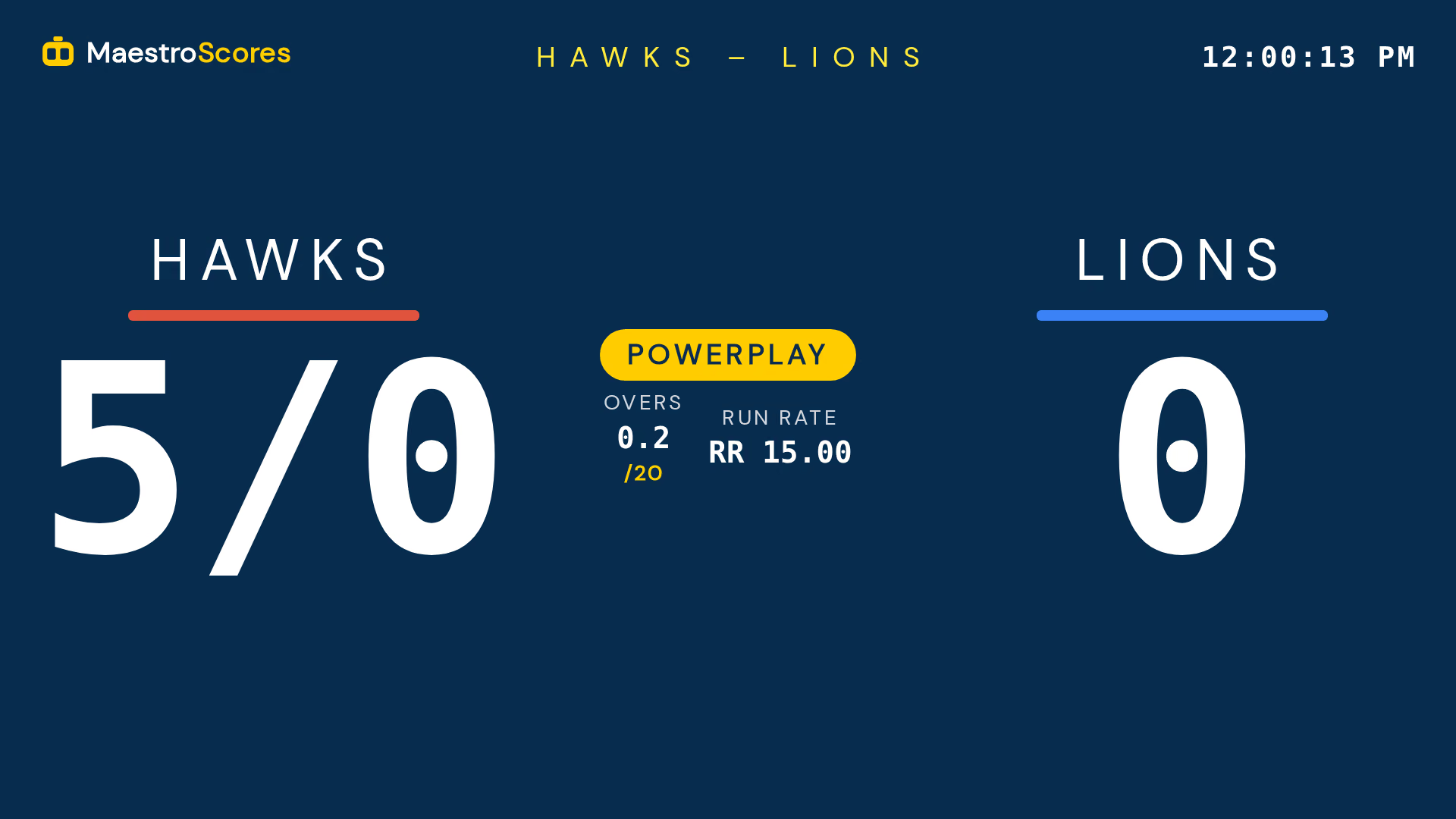

The ruleAfter the toss, every ball is scored as it is bowled, and every legal ball counts towards the over.
A wicket: when a batter is out
A wicket falls when a batter is out. The next batter comes in, and the innings goes on until 10 batters are out or the overs are used up. On the board you tap Wicket for the ball on which the batter was out. It counts as one of the over's balls, and the wickets on every screen go up by one.
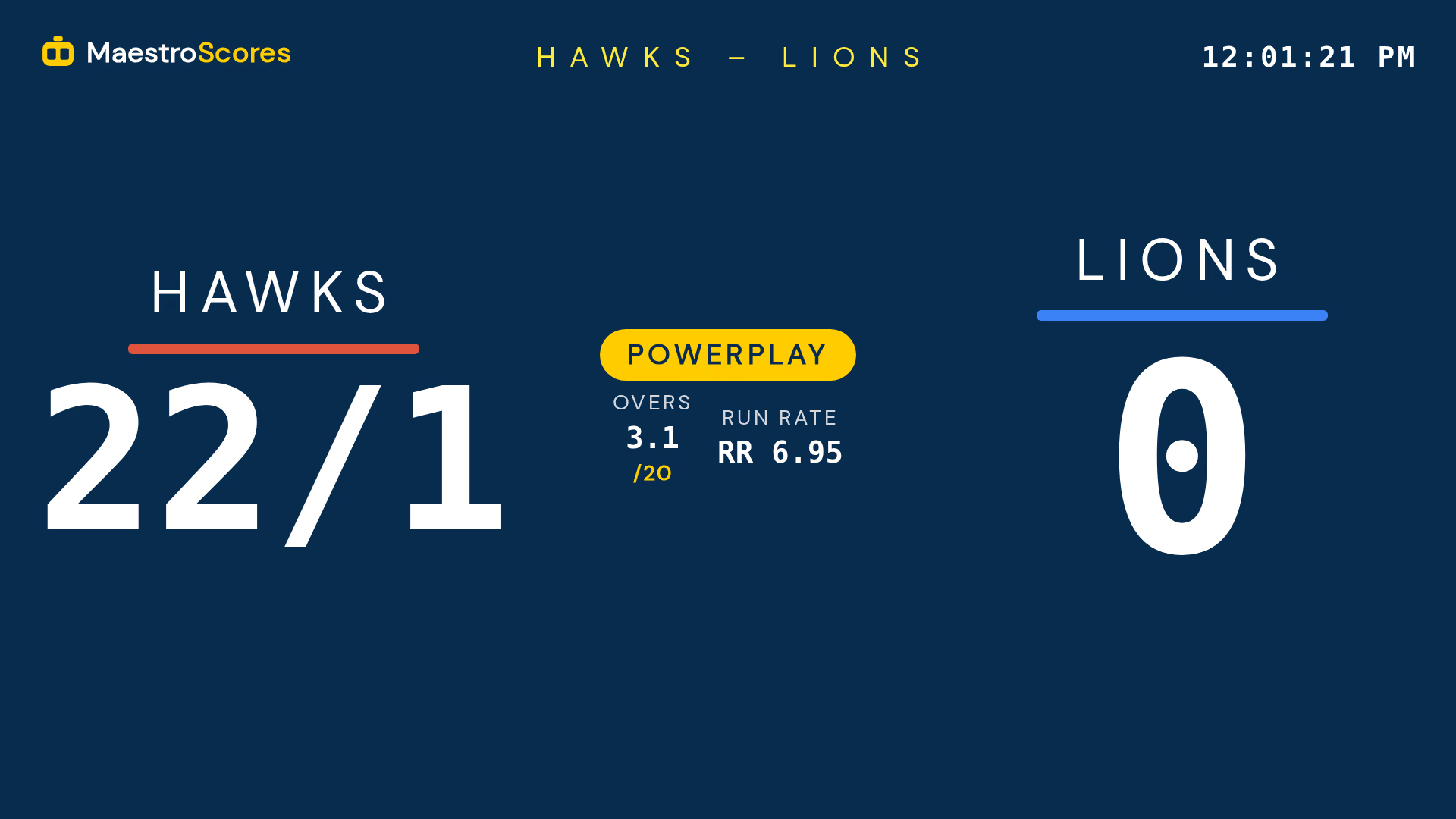

The ruleA wicket falls when a batter is out; the ball counts in the over, and the innings goes on until 10 batters are out or the overs are used up.
Extras: wides, no balls and the free hit
Runs the batters did not score off the bat are extras. A wide is a ball that passes too wide of the batter to be hit, and a no ball is a ball delivered against the rules. Each gives the batting team 1 run, does not count as one of the over's six balls and is bowled again. Any runs the batters complete off a wide or a no ball, or a boundary, count as well as that 1 run: a no ball hit for four is worth 5. Byes: Runs the batters take when the ball touched neither the bat nor the batter. All terms and Leg byes: Runs the batters take when the ball hit the batter's body but not the bat. All terms are runs the batters take when the ball did not touch the bat.
In a T20 international the ball after a no ball is a Free hit: In a T20 international, the ball after a no ball: on it the batter can be out only in the ways allowed on a no ball, such as run out. All terms: the batter can then be out only in the ways allowed on a no ball, such as run out. On the board you tap No ball, the run is added, and the screens show Free hit until the next legal ball.
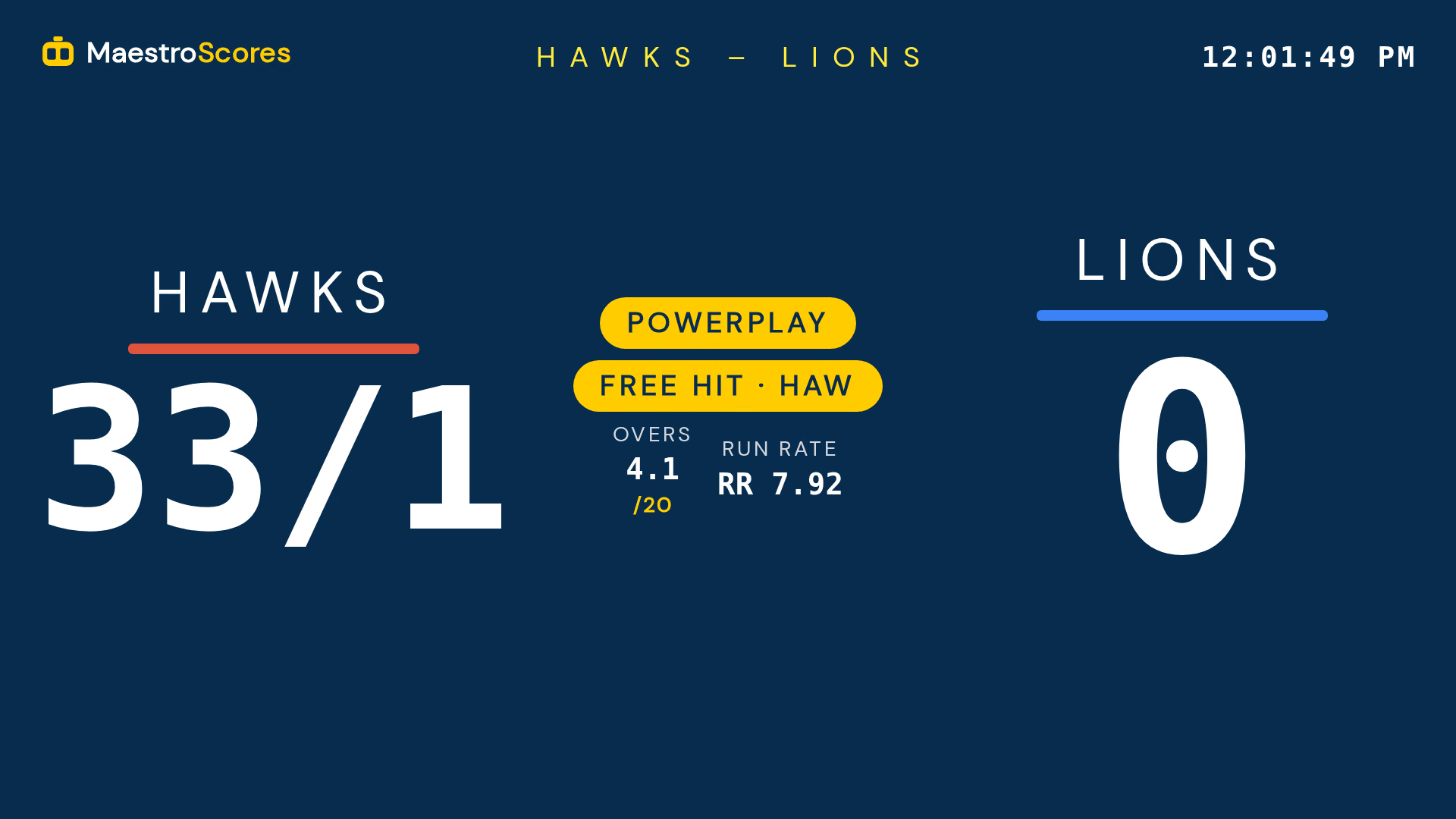

The ruleA wide or a no ball gives the batting team 1 run and is bowled again; in a T20 international the ball after a no ball is a free hit.
The end of an innings and the target
An innings ends when 10 batters are out or the last of the 20 overs has been bowled. The teams then change over for the second innings. The team batting second has a target of one run more than the first team's total. When play stops, for example for rain, and the overs have to be cut, the target is reset for the overs the team batting second can face, by the DLS: The Duckworth/Lewis/Stern method: when play stops and the overs of a match are cut, it sets a new target for the overs the team batting second can face. All terms (Duckworth/Lewis/Stern) method. Unless both teams have had the chance to bat at least 5 overs, the match is a no result. The board closes the innings by itself after its last ball, starts the innings break and shows the target.
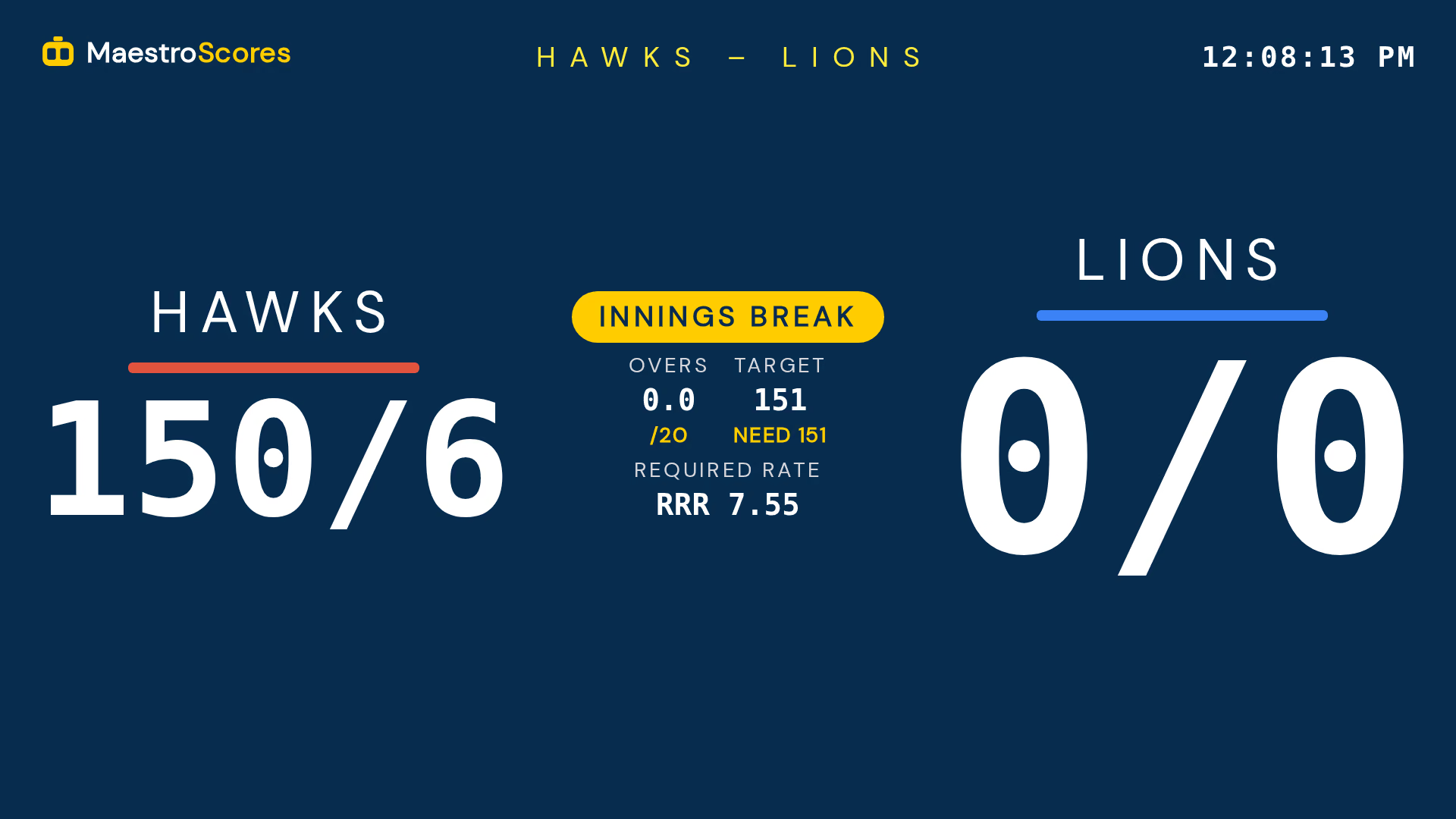

The ruleAn innings ends when 10 batters are out or the last of the 20 overs has been bowled, and the team batting second has a target of one run more than the first team's total.
The chase and the result
In the second innings the screens show the target and the runs the chasing team still needs. A chasing team that reaches the target wins by the number of wickets it has left. Here Lions reach 151 with 4 wickets down, so they win by 6 wickets. When the team batting first wins, it wins by the number of runs it was ahead. The board ends the match on the ball that decides it.
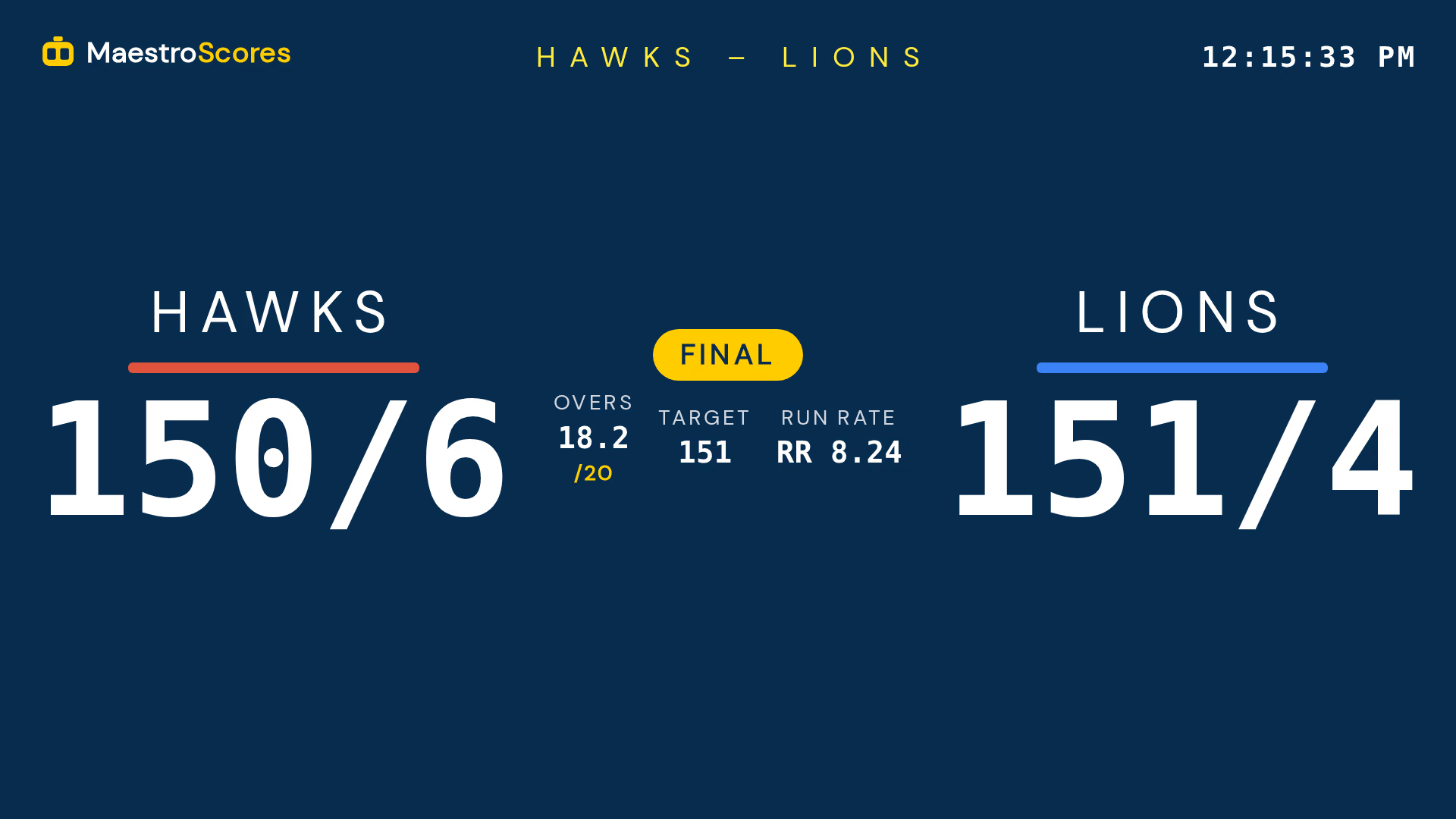

The ruleA chasing team that reaches the target wins by the number of wickets it has left.
A tie and the Super Over
When both teams finish with the same total, the scores are tied. In a T20 international a tie goes to a Super Over: The tie-break of a tied T20 international: each team bats for one more over, and the team that batted second in the match bats first. All terms: each team bats for one more over, and the team that batted second in the match bats first. If the Super Over is tied too, more Super Overs follow until there is a winner. The board starts the Super Over by itself when the scores are level after the second innings.
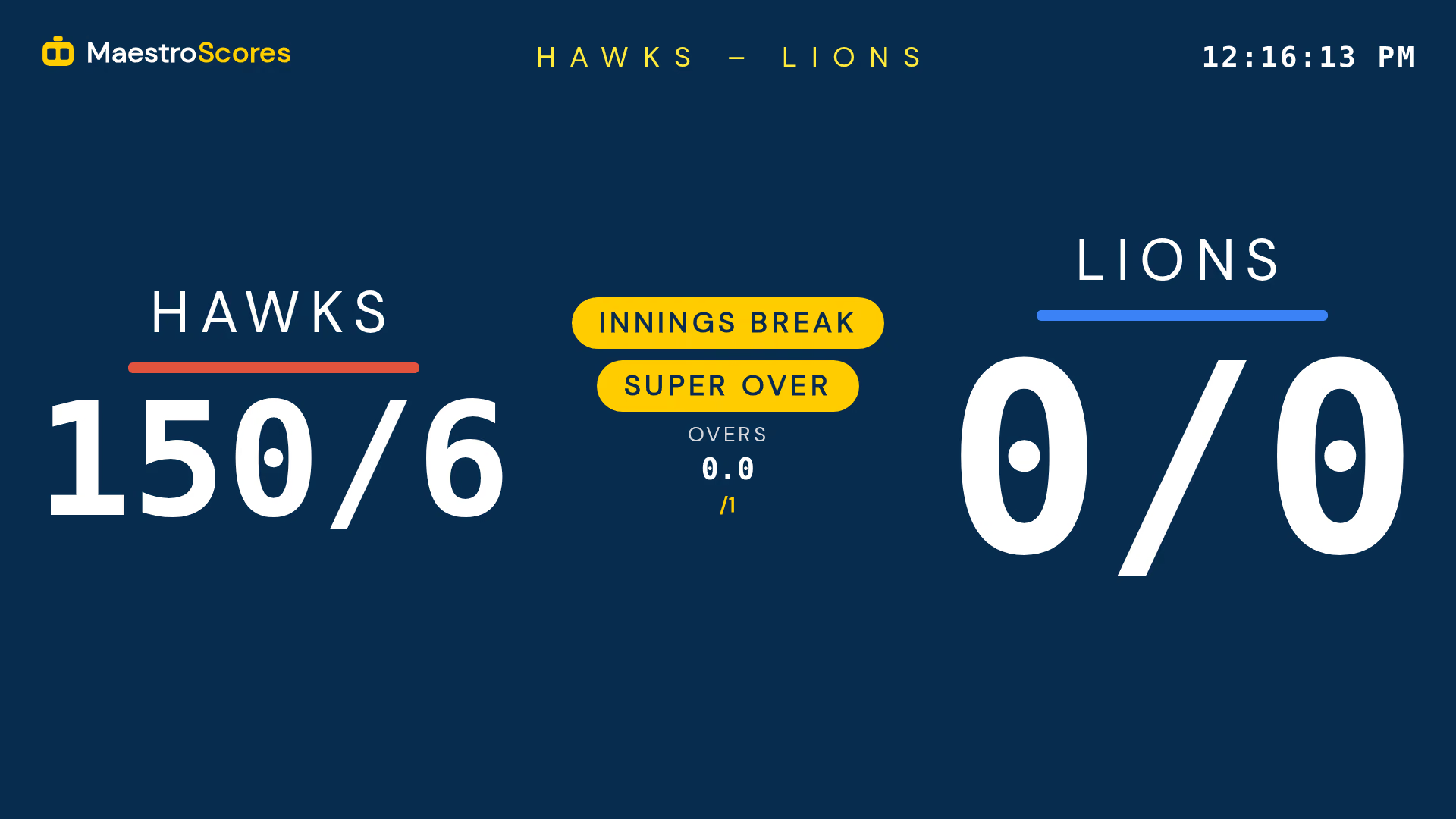

The ruleWhen both teams finish with the same total, a T20 international goes to a Super Over, and the team that batted second in the match bats first in it.
Other formats: ODI, Test, The Hundred, T10 and club cricket
One Day Internationals (ODIs) give each team one innings of up to 50 overs, and no bowler may bowl more than 10 overs. A Test match gives each team two innings with no limit on overs and is scheduled for five days. A Test that has no result when its time runs out is a draw.
The Hundred, a competition of the England and Wales Cricket Board (ECB), gives each team 100 balls: 20 overs of 5 balls, and the board counts the balls left. T10 cricket plays 10 overs a side. Club matches under the ECB's playing conditions have 40 overs a side.
On MaestroScores you choose the rules when you create the board. A new cricket board starts on the T20 rules, and in the United Kingdom and Australia on the 40-over club rules. Tape-ball, box and indoor cricket have rule sets of their own.
FAQ
How many players are in a cricket team?
Each team has 11 players. The innings ends when 10 batters are out, because the last batter has no partner left to bat with.
How many overs are in a T20 match?
Each team bats for up to 20 overs of six balls. An ODI has 50 overs a side, and a Test match has no limit on overs.
How many runs is a six in cricket?
A six scores 6 runs: the ball goes over the boundary without touching the ground. A ball that reaches the boundary along the ground scores 4.
What is a free hit in cricket?
In international limited-overs cricket, the ball after a no ball is a free hit. On a free hit the batter can be out only in the ways allowed on a no ball, such as run out.
What happens if a T20 match is tied?
The teams play a Super Over: each team bats for one more over. If the Super Over is tied too, more Super Overs follow until there is a winner.
Keep cricket score on a board
Create a cricket board with the rules you play, tap each ball on your phone, and open the Scoreboard link on any screen at the ground.
Cricket terms
- All out
- When 10 batters are out, the batting team has no pair left to bat, and its innings ends.
- Boundary
- The edge of the playing area. A ball hit to it along the ground scores 4 runs, and a ball hit over it without touching the ground scores 6.
- Byes
- Runs the batters take when the ball touched neither the bat nor the batter.
- DLS
- The Duckworth/Lewis/Stern method: when play stops and the overs of a match are cut, it sets a new target for the overs the team batting second can face.
- Extras
- Runs the batters did not score off the bat: wides, no balls, byes and leg byes.
- Fielding circle
- The marked area around the pitch. During the powerplay only two fielders may stand outside it.
- Free hit
- In a T20 international, the ball after a no ball: on it the batter can be out only in the ways allowed on a no ball, such as run out.
- Innings
- A team's turn to bat. It ends when 10 of its batters are out or its overs are used up; in a T20 match each team bats for one innings.
- LBW
- Leg before wicket: a way of being out, when a ball that would have hit the wicket hits the batter's body instead of the bat.
- Leg byes
- Runs the batters take when the ball hit the batter's body but not the bat.
- Legal ball
- A ball that counts towards the over: every ball except a wide or a no ball.
- No ball
- A ball delivered against the rules, for example with the bowler's front foot too far forward. It gives the batting team 1 run, on top of any runs scored off it, and is bowled again.
- Over
- Six legal balls bowled by one bowler. No bowler may bowl two overs in a row.
- Powerplay
- The first 6 overs of each innings in a T20 match, when only two fielders may stand outside the fielding circle.
- Run out
- A way of being out: the fielding side breaks the wicket while the batter is out of the ground, for example while running.
- Stumped
- A way of being out: the wicket-keeper breaks the wicket while the batter is out of the ground and not attempting a run.
- Super Over
- The tie-break of a tied T20 international: each team bats for one more over, and the team that batted second in the match bats first.
- T20
- Twenty20 cricket: each team bats for one innings of up to 20 overs.
- Target
- The runs the team batting second needs to win: one run more than the first team's total.
- Wicket
- The three stumps and two bails a batter defends. A wicket also means a batter out: when a batter is out, a wicket falls.
- Wide
- A ball that passes too wide of the batter to be hit. It gives the batting team 1 run, on top of any runs scored off it, and is bowled again.
- ICC Men's Twenty20 International Playing Conditionsimages.icc-cricket.com
- ICC Men's One-Day International Playing Conditionsimages.icc-cricket.com
- ICC Men's Test Match Playing Conditionsimages.icc-cricket.com
- The Laws of Cricket (2017 Code 4th Edition – 2026), MCClords.org
- The Hundred Playing Conditions (ECB)resources.ecb.co.uk
- ECB Playing Conditions – 40 overs per sideresources.ecb.co.uk