Flag football is played 5 against 5 with no contact: there is no tackling, blocking or kicking, and a defender stops the Ball carrier: The player who has the ball. A defender stops the ball carrier by pulling a flag, not by tackling. All terms by pulling a flag from the carrier's Flag belt: The belt every player wears, with 2 flags. A play ends when a defender pulls a flag from the ball carrier, who then has fewer than 2. All terms. A Touchdown: A score worth 6 points, made when a player with the ball crosses the opponent's goal line into the end zone. All terms is worth 6 points, and the Try: The one play after a touchdown for extra points: from the 5-yard line for 1 point, or from the 10-yard line for 2 points. There are no kicked extra points. All terms after it is worth 1 point from the 5-yard line or 2 points from the 10-yard line. A game has two halves of 20 minutes.
This page goes through the IFAF International Flag Football Rules 2023 for 5 on 5, the rules of the International Federation of American Football, and shows each rule on a MaestroScores scoreboard with the flag football rules chosen.
Five players a side and no contact
Each team has up to 5 players on the field. Flag football is non-contact: blocking, tackling and kicking are not allowed. Every player wears a belt with 2 flags, and a play ends when a defender pulls a flag from the ball carrier, who then has fewer than 2 flags. The play also ends when the ball carrier goes Out of bounds: Outside the field's lines. A ball carrier who goes out of bounds ends the play. All terms or touches the ground with a knee or any part of the body other than a hand or a foot.
A ball carrier may not protect the flags. Covering a flag with a hand, an arm, a leg or the ball, or stretching a hand out towards the defender, is Flag guarding: Covering a flag with a hand, an arm, a leg or the ball, or stretching a hand out towards the defender, to avoid a flag pull. It is a foul with a 5-yard penalty and loss of down. All terms: a foul with a 5-yard penalty and loss of Down: One play, from the snap until the play ends. A team has 4 downs to cross the middle line, and once it has crossed, 4 new downs to score a touchdown. All terms. A Fumble: A ball the carrier loses, other than by a pass or a hand-off. It is dead when it hits the ground or a team-mate touches it, and the team that fumbled keeps the ball. All terms, a ball the carrier loses, is dead as soon as it hits the ground or a team-mate touches it, and the ball stays with the team that fumbled, at the spot where it was lost. Play goes on only if the fumbler or an opponent catches it first.
The field and the downs: 4 downs to cross the middle line
The field is 50 yards (45.75 m) long and 25 yards (22.90 m) wide, with an End zone: The area at each end of the field, 10 yards (9.15 m) deep, where a team scores a touchdown. All terms of 10 yards (9.15 m) at each end. A line across the middle of the field, the Middle line: The line across the middle of the field, the only line to gain: a team that crosses it gets a first down. All terms, is the only Line to gain: The line a team must cross within its downs to get a first down. In flag football it is always the middle line. All terms. A team has 4 downs to cross the middle line, and once it has crossed, 4 new downs to score a touchdown.
There are no kick-offs. Each half starts with a Snap: The pass of the ball backwards between the center's legs that starts each play. All terms from a team's own 5-yard line. The other team also starts from its own 5-yard line after a try, after a Safety: A score of 2 points for the defense, when a play ends with the ball in the offense's own end zone. All terms, and when the offense has used its 4 downs without a score or a First down: The new series of downs a team gets when it crosses the middle line. All terms. After an interception, when a defender catches a pass, the new Series: A team's set of downs with the ball. In overtime each team gets one series from the middle line. All terms starts where the play ended.
On the board you set the down with the down keys, and the Scoreboard shows it. The board counts no yards to go, because the line to gain is always the middle line.
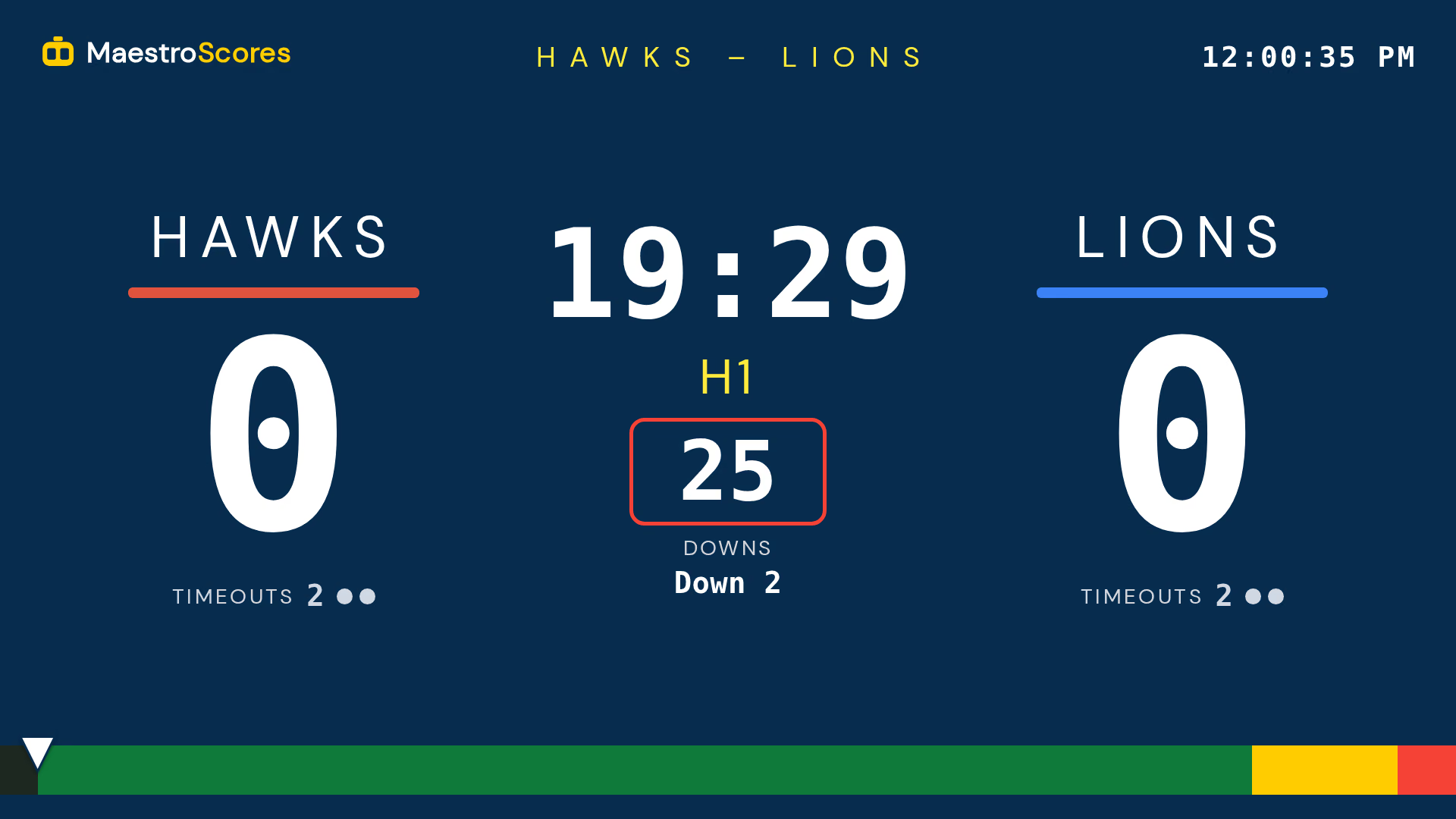

The ruleA team has 4 downs to cross the middle line, and once it has crossed, 4 new downs to score a touchdown.
How a play works: the pass, the rush and the no-running zones
Each play starts with a snap to the Quarterback: The offensive player who first gets the ball after the snap. The quarterback may not run with the ball past the scrimmage line, unless another player has had it and given it back. All terms, who has 7 seconds to pass the ball or hand it off. The quarterback may not run with the ball past the Scrimmage line: The line across the field where the ball is snapped. A forward pass must be thrown from behind it. All terms, unless another player has had the ball and given it back. A team may throw one forward pass each down, and only from behind the scrimmage line.
Only a defender who lines up more than 7 yards (6.4 m) from the scrimmage line at the snap may rush the quarterback at once, and up to 2 of them can claim right of way as Blitzer: A defender who lines up more than 7 yards (6.4 m) from the scrimmage line and raises a hand before the snap, which gives them right of way to rush the quarterback. A team may have up to 2. All terms by raising a hand before the snap. Every defender closer than 7 yards (6.4 m) stays behind the scrimmage line until the quarterback has handed off or passed the ball.
The 5-yard areas in front of both goal lines are No-running zone: The 5-yard area in front of each goal line. When the ball is snapped on or inside the opponent's 5-yard line, the offense must pass and may not run. All terms. When the ball is snapped on or inside the opponent's 5-yard line, the offense must make a forward pass play and may not run the ball.
These are the referees' calls, and the board keeps none of them: after each play you set the next down.
Flag football scoring: touchdowns and tries
There are no kicks in flag football, so there are no Field goal: A kick through the goalposts in tackle football. Flag football has no kicks, so it has no field goals. All terms and no kicked extra points. After a touchdown the scoring team chooses its try: one play from the 5-yard line for 1 point, or from the 10-yard line for 2 points. If the defense scores a touchdown during the try, it gets 2 points. A safety is scored when the ball becomes dead on or behind a team's own goal line and that team put it there, for example when a defender pulls the ball carrier's flag in the carrier's own end zone; its 2 points go to the other team. On the board each score has its own key under the team: TD for a touchdown, PAT for the 1-point try, 2PT for the 2-point try, and Safety.
These are the points in IFAF flag football:
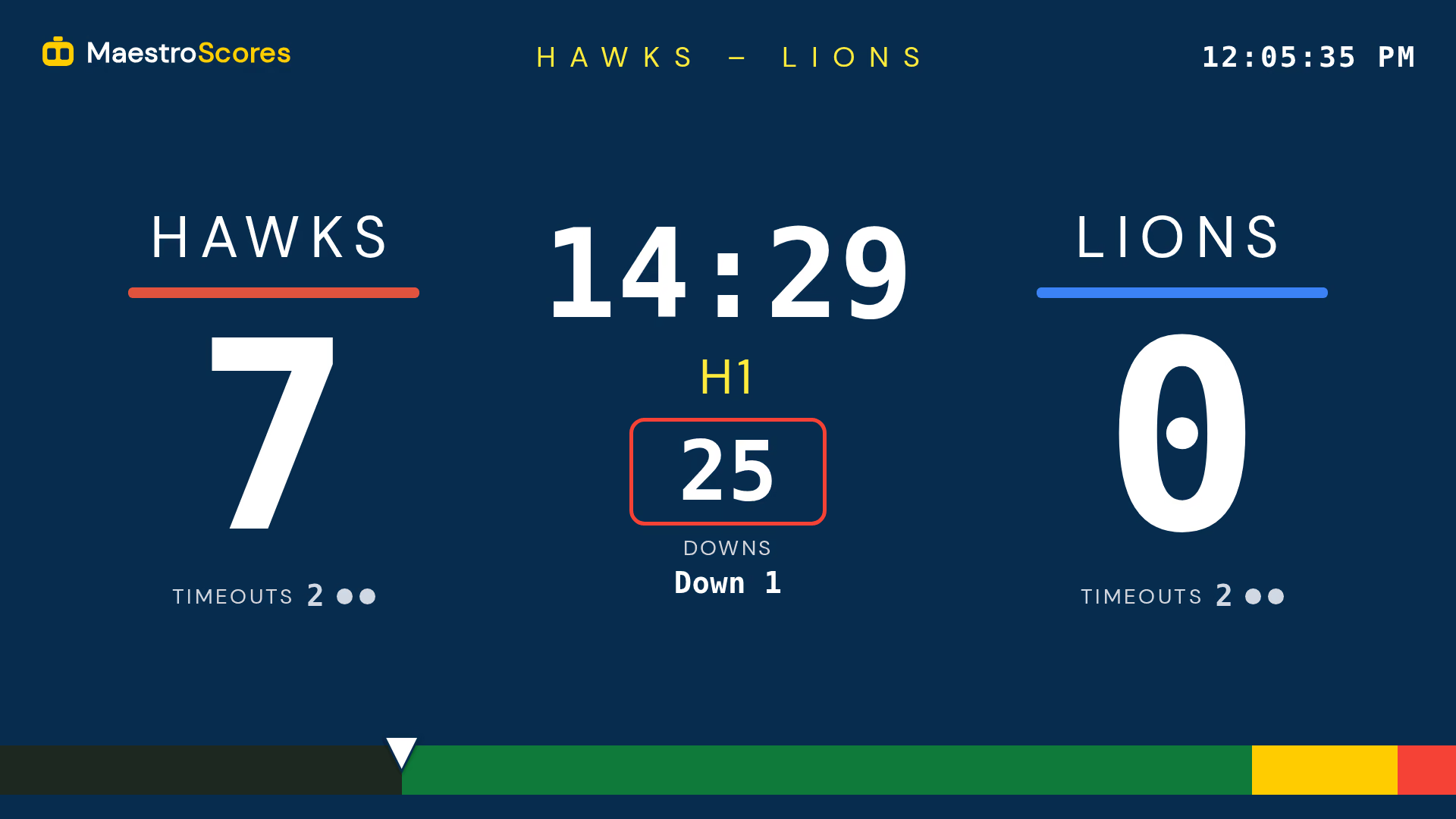

The ruleA touchdown is worth 6 points, and the try after it 1 point from the 5-yard line or 2 points from the 10-yard line.
| Score | Points |
|---|---|
| Touchdown | 6 |
| Try from the 5-yard line | 1 |
| Try from the 10-yard line | 2 |
| Defense touchdown during a try | 2 |
| Safety, for the defense | 2 |
Game time: two halves of 20 minutes
A game has 40 minutes of playing time: two halves of 20 minutes, with a 2-minute Half-time: The 2-minute break between the two halves of 20 minutes. All terms. The clock stops for a timeout, an injury or at the referee's call. In the last 2 minutes of each half it also stops for a first down, a penalty, the ball or the runner out of bounds, a pass that hits the ground, and a score and its try.
The referee tells both teams when 2 minutes are left in a half. If one team then leads by 30 points or more, the clock keeps running in those last 2 minutes. On the board the clock stops by itself for a score in the last 2 minutes, unless one team leads by 30 points or more. The offense has 25 seconds to snap the ball after the referee has declared it ready for play.
On the board you start and stop the game clock on the referee's signals and start the 25-second Play clock: The 25 seconds the offense has to snap the ball after the referee has declared it ready for play. All terms before each snap, and the Scoreboard shows both clocks. At the end of the first half you tap Next period.
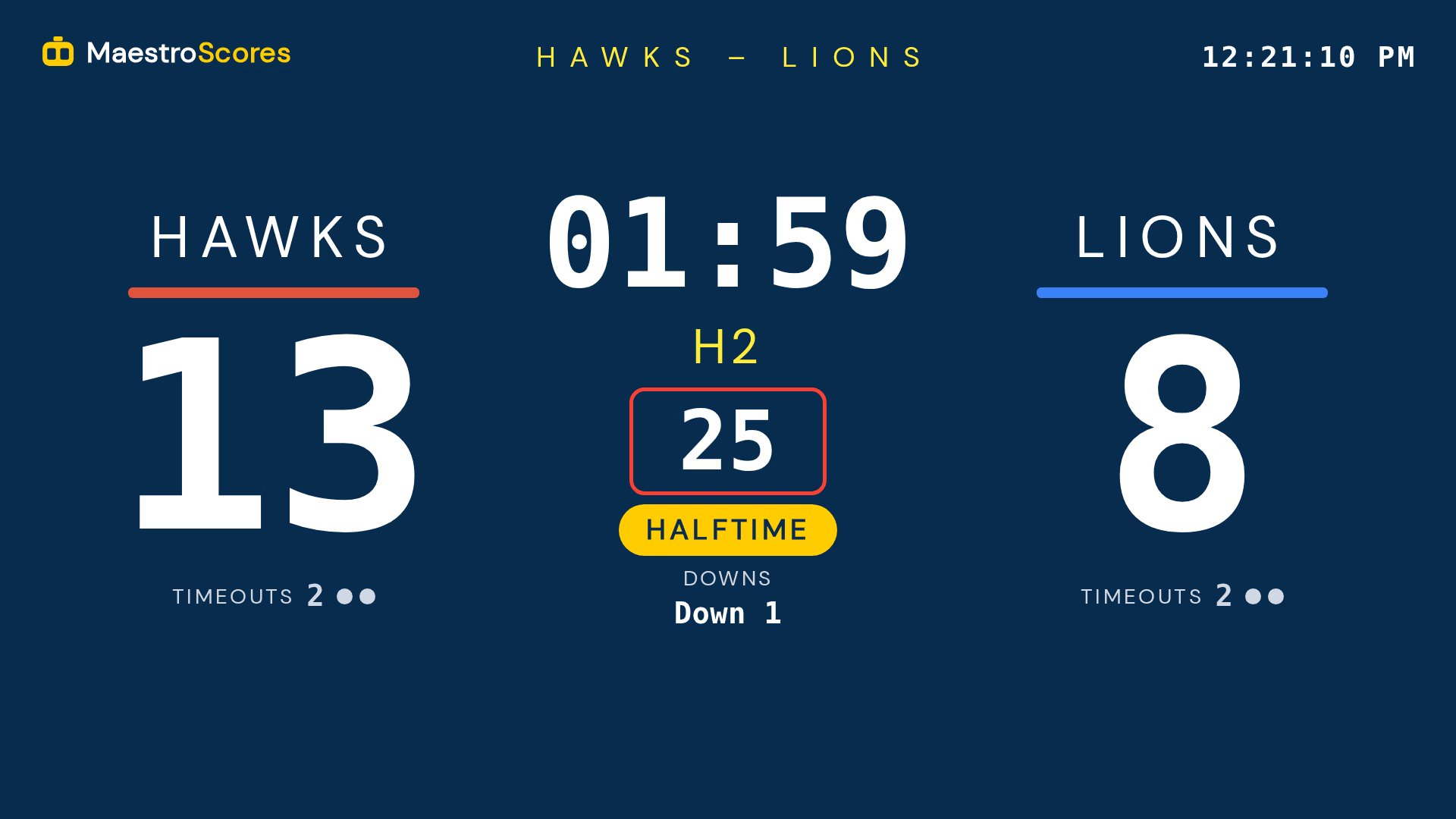

The ruleA game has two halves of 20 minutes, with a 2-minute half-time.
Timeouts: 2 a half, 60 seconds each
Each team has 2 timeouts in each half, and a timeout lasts at most 60 seconds. Unused timeouts do not carry over to the second half, and there are no timeouts in Overtime: Play after a level game that needs a winner: first one series each from the middle line, then 1-point tries from the 5-yard line until one team leads after a period. All terms. On the board you tap Timeout under the team that called it: the game clock stops, the screens show the timeout, and the team's timeouts left go down by one.
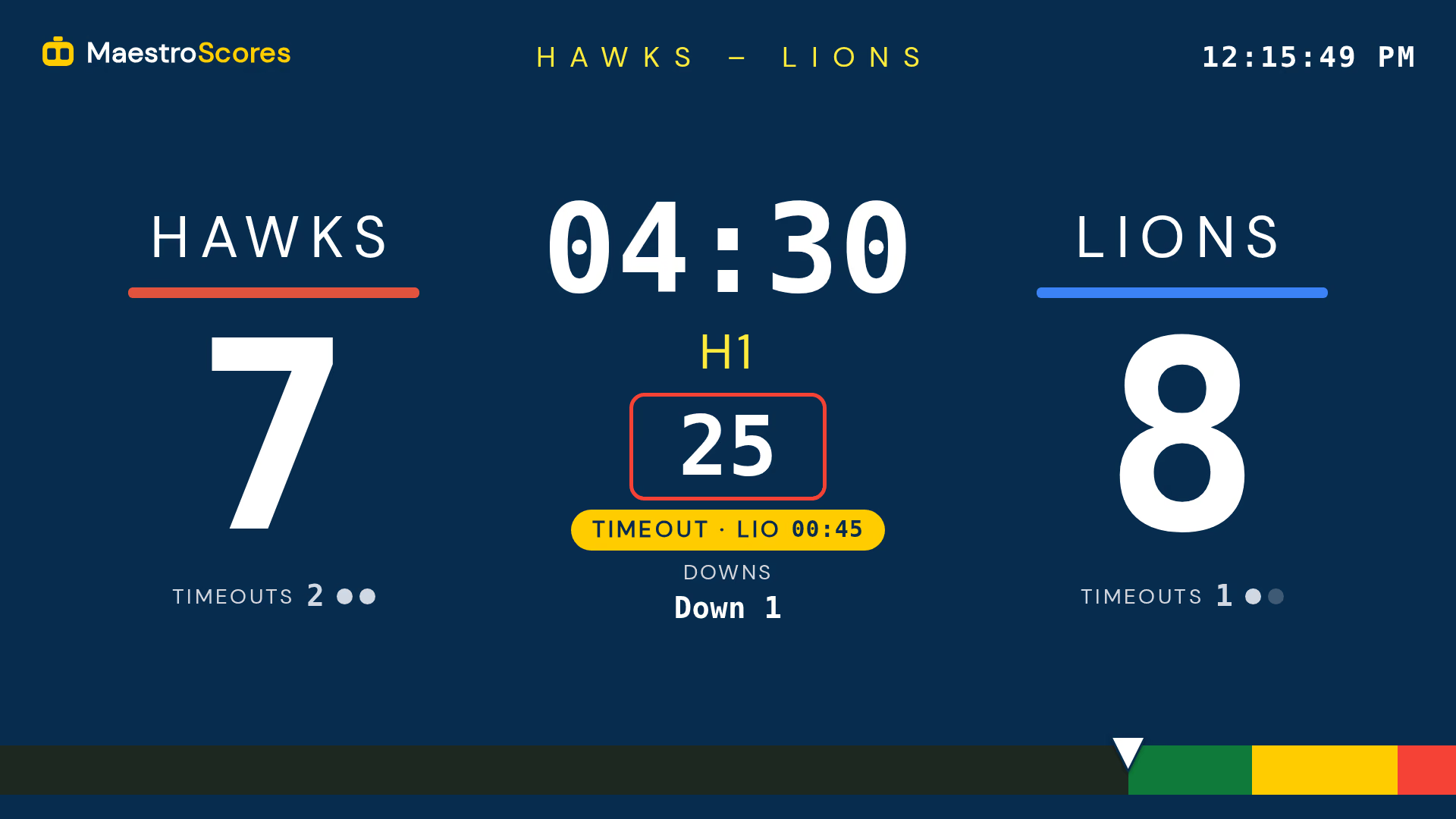

The ruleEach team has 2 timeouts in each half, and a timeout lasts at most 60 seconds.
Overtime: only when a winner is needed
A game that is level after two halves is a tie, unless the competition needs a winner. Then the teams play overtime after a 2-minute break. In the first period each team gets one series of downs from the middle line, with no first down there, and keeps the ball until it scores, its try included, or runs out of downs. If the score is still level, each later period is one 1-point try for each team from the 5-yard line, until one team leads after a period.
On the board, a game marked as a Knockout: A game that must have a winner, so a level game goes on to overtime instead of ending in a tie. All terms goes to overtime when you tap Next period with the score level after the second half. In a league game you end a level game with Final, and the board records a tie.
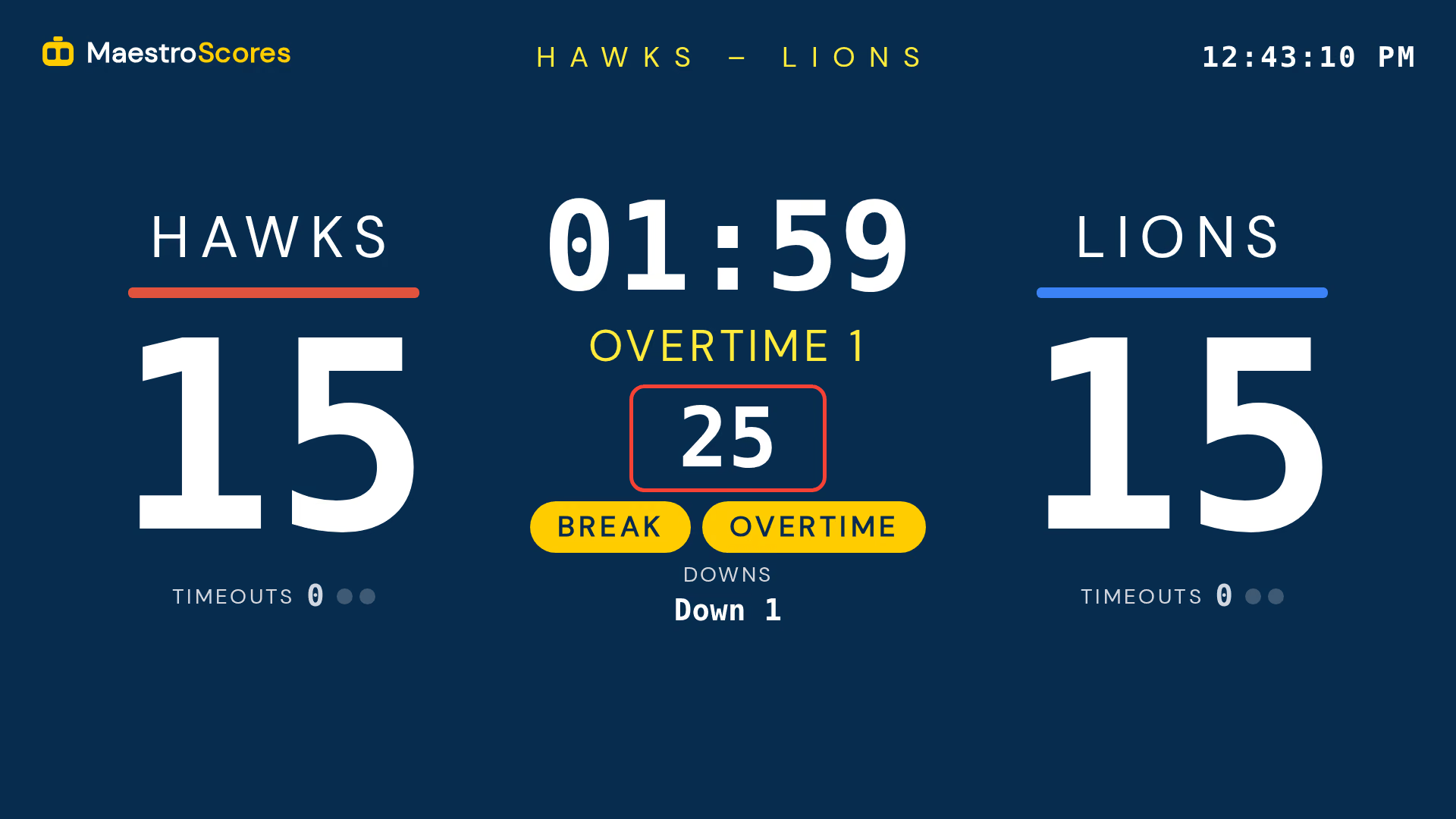

The ruleA level game is a tie unless the competition needs a winner; then the teams play overtime after a 2-minute break.
How the board keeps flag football
When you create a flag football board, the IFAF rules are chosen for you: two halves of 20 minutes, 2 timeouts a half and a 25-second play clock. The rules allow a different playing time by competition or age, so a league or a youth division with shorter halves sets their length when the board is created. You end the game with Final.
FAQ
How many players are on a flag football team?
Up to 5 players a team are on the field at once under the IFAF rules. A team that is more than one player short forfeits the game.
How does scoring work in flag football?
A touchdown is worth 6 points. The try after it is worth 1 point from the 5-yard line or 2 points from the 10-yard line, and a safety gives the defense 2 points.
How long is a flag football game?
Two halves of 20 minutes with a 2-minute half-time under the IFAF rules. Competitions and age groups may play a different time.
Is there tackling in flag football?
No. Flag football is non-contact: blocking, tackling and kicking are not allowed, and a defender stops the ball carrier by pulling a flag.
What happens if a flag football game is tied?
The tie stands unless the competition needs a winner. Then the teams play overtime: one series each from the middle line, then 1-point tries from the 5-yard line until one team leads.
Keep flag football score on a board
Create a flag football board, tap each touchdown and try on your phone, and open the Scoreboard link on any screen at the field.
Flag football terms
- Ball carrier
- The player who has the ball. A defender stops the ball carrier by pulling a flag, not by tackling.
- Blitzer
- A defender who lines up more than 7 yards (6.4 m) from the scrimmage line and raises a hand before the snap, which gives them right of way to rush the quarterback. A team may have up to 2.
- Down
- One play, from the snap until the play ends. A team has 4 downs to cross the middle line, and once it has crossed, 4 new downs to score a touchdown.
- End zone
- The area at each end of the field, 10 yards (9.15 m) deep, where a team scores a touchdown.
- Field goal
- A kick through the goalposts in tackle football. Flag football has no kicks, so it has no field goals.
- First down
- The new series of downs a team gets when it crosses the middle line.
- Flag belt
- The belt every player wears, with 2 flags. A play ends when a defender pulls a flag from the ball carrier, who then has fewer than 2.
- Flag guarding
- Covering a flag with a hand, an arm, a leg or the ball, or stretching a hand out towards the defender, to avoid a flag pull. It is a foul with a 5-yard penalty and loss of down.
- Fumble
- A ball the carrier loses, other than by a pass or a hand-off. It is dead when it hits the ground or a team-mate touches it, and the team that fumbled keeps the ball.
- Half-time
- The 2-minute break between the two halves of 20 minutes.
- Knockout
- A game that must have a winner, so a level game goes on to overtime instead of ending in a tie.
- Line to gain
- The line a team must cross within its downs to get a first down. In flag football it is always the middle line.
- Middle line
- The line across the middle of the field, the only line to gain: a team that crosses it gets a first down.
- No-running zone
- The 5-yard area in front of each goal line. When the ball is snapped on or inside the opponent's 5-yard line, the offense must pass and may not run.
- Out of bounds
- Outside the field's lines. A ball carrier who goes out of bounds ends the play.
- Overtime
- Play after a level game that needs a winner: first one series each from the middle line, then 1-point tries from the 5-yard line until one team leads after a period.
- Play clock
- The 25 seconds the offense has to snap the ball after the referee has declared it ready for play.
- Quarterback
- The offensive player who first gets the ball after the snap. The quarterback may not run with the ball past the scrimmage line, unless another player has had it and given it back.
- Safety
- A score of 2 points for the defense, when a play ends with the ball in the offense's own end zone.
- Scrimmage line
- The line across the field where the ball is snapped. A forward pass must be thrown from behind it.
- Series
- A team's set of downs with the ball. In overtime each team gets one series from the middle line.
- Snap
- The pass of the ball backwards between the center's legs that starts each play.
- Touchdown
- A score worth 6 points, made when a player with the ball crosses the opponent's goal line into the end zone.
- Try
- The one play after a touchdown for extra points: from the 5-yard line for 1 point, or from the 10-yard line for 2 points. There are no kicked extra points.
- International Flag Football Rules 2023 (IFAF)rules.bafra.info