A Little League Baseball game in the Majors division is six Inning: The part of a game in which both teams bat once. The visiting team bats in the top of the inning, the home team in the bottom. All terms long, or lasts until a time limit the local league sets. The Mercy rule: Also called the run rule: it ends a game early when one team leads by a set number of runs after a set number of innings. All terms can end it early when one team is far ahead, and every pitcher has a daily pitch limit that depends on League age: The age Little League counts a player by for the whole season. It sets a pitcher's daily pitch limit and days of rest. All terms, with Days of rest: The calendar days a Little League pitcher must wait before pitching again, set by the number of pitches thrown in a day. All terms after a set number of pitches.
This page goes through those rules as Little League sets them for the regular season, and shows each one on a MaestroScores scoreboard with the Little League rules chosen.
A game of six innings
A Little League (Majors) game has six innings. A local league may instead set a time limit of at least 1 hour and 45 minutes; an inning started before time is up is played to its end, and no new inning starts after it. Little League counts a Majors game as official after three and a half innings. In each inning the visiting team bats first and the home team second, and each Half-inning: One team's turn at bat, the top or the bottom of an inning. It ends with the third out. All terms ends with the third Out: A batter or runner put out, on a strikeout, a caught fly ball, a tag or a force play. Three outs end a team's half-inning. All terms. The board ends the game at once when the home team takes the lead in the bottom of the sixth inning, and plays on into Extra innings: Innings played when the score is level after the last regulation inning, until the visiting team leads at the end of a completed inning or the home team scores the winning run. All terms when the score is level after six. A tied game does not always go on, though: Little League's pitching rules also speak of games declared regulation tie games.
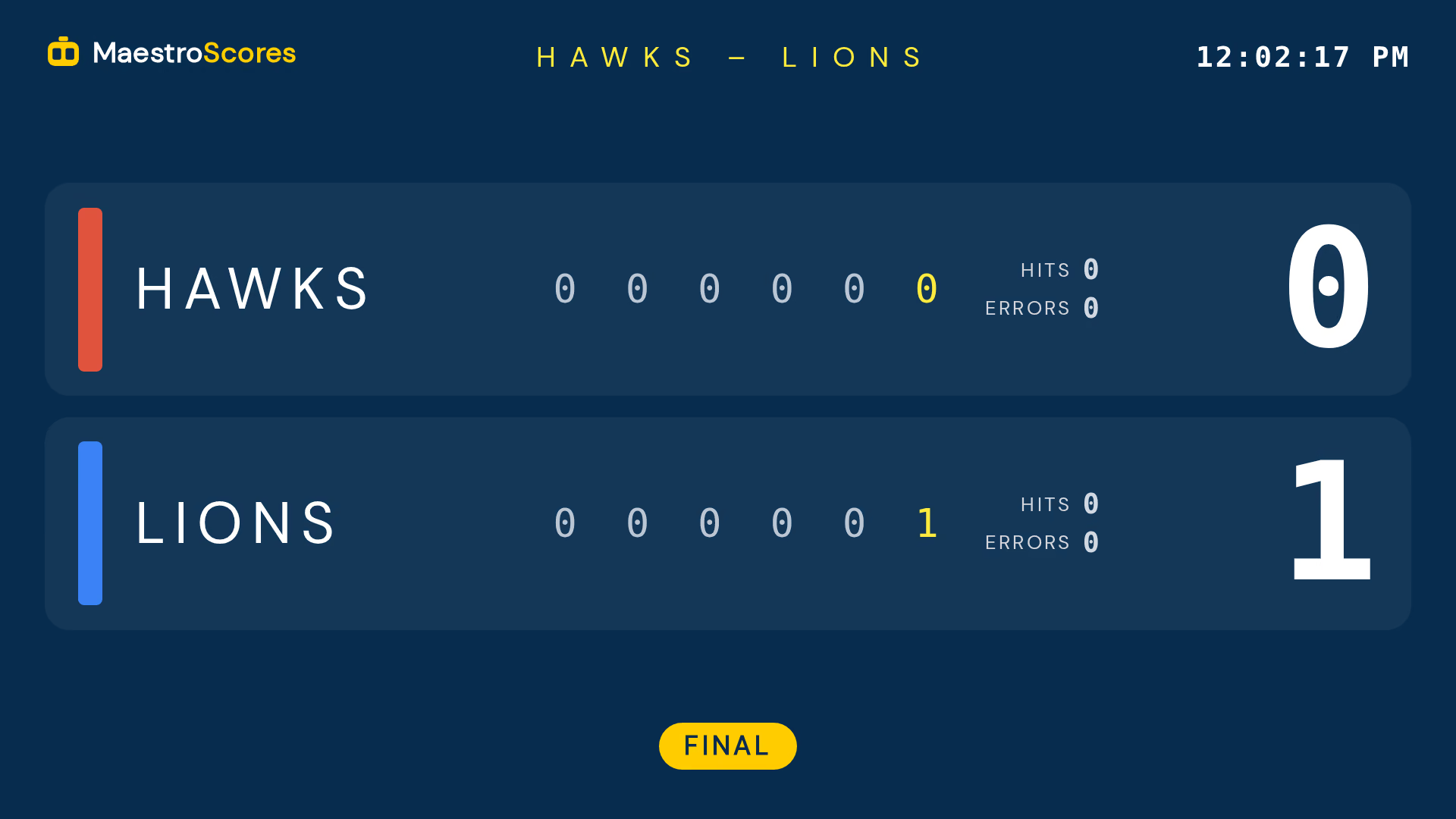

The ruleA Little League (Majors) game has six innings, and a home team that takes the lead in the bottom of the sixth wins at once.
The run rule: 15 runs after three innings, 10 after four
Little League ends a game early when one team is far ahead. With a lead of 15 Run: Baseball's point: a runner who touches first, second, third and home base before the third out scores one run. No run counts on a play whose third out is a force out or the batter put out before first base. All terms or more after three innings, or 10 runs or more after four, the manager of the trailing team concedes the game. When the home team is the one ahead, half an inning less is enough, because it would not bat again. When the visiting team reaches the lead in the top of an inning, the home team still bats in the bottom of it. When the home team reaches the run rule's lead in the bottom of an inning, the game ends the moment the run that makes that lead scores, whatever the number of outs, though when a Home run: A hit on which the batter scores, most often a fair ball out of the playing field. Every runner on base scores too. All terms with runners on base ends the game by the 10-run rule, all of its runs count.
In the regular season the run rule is optional for each local league, which may also choose an 8-run rule after five innings. The 15- and 10-run rules are mandatory in the International Tournament. On MaestroScores the Little League rules carry the 15- and 10-run rules: when an inning's half ends with one of them reached, the board asks the scorekeeper whether to end the game, and the game ends when you press Final. A home team that reaches the lead while batting ends the game with that run, without a question.
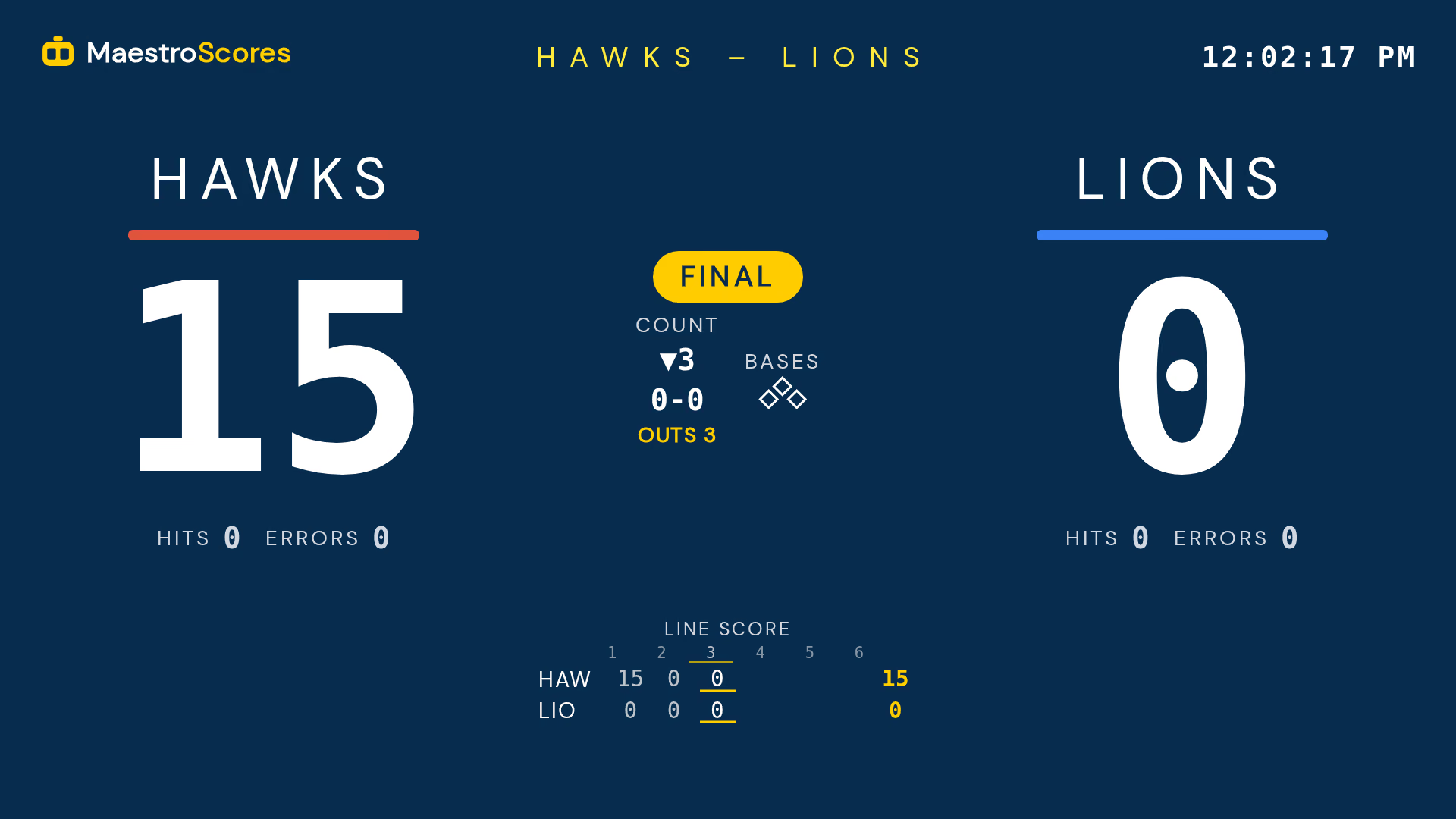

The ruleA lead of 15 runs after three innings, or 10 runs after four, ends a Little League game.
Pitch limits by league age
Every Little League pitcher has a daily maximum that depends on league age. The manager must take the pitcher off the mound at the limit, and the player may stay in the game at another position. A pitcher who reaches the limit while facing a batter may finish that batter, but may not start a new one.
| League age | Pitches per day |
|---|---|
| 6-8 | 50 |
| 9-10 | 75 |
| 11-12 | 85 |
| 13-16 | 95 |
Days of rest after pitching
The number of pitches a player throws in a day sets how many calendar days of rest come before the next game on the mound. For a pitcher of league age 14 or under, 1 to 20 pitches need no rest. For league ages 15 and 16 the thresholds are 31, 46, 61 and 76 pitches. No player may pitch on three days in a row.
| Pitches in a day (league age 14 or under) | Days of rest |
|---|---|
| 21-35 | 1 |
| 36-50 | 2 |
| 51-65 | 3 |
| 66 or more | 4 |
Keeping the pitch count on the board
On MaestroScores you tap each pitch as a Ball: A pitch outside the strike zone that the batter does not swing at. Four balls are a walk. All terms, a Strike: A pitch the batter swings at and misses, a pitch through the strike zone, or a foul ball with fewer than two strikes. Three strikes put the batter out. All terms or a Foul ball: A batted ball that settles in foul territory, outside the foul lines. It is a strike with fewer than two strikes; with two strikes it leaves the count as it is, unless it is a bunt or a foul tip the catcher catches. All terms. The board counts the balls, the strikes and the outs, and every pitch the pitcher throws. The Classic Scoreboard shows the pitching team's Pitch count: The number of pitches a pitcher has thrown. In Little League it is held to a daily limit and sets the days of rest. All terms under its score, beside Count: The balls and strikes on the batter, said with the balls first; a full count is three balls and two strikes. It starts again with each new batter. All terms and the bases, and the board's own page marks when a pitcher passes 20, 35, 50 and 65 pitches, the points after which the days of rest go up.
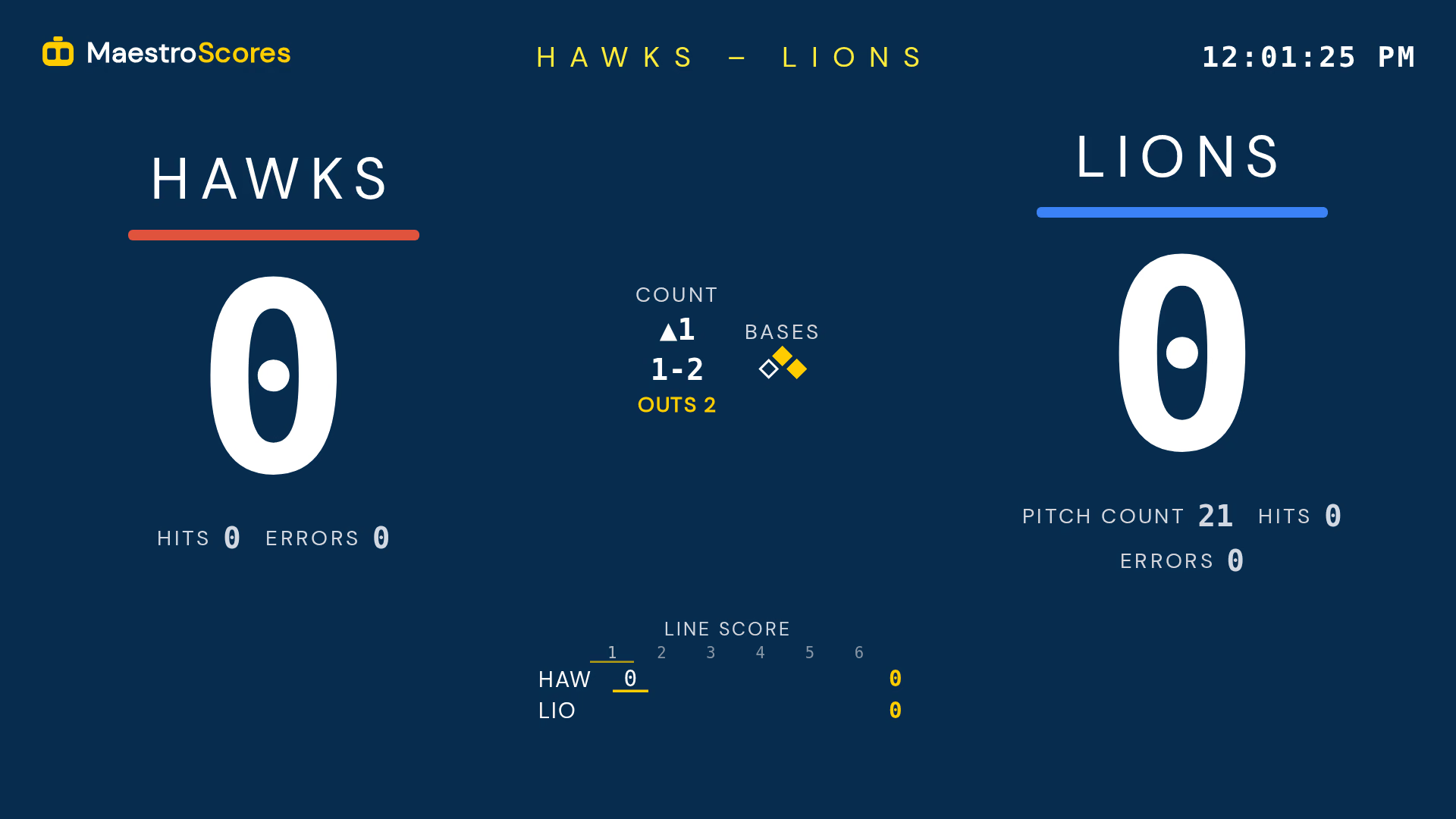
The ruleFrom 21 pitches in a day, a Little League pitcher of league age 14 or under needs a day of rest before pitching again.
FAQ
How many innings are in a Little League game?
Six innings in the Little League (Majors) division, or a time limit of at least 1 hour and 45 minutes where the local league sets one. A game level after six innings may go into extra innings or end as a regulation tie game, and the run rule can end a game early.
What is the 10-run rule in Little League?
A team that leads by 10 runs or more after four innings wins the game, or after three and a half innings when the home team is ahead. A lead of 15 runs ends the game after three innings.
How many pitches can a Little League pitcher throw?
50 a day at league age 6 to 8, 75 at 9 to 10, 85 at 11 to 12 and 95 at 13 to 16. A pitcher who reaches the limit during an at-bat may finish that batter.
How many days of rest does a pitcher need after 66 pitches?
Four calendar days for a pitcher of league age 14 or under. 51 to 65 pitches need three days, 36 to 50 two days, and 21 to 35 one day.
Keep Little League score on a board
Create a baseball board, choose the Little League rules, tap each pitch, out and run on your phone, and open the Scoreboard link on any screen at the field.
Baseball terms
- Ball
- A pitch outside the strike zone that the batter does not swing at. Four balls are a walk.
- Bases loaded
- Runners on first, second and third base, so a walk forces in a run.
- Bunt
- A ball the batter does not swing at but meets with the bat on purpose and taps slowly into the infield. A bunt that goes foul with two strikes is strike three.
- Count
- The balls and strikes on the batter, said with the balls first; a full count is three balls and two strikes. It starts again with each new batter.
- Days of rest
- The calendar days a Little League pitcher must wait before pitching again, set by the number of pitches thrown in a day.
- Double
- A hit on which the batter reaches second base safely.
- Error
- A fielder's misplay that lets a batter reach base or a runner move up when ordinary play would have put him out or held him. The E on a scoreboard counts a team's errors.
- Extra innings
- Innings played when the score is level after the last regulation inning, until the visiting team leads at the end of a completed inning or the home team scores the winning run.
- Force out
- An out made by touching the base a runner has to move to because the batter became a runner. No run counts on a play whose third out is a force out.
- Foul ball
- A batted ball that settles in foul territory, outside the foul lines. It is a strike with fewer than two strikes; with two strikes it leaves the count as it is, unless it is a bunt or a foul tip the catcher catches.
- Foul tip
- A batted ball that goes sharp and direct from the bat to the catcher and is caught. A caught foul tip is a strike, so with two strikes it is strike three.
- Half-inning
- One team's turn at bat, the top or the bottom of an inning. It ends with the third out.
- Hit
- A fair ball on which the batter reaches base safely, without the help of a fielding error. The H on a scoreboard counts a team's hits.
- Home run
- A hit on which the batter scores, most often a fair ball out of the playing field. Every runner on base scores too.
- Inning
- The part of a game in which both teams bat once. The visiting team bats in the top of the inning, the home team in the bottom.
- League age
- The age Little League counts a player by for the whole season. It sets a pitcher's daily pitch limit and days of rest.
- Line score
- Each team's runs inning by inning, in a row, with the total at the end.
- Mercy rule
- Also called the run rule: it ends a game early when one team leads by a set number of runs after a set number of innings.
- Out
- A batter or runner put out, on a strikeout, a caught fly ball, a tag or a force play. Three outs end a team's half-inning.
- Pitch count
- The number of pitches a pitcher has thrown. In Little League it is held to a daily limit and sets the days of rest.
- Pitch timer
- The countdown a pitcher has for each pitch, also called the pitch clock. Under MLB's rules a pitcher who is late is charged with a ball, and a batter who is late with a strike.
- Regulation game
- A game that counts, with its result: one played to its end, or one called early, for rain or darkness for example, once enough innings have been played.
- Run
- Baseball's point: a runner who touches first, second, third and home base before the third out scores one run. No run counts on a play whose third out is a force out or the batter put out before first base.
- Strike
- A pitch the batter swings at and misses, a pitch through the strike zone, or a foul ball with fewer than two strikes. Three strikes put the batter out.
- Strikeout
- Strike three: the batter is out.
- Walk
- Ball four: the batter takes first base, and a runner forced by the batter moves up one base.
- Walk-off
- The run that wins the game for the home team in the bottom of the last inning or of an extra inning. The game ends the moment it scores.
- Little League: Regular Season Pitching Ruleslittleleague.org
- What is the Little League® Run Rule?littleleague.org
- The 8, 10, and 15-Run Rules: What Parents Need to Knowlittleleague.org
- Little League: Regulation VII: Making a Regular Season Schedulelittleleague.org