When a soccer game is tied at full time, a league game ends as a Draw: A match that ends with both teams on the same number of goals, or none. In a league the draw stands. All terms. A game that must have a winner goes on as its competition rules decide: to Extra time: Two equal periods of no more than 15 minutes each, played when a level match must have a winner. Both are played in full. All terms, or straight to a Penalty shoot-out: Kicks from the penalty mark, taken after a level match has ended when a winner is needed: five each, taken alternately, then one each until one team leads. All terms. Extra time is two periods of up to 15 minutes each, played in full even after a goal. If the score is still level after extra time, a penalty shoot-out decides the winner: five kicks for each team, then one kick each until one team leads.
This page plays a tied cup game through under the IFAB Laws of the Game 2026/27 on a MaestroScores scoreboard, from the end of the second Half: One of the two equal parts of a match. The teams change ends for the second half. All terms to the last kick of the shoot-out. It then shows college overtime (NCAA), where the first goal wins, the extra time of beach soccer, and what US high schools do.
A tie at full time: a draw, or a way to find a winner
Under the IFAB Laws of the Game, a match in which both teams score the same number of goals, or no goals, is drawn. In a league the draw stands. The game goes on only when the competition rules need a winner, as in a cup or a Knockout: A round or a cup game that must have a winner, so a level game goes on to extra time and penalties. All terms round, and the Laws allow just three ways to find one:
- The Away goals rule: A way to settle a tie of two matches, home and away: with the goals level over both, the team that scored more goals away from home goes through. All terms, for a tie of two matches, home and away.
- Extra time: two equal periods of no more than 15 minutes each.
- A penalty shoot-out, taken after the match has ended.
- A competition may combine them: extra time first, then the shoot-out if the score is still level.
- The competition rules decide which are used, alone or together: some competitions go from a draw straight to the shoot-out, with no extra time.
The end of the second half: going to extra time
Extra time follows the second half and its added time when the score is level. Before it starts, the referee tosses a coin again, as before the Kick-off: The kick that starts each half and each period of extra time, and restarts play after a goal. All terms, to decide the ends and the team that kicks off. On MaestroScores, you mark a game as one that must have a winner when you set up the board. At the final whistle of the second half you tap Next period, and in a level game the board moves on to extra time.
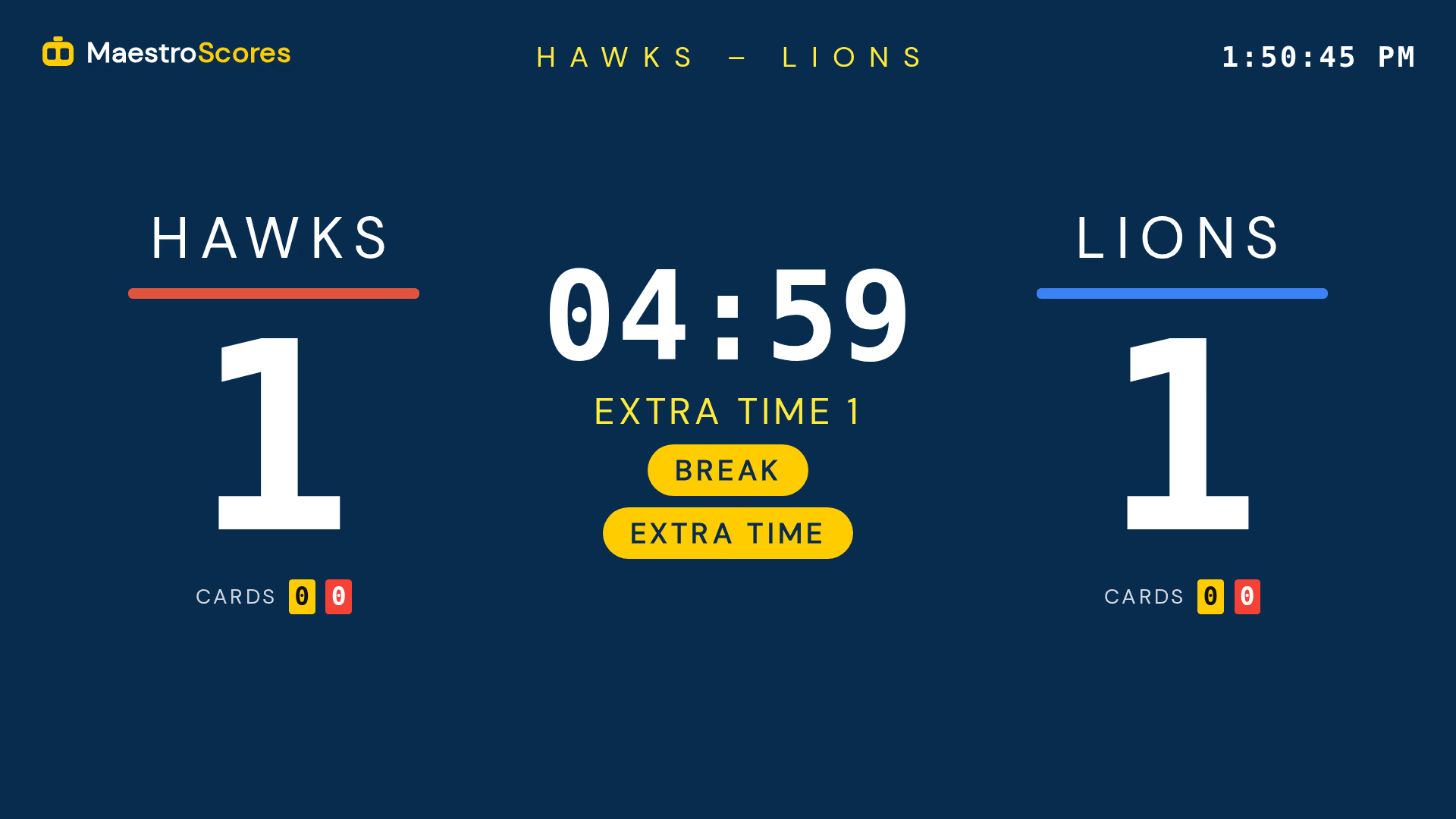

The ruleA level game that must have a winner goes on to extra time after the second half and its Added time: Time the referee adds at the end of a half for playing time lost, for example to substitutions, injuries and goal celebrations. All terms.
Extra time: two periods of up to 15 minutes
Extra time is two equal periods of no more than 15 minutes each. Between them the players may have a short Drinks break: A short pause of up to one minute, which the players may have between the periods of extra time. All terms of up to one minute, and a kick-off starts each period. A goal in extra time does not end the game: both periods are played in full, and the team ahead at the end of extra time wins. On the board you tap Goal in extra time as in any half.
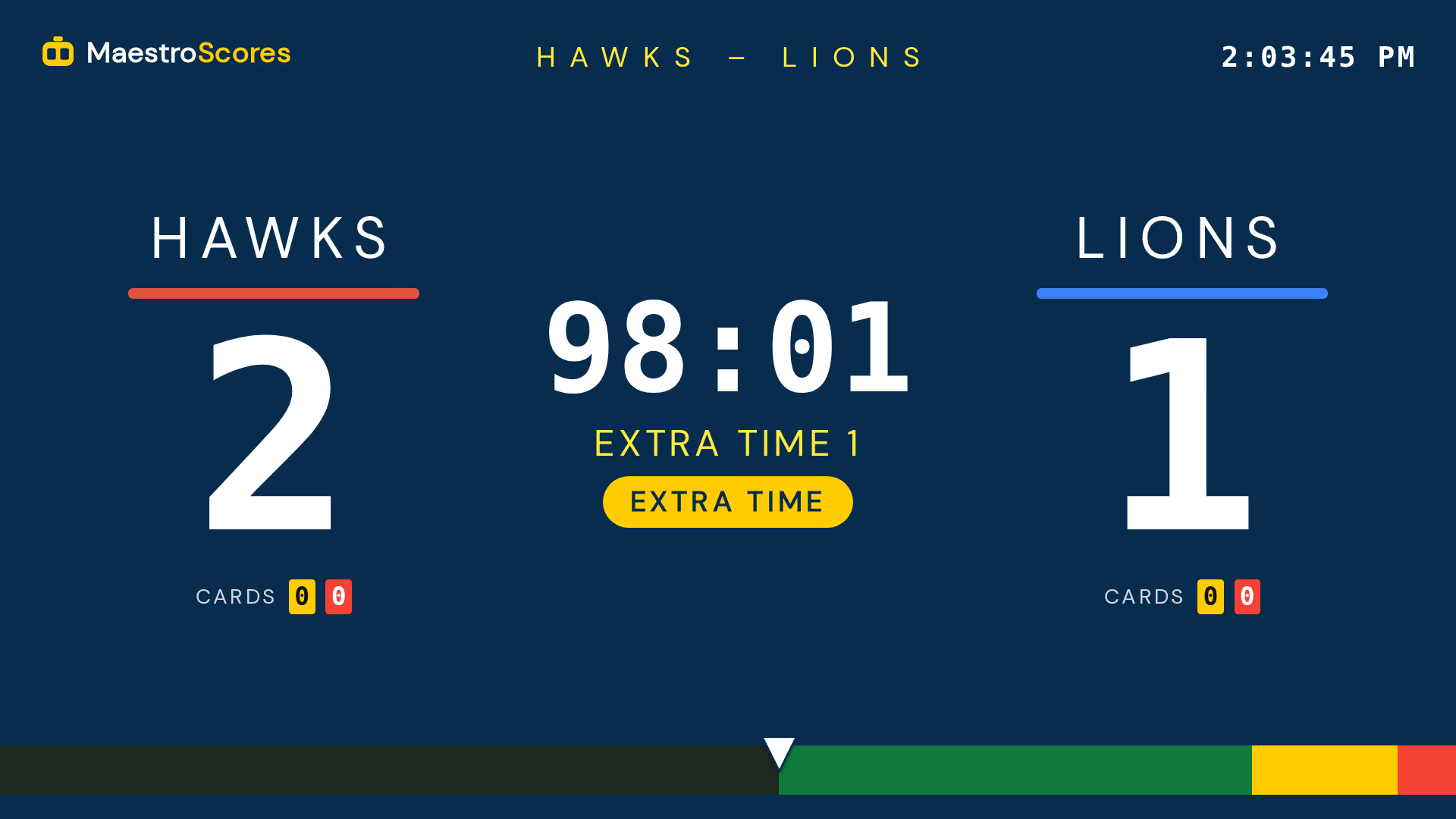

The ruleA goal in extra time does not end the game: both periods are played in full.
Still level after extra time: the penalty shoot-out
If the score is still level after extra time, the teams take kicks from the penalty mark after the match has ended. They kick alternately, five kicks each. If one team has scored more goals than the other could score with all its remaining kicks, the shoot-out ends at once. If the teams are level after five kicks each, the kicks go on, one for each team, until one team has scored a goal more than the other from the same number of kicks.
On the board, you tap Next period at the end of extra time to open the shoot-out, then Scored or Missed for each kick. The board ends the shoot-out by itself when one team can no longer be caught, and shows Final.
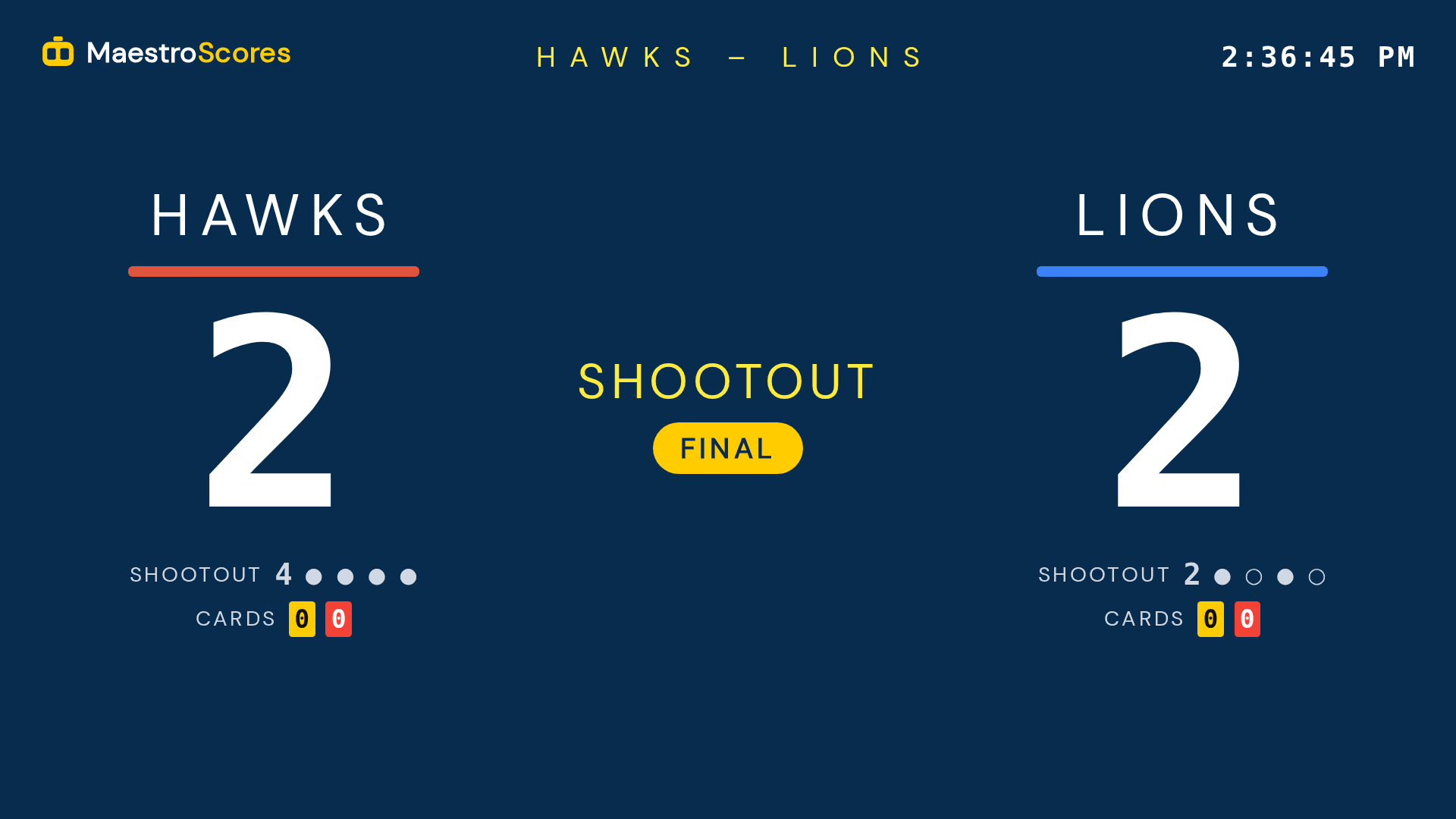

The ruleThe shoot-out ends at once when one team has scored more than the other could score with all its remaining kicks.
College soccer (NCAA): sudden-victory overtime
NCAA soccer settles a tie in two ways. A regular-season game that is tied after 90 minutes ends as a tie. In postseason games, conference tournaments included, up to two Sudden-victory overtime: College soccer's overtime (NCAA): the first team to score wins the game. All terms periods of 10 minutes each are played after a 5-minute interval, with at most 2 minutes between them. The first team to score wins the game.
If the score is still tied after the second overtime, the game is recorded as a tie, and kicks from the penalty mark decide which team advances: five each, then one each until one team leads. Only in the national championship game does the winner of the kicks also get the win in the record. On the board, a goal in NCAA overtime ends the game by itself.
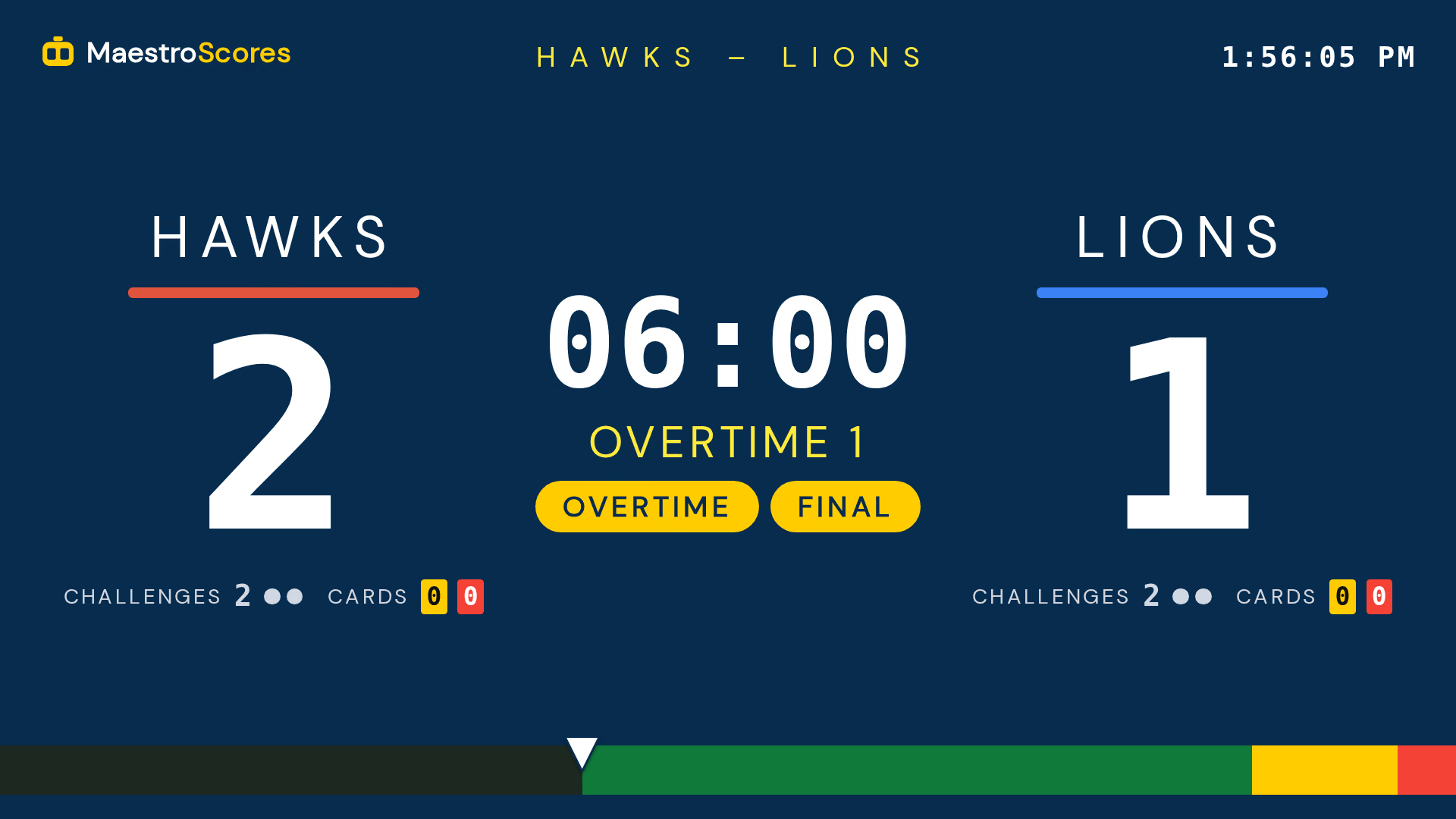

The ruleIn NCAA postseason overtime the first team to score wins the game.
Beach soccer: one period of extra time
Beach soccer under the FIFA Beach Soccer Laws plays three periods of 12 minutes. A level match that needs a winner goes straight into one period of extra time of no more than 3 minutes, with no interval before it, only a drinks break of up to one minute. If the score is still level, a penalty shoot-out follows: five kicks each, then one each until one team leads. On the board, every level beach soccer game plays its extra time and its shoot-out, with no need to mark it as a game that must have a winner.
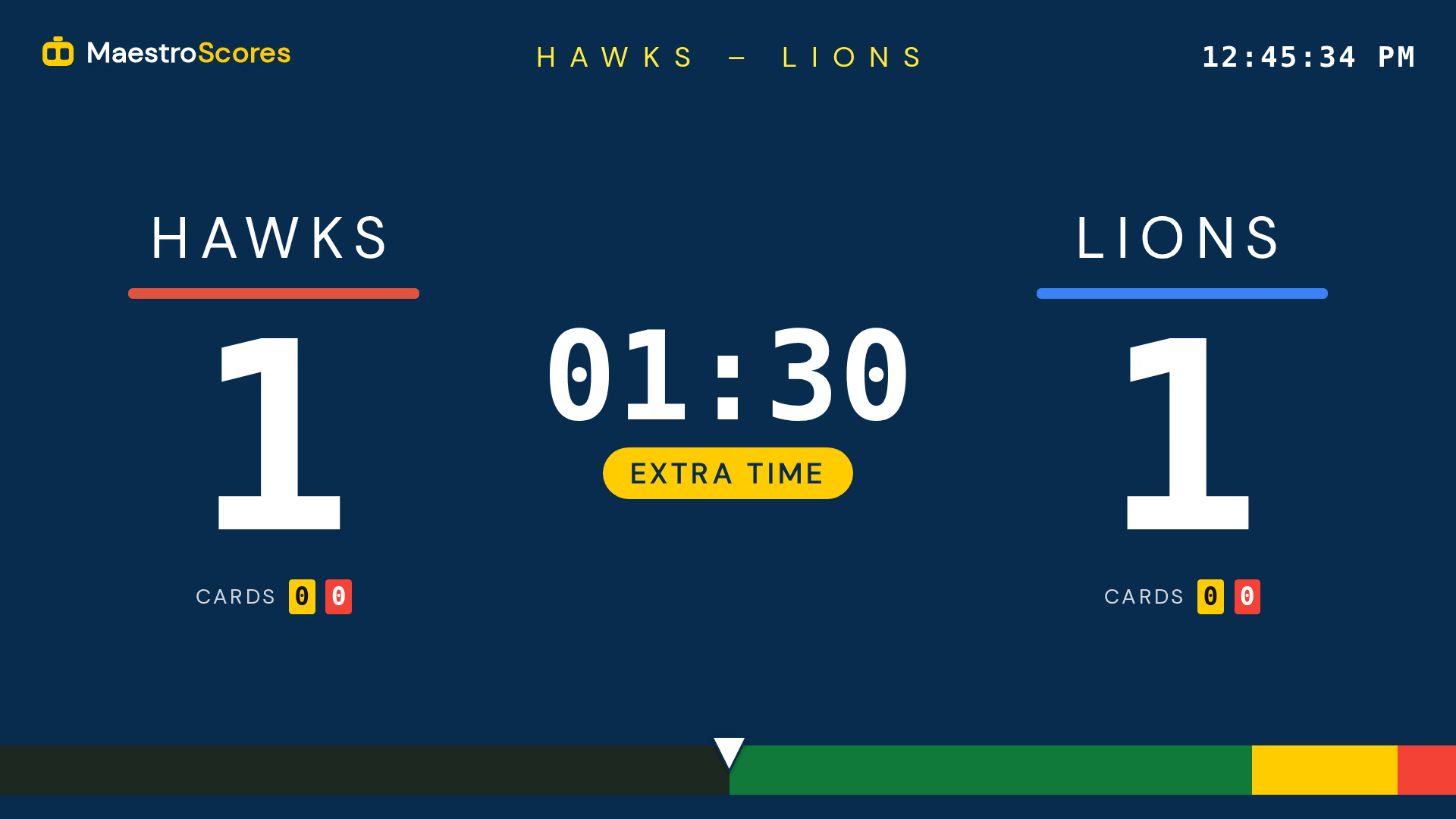

The ruleA level beach soccer match goes straight into one period of extra time of no more than 3 minutes.
High school soccer (NFHS): overtime set by each state
US high school rules leave a tied game to each state association. A state may allow overtime of up to 20 minutes in all, with 5 minutes after the game and 2 minutes between the overtime periods, and it sets its own tie-breaking procedure for the postseason. The board's US high school rule set plays no overtime: a tied game ends level when you tap Final.
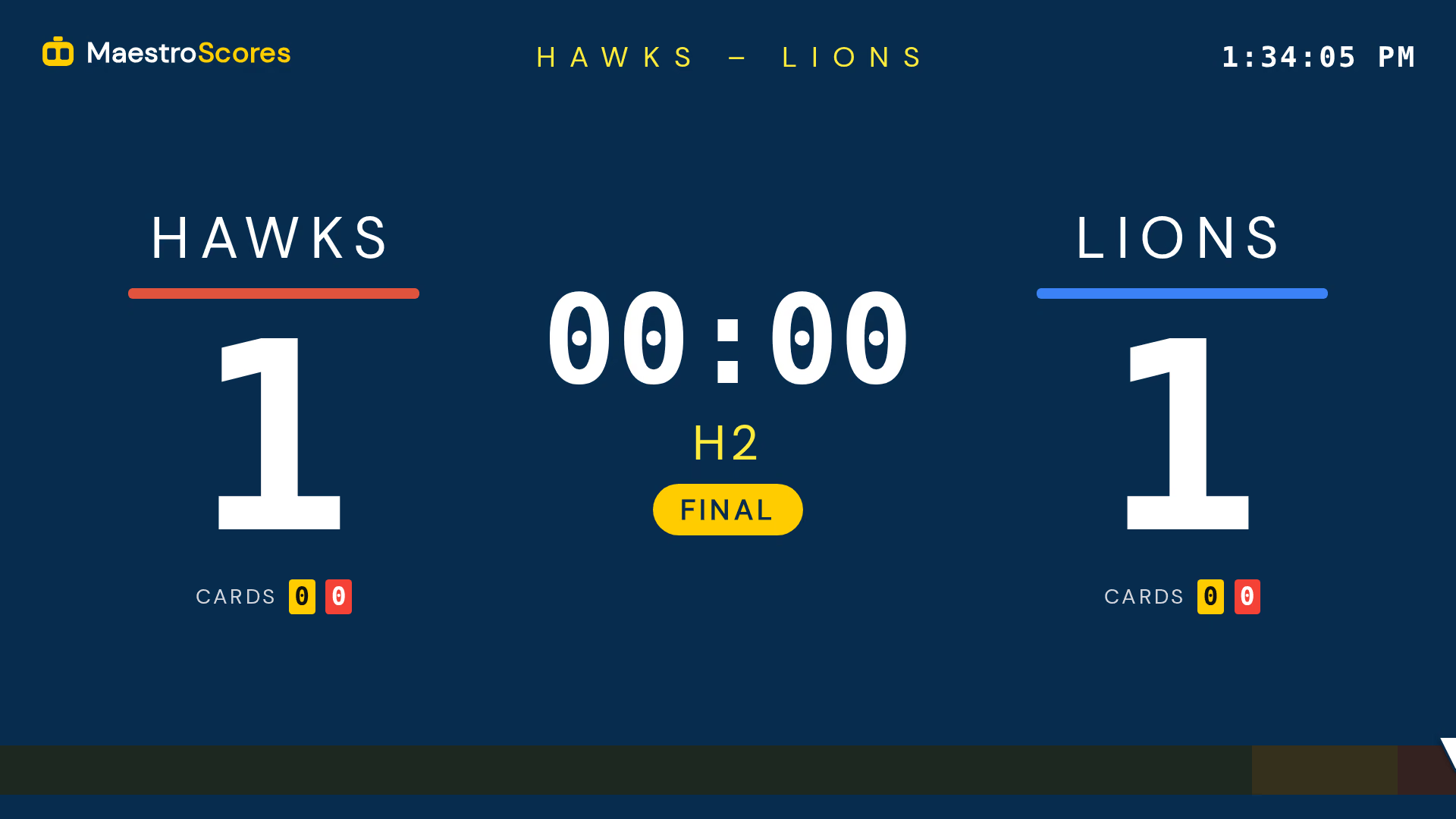

The ruleUS high school rules leave overtime to each state association; the board's US high school rule set plays none.
How the scoreboard keeps a tied game
On MaestroScores the rule set you choose decides what a tied game does. Under the IFAB Laws and the NCAA rules, a game you mark as one that must have a winner plays its extra time or overtime and then the shoot-out; any other game ends as a draw when you tap Final. You step through the periods with Next period, tap Goal for each goal and Scored or Missed for each kick, and the Scoreboard and the Scorebug show every step at once.
FAQ
How long is overtime in soccer?
Under the IFAB Laws, extra time is two periods of no more than 15 minutes each. NCAA college overtime is up to two periods of 10 minutes, and beach soccer plays one period of no more than 3 minutes.
Is there a golden goal in soccer extra time?
Not under the IFAB Laws: both periods of extra time are played in full, whatever the score. In NCAA postseason overtime the first goal wins the game.
How many penalty kicks does each team take?
Five each, taken alternately. If the teams are still level after five kicks each, they go on one kick each until one team has scored more from the same number of kicks.
Can a soccer game end in a tie?
Yes. A league game that is level at full time is a draw, and an NCAA regular-season game that is tied after 90 minutes is recorded as a tie. Only a game that must have a winner goes on, to extra time and penalties or, where its competition rules say so, straight to penalties.
Do the goals of a penalty shoot-out count in the score?
No. The shoot-out is taken after the match has ended, so the match score stays level. The referee keeps a separate record of the kicks.
Keep a soccer cup game on a board
Create a soccer board with the rules you play, mark it as a game that must have a winner, and tap each goal and kick on your phone. Every screen at the field shows extra time and the shoot-out.
Soccer terms
- Added time
- Time the referee adds at the end of a half for playing time lost, for example to substitutions, injuries and goal celebrations.
- Away goals rule
- A way to settle a tie of two matches, home and away: with the goals level over both, the team that scored more goals away from home goes through.
- Caution
- A formal warning the referee gives a player, shown with a yellow card.
- Corner kick
- A restart for the attacking team, kicked from the corner of the field, when the ball goes out over the goal line last touched by a defender, without a goal being scored.
- Draw
- A match that ends with both teams on the same number of goals, or none. In a league the draw stands.
- Drinks break
- A short pause of up to one minute, which the players may have between the periods of extra time.
- Extra time
- Two equal periods of no more than 15 minutes each, played when a level match must have a winner. Both are played in full.
- Fourth official
- The match official beside the field who, at the end of each half, shows the minimum added time the referee has decided. The referee may add more, but not less.
- Free kick
- The kick a foul gives the other team. A direct free kick is given for fouls such as kicking, tripping, pushing or holding an opponent, or a handball offence; an indirect free kick for lesser offences, such as playing in a dangerous manner.
- Goal line
- The line at each end of the field. A goal is scored when the whole of the ball passes over it, between the goalposts and under the crossbar.
- Golden goal
- A goal in extra time that ends the match at once. The IFAB Laws have none: both periods of extra time are played in full.
- Half
- One of the two equal parts of a match. The teams change ends for the second half.
- Half-time
- The interval between the two halves, when the players may rest.
- Handball
- Touching the ball with a hand or arm in a way the Laws forbid. It is a direct free kick offence for every player except the goalkeeper inside their own penalty area.
- Kick-off
- The kick that starts each half and each period of extra time, and restarts play after a goal.
- Knockout
- A round or a cup game that must have a winner, so a level game goes on to extra time and penalties.
- Offside
- A player in the opponents' half nearer to the opponents' goal line than both the ball and the second-last opponent is in an offside position. It is an offence only when the player becomes involved in active play after a team-mate plays the ball, and gives the other team an indirect free kick.
- Penalty area
- The marked area in front of each goal. A direct free kick offence there by the defending team gives a penalty kick, and inside it the goalkeeper may handle the ball.
- Penalty kick
- A kick at goal from the penalty mark, awarded when a player commits a direct free kick offence inside their own penalty area.
- Penalty shoot-out
- Kicks from the penalty mark, taken after a level match has ended when a winner is needed: five each, taken alternately, then one each until one team leads.
- Red card
- The card the referee shows for a sending-off.
- Sending-off
- A player ordered off for the rest of the match, shown with a red card. A player sent off after the kick-off cannot be replaced.
- Sudden-victory overtime
- College soccer's overtime (NCAA): the first team to score wins the game.
- Yellow card
- The card the referee shows for a caution. A second yellow card in the same match is a sending-off.
- Law 7 - The Duration of the Match (IFAB)theifab.com
- Law 8 - The Start and Restart of Play (IFAB)theifab.com
- Law 10 - The Outcome of a Match (IFAB)theifab.com
- 2026 and 2027 NCAA Men's and Women's Soccer Rulesncaaorg.s3.amazonaws.com
- Beach Soccer Laws of the Game 2025-26 (FIFA)digitalhub.fifa.com
- A Comparative Study of Rules and Laws: 2026-27 Soccer Guide (NFHS)assets.nfhs.org