Deuce: The score when both players have won three points in a game, 40-40. A player then needs two points in a row to win the game. All terms is the score of 40-40 in a tennis Game: A run of points served by one player, won by the first player to win four points with a lead of two. All terms. From deuce, a player needs to win two points in a row to win the game. The first of those points gives the player the Advantage: The point after deuce: its winner wins the game with the next point, and losing that point brings the score back to deuce. Scoreboards show it as Ad. All terms, and the second wins the game. If the other player wins the point after an advantage, the score goes back to deuce.
This page plays a deuce game through on a MaestroScores scoreboard under the 2026 ITF Rules of Tennis. It then shows the same rule in a Set: A run of games, won by the first player to win six games with a lead of two. In a tie-break set, a tie-break decides it at six games all. All terms and in a Tie-break: One game that decides a set at six games all. Its points are counted one by one, and the first player to seven points with a lead of two wins it and the set, 7-6. All terms, and the No-Ad: A way of scoring games without advantage: at deuce one deciding point is played, and its winner wins the game. All terms method, which ends deuce with a single point.
What deuce means: 40-40
Deuce is what the score is called when both players have won three points in a game. A game's score goes from Love: No points, or no games. A game's points are called love, 15, 30 and 40, and love-all is no points each. All terms (0) to 15, 30, 40 and then game, so three points each would read 40-40. At deuce the game cannot end with the next point: a player has to be two points ahead to win it.
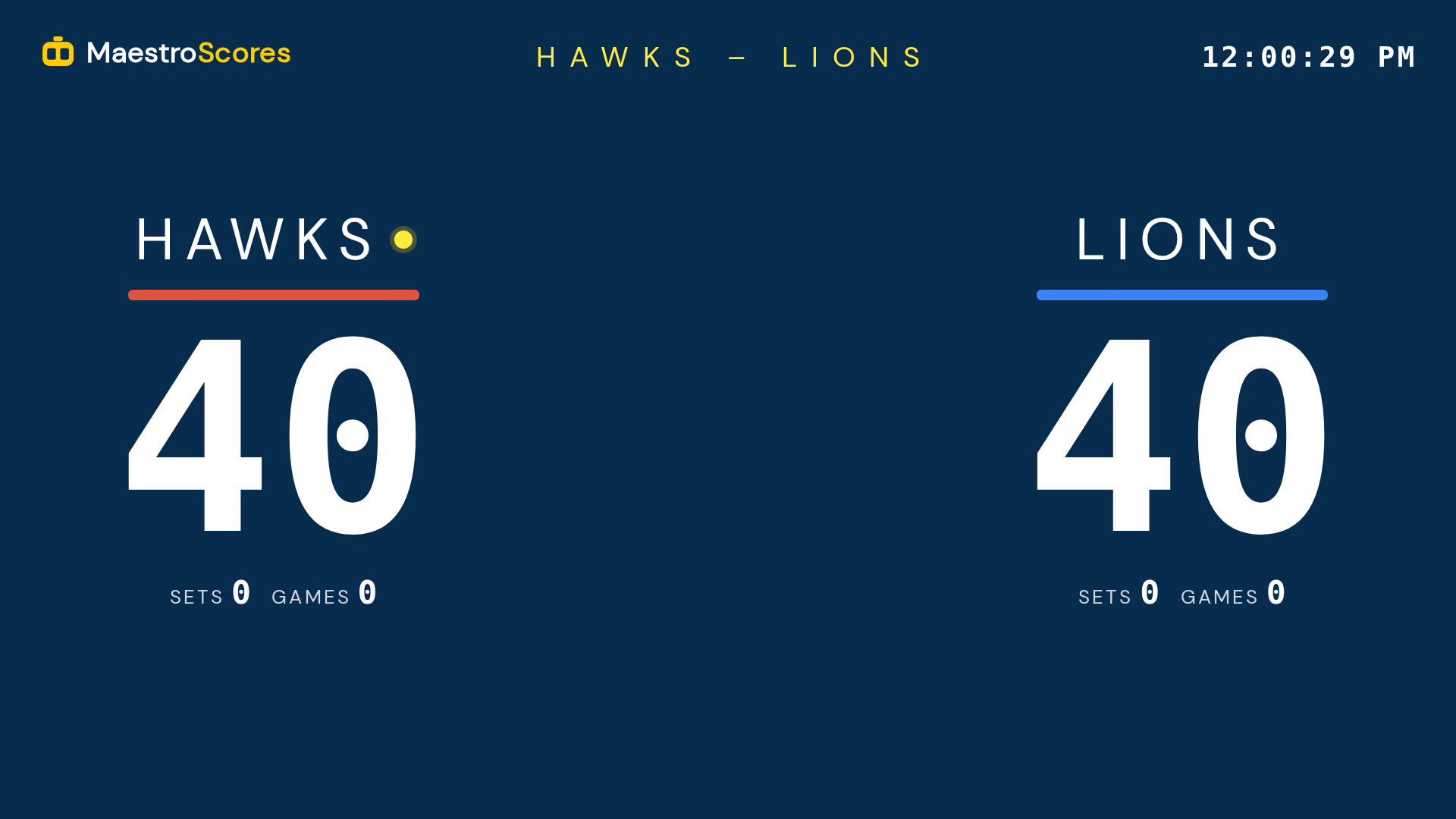

The ruleDeuce is three points each, 40-40: from there a player has to win two points in a row.
Advantage: one point ahead after deuce
The player who wins the point after deuce has the advantage. The scoreboard shows Ad beside that player. If the same player wins the next point too, the game is over. If the other player wins it, the advantage is gone and the score is deuce again. Under standard scoring this can happen any number of times in one game.


The ruleAfter deuce, the player who wins the next point has the advantage; losing the point after it brings the score back to deuce.
Winning the game from deuce: two points in a row
A player wins a game from deuce by winning two points in a row: the point that gives the advantage, and the point after it. The board then counts the game, starts the next one at love-all (0-0) and passes the serve to the other player.
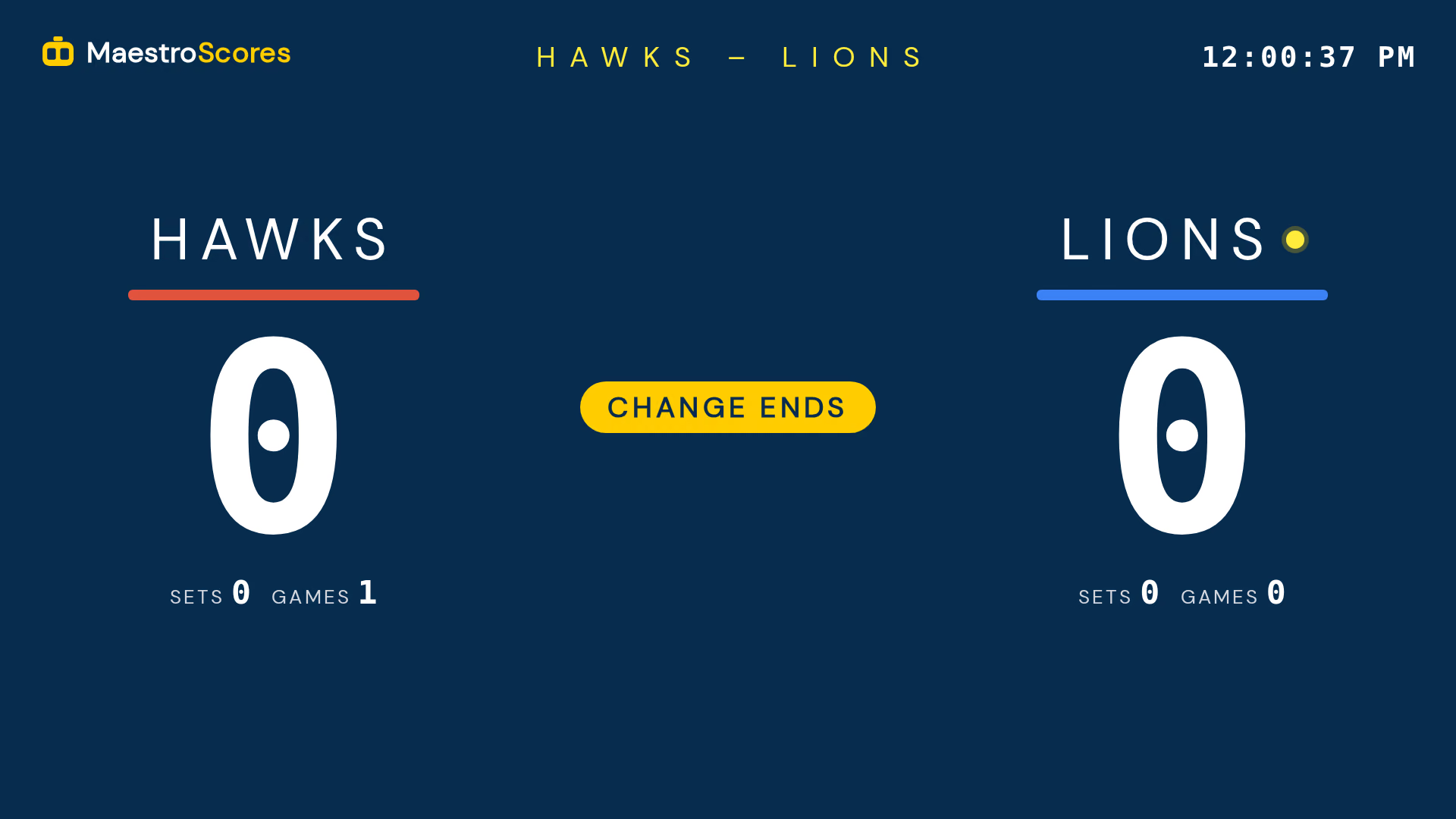

The ruleFrom deuce, a player wins the game with two points in a row: the advantage, then the game.
The same rule in a set and in a tie-break
A set follows the same idea with games. The first player to win six games wins the set, but only with a lead of two games. In a tie-break set, a tie-break is played when the games reach 6-6. The tie-break counts points one by one, and the first player to seven points wins it, again with a lead of two points. If the tie-break reaches six points all, it goes on until one player is two points ahead. Some events play an Advantage set: A set with no tie-break: it goes on until one player leads by two games. All terms instead of a tie-break set: it has no tie-break and goes on past 6-6 until one player leads by two games.
Some matches replace the deciding set with a Match tie-break: A tie-break to 10 points with a lead of two, played at one set all in place of the deciding set. Its winner wins the match. All terms to 10 points. It also needs a lead of two points.
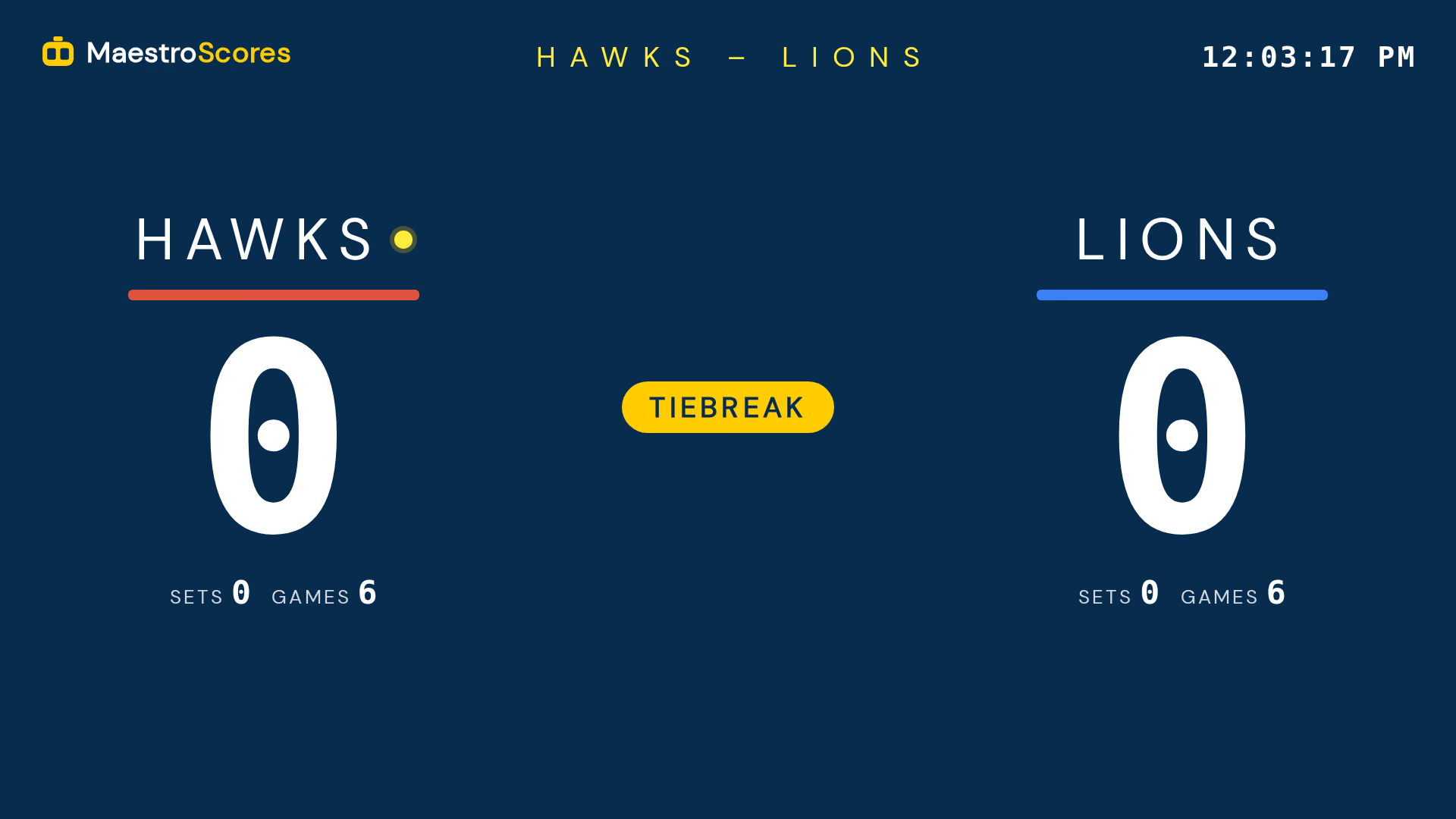

The ruleA set needs a lead of two games; at six games all a tie-break to seven points, won by two, decides it.
No-Ad scoring: one deciding point at deuce
Some matches, often doubles, use No-Ad scoring instead of advantage. At deuce, one Deciding point: Under No-Ad scoring, the one point played at deuce. The receiving player or team chooses to receive it in the right or the left half of the court. All terms is played, and whoever wins it wins the game. The receiving player or team chooses whether to receive that point on the right or the left side of the court.
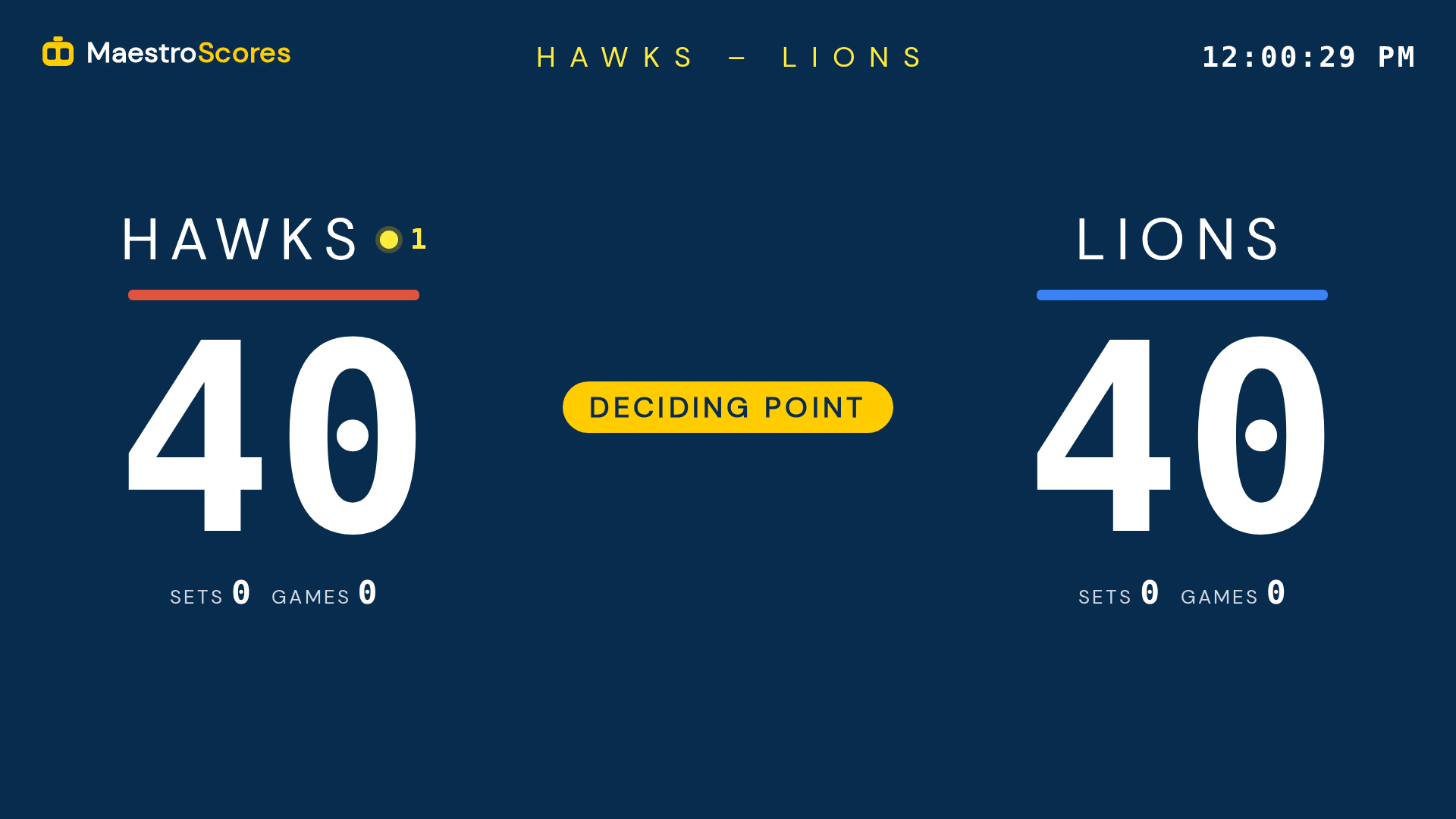

The ruleUnder No-Ad scoring one deciding point is played at deuce, and whoever wins it wins the game.
How the scoreboard keeps a deuce game
On MaestroScores you tap the player who won each point. The board calls 15, 30 and 40, shows Ad beside the player with the advantage, counts the game and starts a tie-break at six games all, as the rules chosen for the board say. Advantage or No-Ad is part of those rules. The Scoreboard on a TV and the Scorebug on a stream show the same score at the same moment.
FAQ
What does deuce mean in tennis?
Deuce is the score when both players have won three points in a game, which would read 40-40. From deuce, a player has to win two points in a row to win the game.
What comes after deuce?
Advantage. The player who wins the point after deuce has the advantage. Winning the next point as well wins the game; losing it brings the score back to deuce.
How many times can a game go back to deuce?
Under standard scoring there is no limit. The score returns to deuce each time the player with the advantage loses the next point. Under No-Ad scoring there is one deuce, and one deciding point ends the game.
Is there deuce in a tie-break?
A tie-break does not use the word deuce, but it follows the same rule. The first player to seven points wins the tie-break with a lead of two points, so at six points all it goes on until one player leads by two.
Keep tennis score on a board
Create a tennis board with the rules you play, tap the player who won each point on your phone, and open the Scoreboard link on any screen at the court.
Tennis terms
- Advantage
- The point after deuce: its winner wins the game with the next point, and losing that point brings the score back to deuce. Scoreboards show it as Ad.
- Advantage set
- A set with no tie-break: it goes on until one player leads by two games.
- Alleys
- The strips between the singles and the doubles sidelines. In doubles they are in for every shot after the serve.
- Best of three, best of five
- How many sets a match can last. In the best of three the first player to win two sets wins the match; in the best of five, the first to win three.
- Change of ends
- The players swap ends of the court after the first game, the third and every odd game of a set, and after every six points of a tie-break.
- Deciding point
- Under No-Ad scoring, the one point played at deuce. The receiving player or team chooses to receive it in the right or the left half of the court.
- Deuce
- The score when both players have won three points in a game, 40-40. A player then needs two points in a row to win the game.
- Double fault
- Two faults in a row on the same point, which lose the point.
- FAST4
- A short format of Tennis Australia: sets to four games, No-Ad games, and a tie-break at three games all.
- Fault
- A serve that breaks the rules, most often one that does not land in the service court diagonally opposite. After a first fault the server serves again.
- Foot fault
- A fault the server makes with the feet while serving: touching the baseline or the court with either foot before the racket meets the ball, or walking or running.
- Game
- A run of points served by one player, won by the first player to win four points with a lead of two.
- Let
- A serve that touches the net and still lands in the right service court. It does not count and is served again, but it does not cancel a fault served before it.
- Love
- No points, or no games. A game's points are called love, 15, 30 and 40, and love-all is no points each.
- Match point
- A point that wins the match for the player who leads, if that player wins it.
- Match tie-break
- A tie-break to 10 points with a lead of two, played at one set all in place of the deciding set. Its winner wins the match.
- No-Ad
- A way of scoring games without advantage: at deuce one deciding point is played, and its winner wins the game.
- Service court
- The area across the net, diagonally opposite the server, that a serve must land in. It ends at the singles sideline, in doubles too.
- Set
- A run of games, won by the first player to win six games with a lead of two. In a tie-break set, a tie-break decides it at six games all.
- Set break
- The rest the players may take at the end of each set.
- Set point
- A point that wins the set for the player who leads, if that player wins it.
- Tie-break
- One game that decides a set at six games all. Its points are counted one by one, and the first player to seven points with a lead of two wins it and the set, 7-6.
- Toss
- Before the warm-up, a toss decides who serves first: its winner chooses to serve or to receive, or chooses an end and leaves that choice to the opponent.
- ITF Rules of Tennisitftennis.com