Tennis is scored in points, games and sets. A Game: A run of points served by one player, won by the first player to win four points with a lead of two. All terms goes to the first player to win four points with a lead of two, and its points are called 15, 30, 40 and game. A Set: A run of games, won by the first player to win six games with a lead of two. In a tie-break set, a tie-break decides it at six games all. All terms goes to the first player to win six games with a lead of two, with a Tie-break: One game that decides a set at six games all. Its points are counted one by one, and the first player to seven points with a lead of two wins it and the set, 7-6. All terms at six games all, and a match is usually won by the first player to win two sets.
This page plays one singles match through on a MaestroScores scoreboard under the 2026 ITF Rules of Tennis, from the Toss: Before the warm-up, a toss decides who serves first: its winner chooses to serve or to receive, or chooses an end and leaves that choice to the opponent. All terms to the last point. Each step shows the board at that moment. You tap the player who won each point, and the board counts the games and sets, passes the serve and calls the Change of ends: The players swap ends of the court after the first game, the third and every odd game of a set, and after every six points of a tie-break. All terms by itself.
The tennis scoring system: points, games and sets
A match is made of sets, a set is made of games, and a game is made of points. Every point counts, whoever serves it. The server’s score is called first: 30-15 means the server has won two points and the receiver one. These are the scoring rules of a standard match:
- The points of a game are called Love: No points, or no games. A game's points are called love, 15, 30 and 40, and love-all is no points each. All terms (0), 15, 30 and 40, and the next point wins the game.
- At 40-40, called Deuce: The score when both players have won three points in a game, 40-40. A player then needs two points in a row to win the game. All terms, a player needs two points in a row to win the game.
- A set goes to the first player to win six games with a lead of two games.
- At six games all, a tie-break decides the set.
- A match is the Best of three, best of five: How many sets a match can last. In the best of three the first player to win two sets wins the match; in the best of five, the first to win three. All terms sets, or the best of five where the event announces it.
The start: the toss and the first serve
A toss before the warm-up decides who serves first. The winner of the toss chooses to serve or to receive in the first game, and the opponent then chooses the end of the court. The winner may instead choose the end, and the opponent then chooses to serve or to receive.
The server stands behind the baseline and serves the first point of every game from the right half of the court, then each point from the other half in turn. The serve must land in the Service court: The area across the net, diagonally opposite the server, that a serve must land in. It ends at the singles sideline, in doubles too. All terms diagonally opposite. A server has two tries: after a Fault: A serve that breaks the rules, most often one that does not land in the service court diagonally opposite. After a first fault the server serves again. All terms comes a second serve, and two faults in a row lose the point. A serve is a fault when it does not cross the net and land in that service court, when the server misses the ball trying to hit it, or when the server makes a Foot fault: A fault the server makes with the feet while serving: touching the baseline or the court with either foot before the racket meets the ball, or walking or running. All terms, touching the baseline or the court with either foot before the racket meets the ball. A serve that touches the net and still lands in the right service court is a Let: A serve that touches the net and still lands in the right service court. It does not count and is served again, but it does not cancel a fault served before it. All terms: it does not count and is served again, but it does not cancel a fault served before it.
On the board, the scorekeeper gives the first serve with the serve key. A dot beside the name shows who serves, and the board passes the serve to the other player after every game.
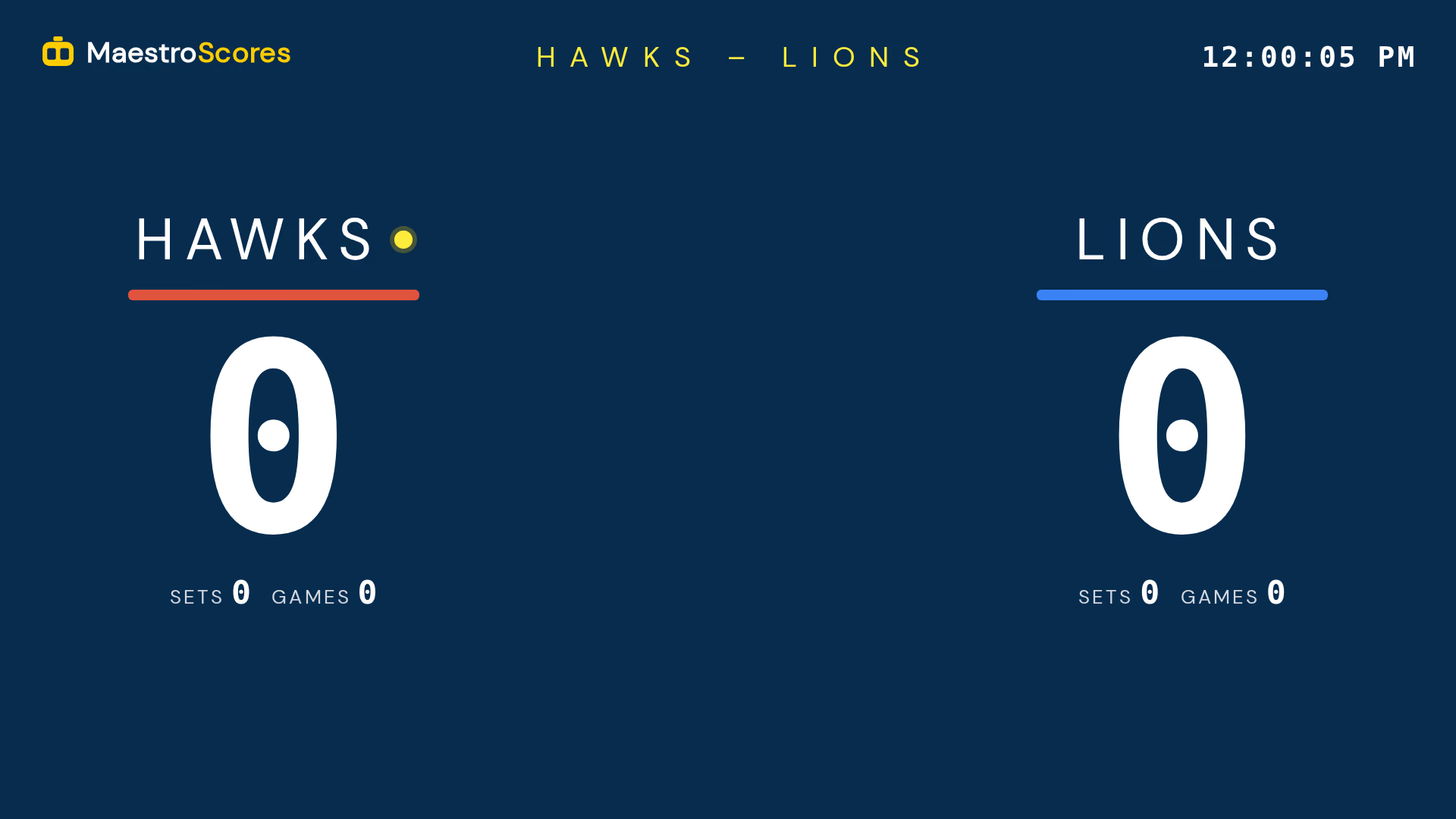

The ruleThe winner of the toss chooses to serve or to receive first, and the serve passes to the other player after every game.
Scoring a point: 15, 30, 40
Each point goes to the player who wins the rally. A player’s first point in a game is called 15, the second 30 and the third 40, and no points is love. The server’s score comes first: when the server wins the first point the score is 15-0, and when the receiver wins the next one it is 15-15, called 15-all.
A player loses the point when the ball bounces twice before they return it, when their shot lands outside the court or stays in the net, when they or their racket touch the net while the ball is in play, or when the ball touches them. A ball that touches a line counts as in.
On the board you tap the player who won the point. The Scorekeeper’s phone, the Scoreboard on a TV and the Scorebug on a stream show the new score at the same moment.
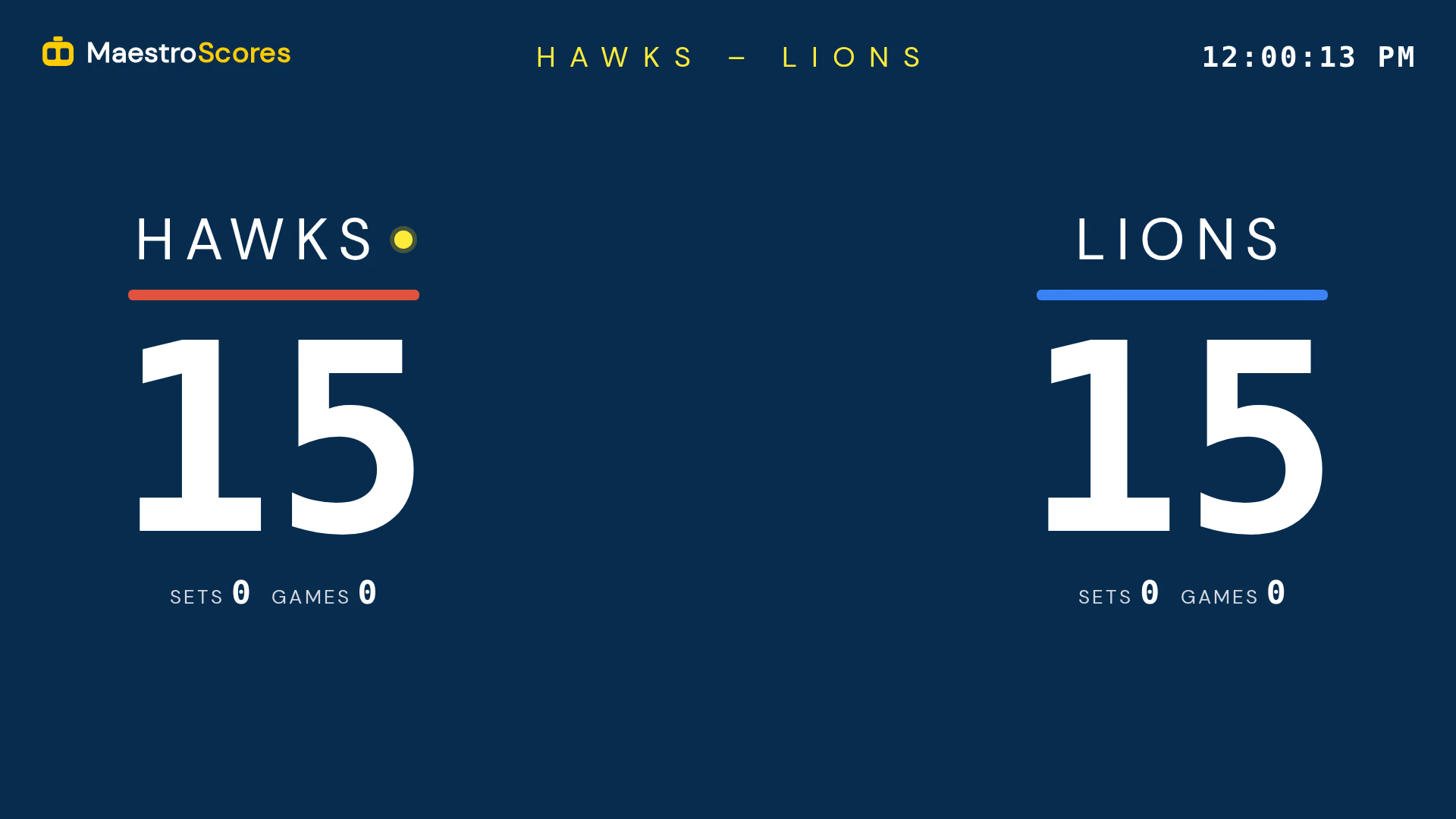

The ruleEach point goes to the player who wins the rally, and the server's score is called first.
Winning a game, then the change of serve and ends
A player wins the game with the next point after 40, unless the other player also has 40. At 40-40 the score is deuce: a player then needs two points in a row, the Advantage: The point after deuce: its winner wins the game with the next point, and losing that point brings the score back to deuce. Scoreboards show it as Ad. All terms and then the game, and the score can go back to deuce any number of times.
When a game ends, the receiver becomes the server for the next game. The players change ends after the first game, the third and every odd game of a set. The board does both by itself: it counts the game, passes the serve and shows the change of ends on the screens.
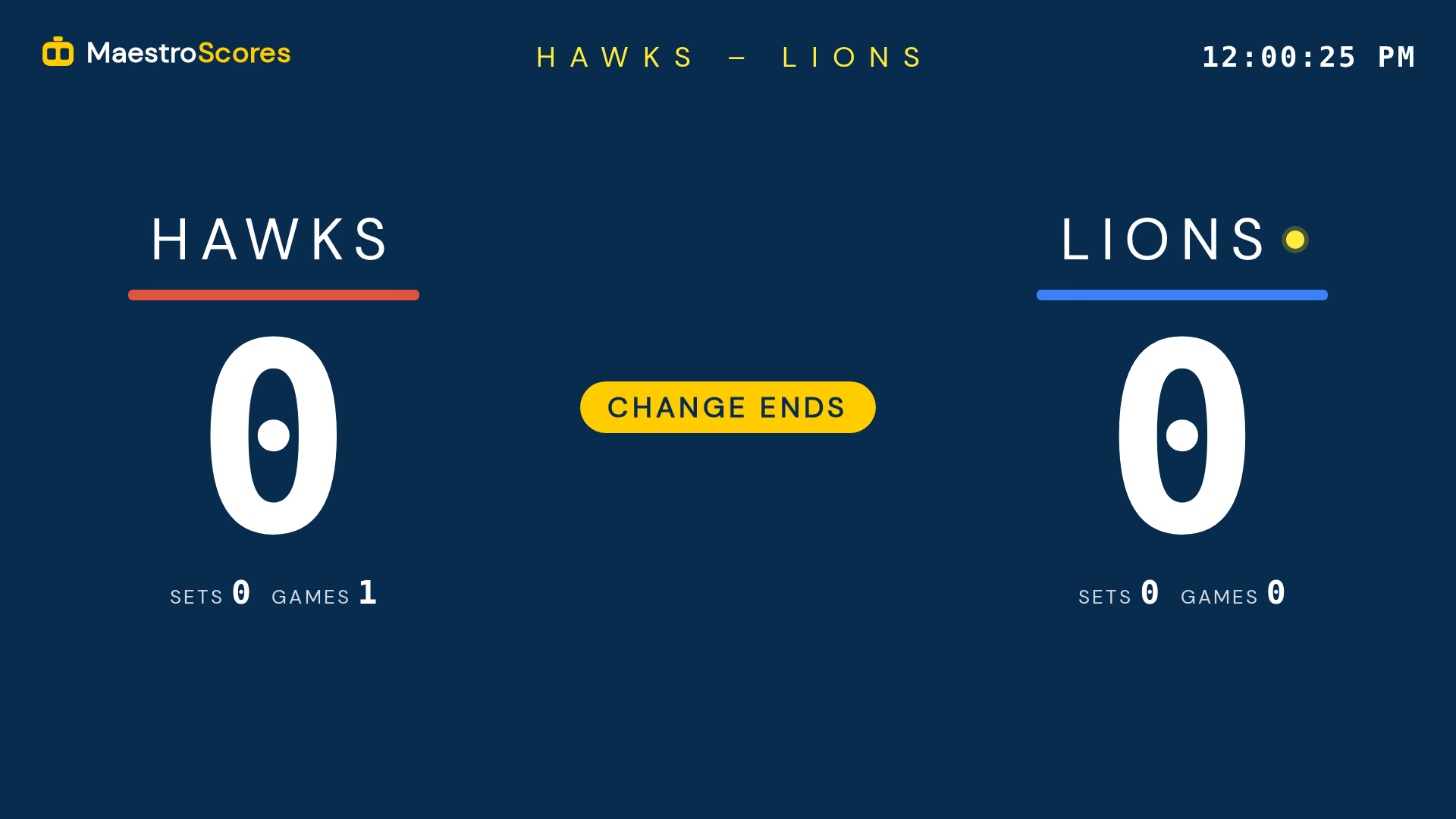

The ruleA player wins the game with the next point after 40, unless the other player has 40 too, and the receiver serves the next game.
Winning a set: six games and a lead of two
A set goes to the first player to win six games with a lead of at least two games. At six games all, a tie-break decides the set.
When a set ends after an odd number of games, as 6-3 does, the players change ends at once. After an even number, they change ends after the first game of the next set. The board records the finished set, counts the sets won and starts the next set at 0-0.
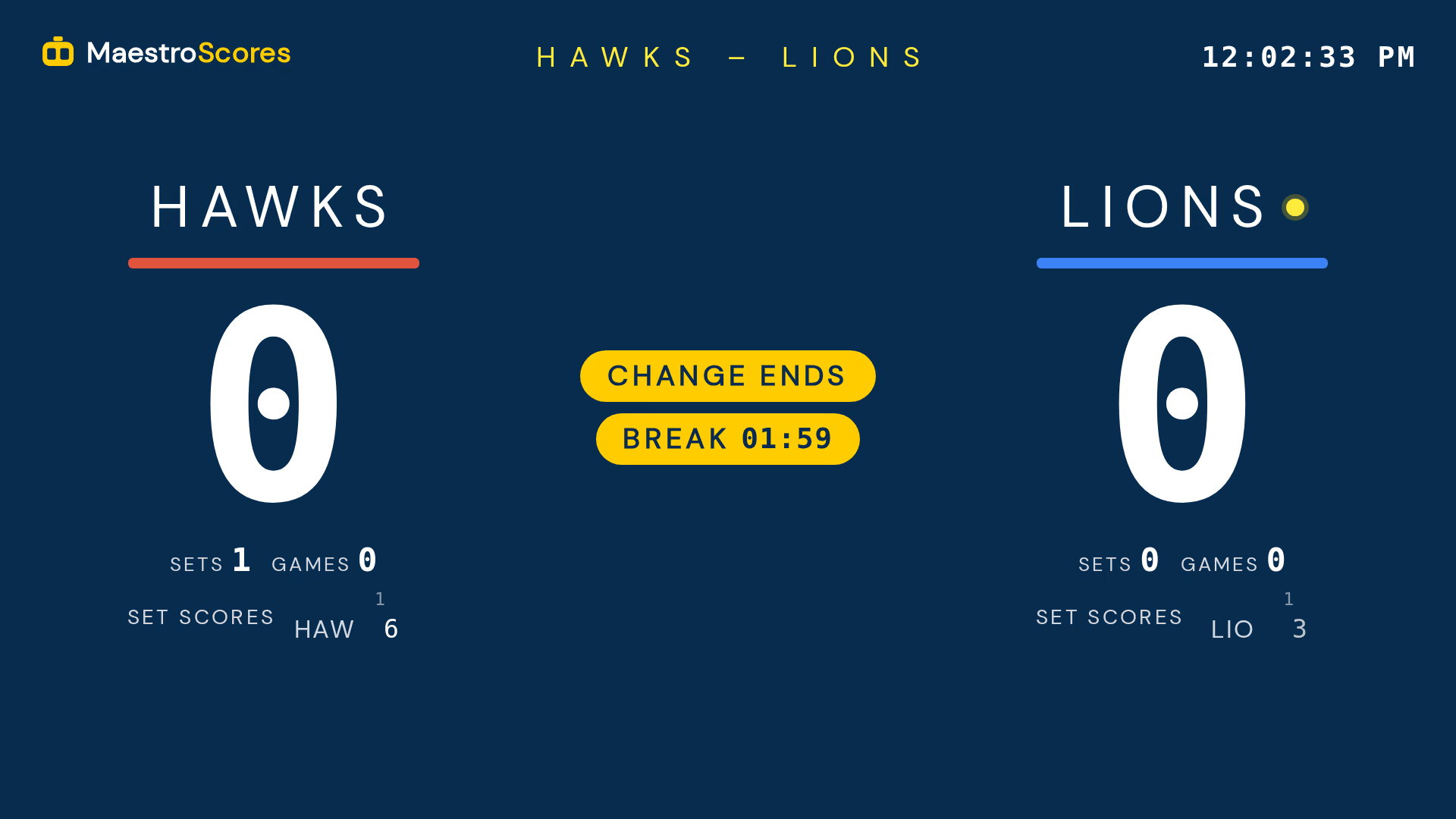

The ruleA set goes to the first player to win six games with a lead of two.
The tie-break at six games all
In a tie-break set, one tie-break game decides the set at six games all. Its points are counted 1, 2, 3 and so on instead of 15, 30 and 40, and the first player to seven points with a lead of two wins the tie-break and the set, 7-6.
The player whose turn it is serves the first point. The opponent serves the next two points, and from then on each player serves two points in turn. The players change ends after every six points, without a rest, and the player who served first in the tie-break receives in the first game of the next set.
On the board you go on tapping the player who won each point. The board counts the tie-break points one by one and passes the serve by itself.
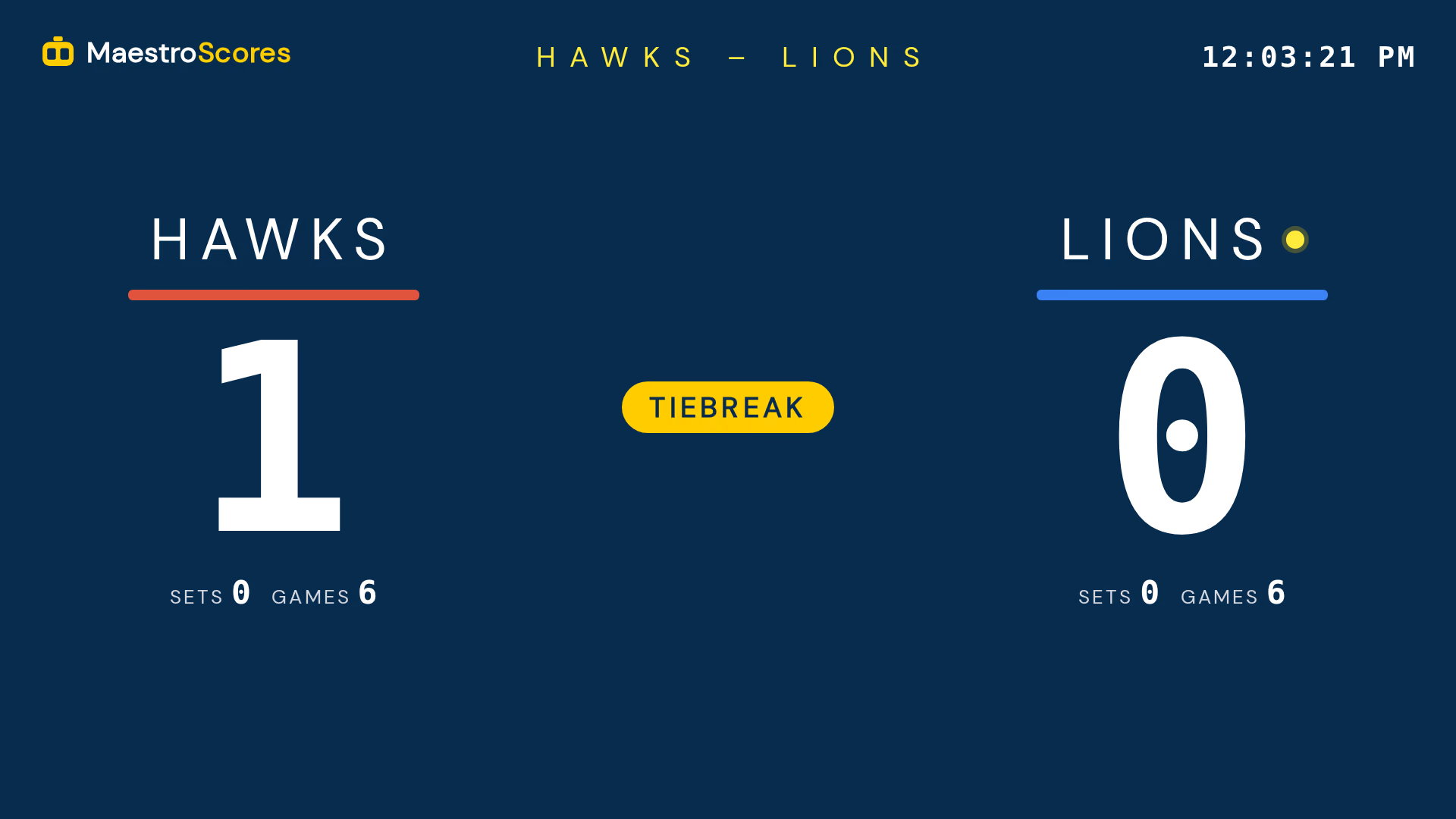

The ruleIn the tie-break the points count one by one, the first player to seven with a lead of two wins the set 7-6, and after the first point each player serves two points in turn.
Winning the match: two sets out of three
A match is played as the best of three sets or the best of five. In the best of three, the first player to win two sets wins the match; in the best of five, the first to win three sets.
Here Hawks win the second set 6-4 and the match by two sets to none. The board ends the match by itself and shows Final on the screens.
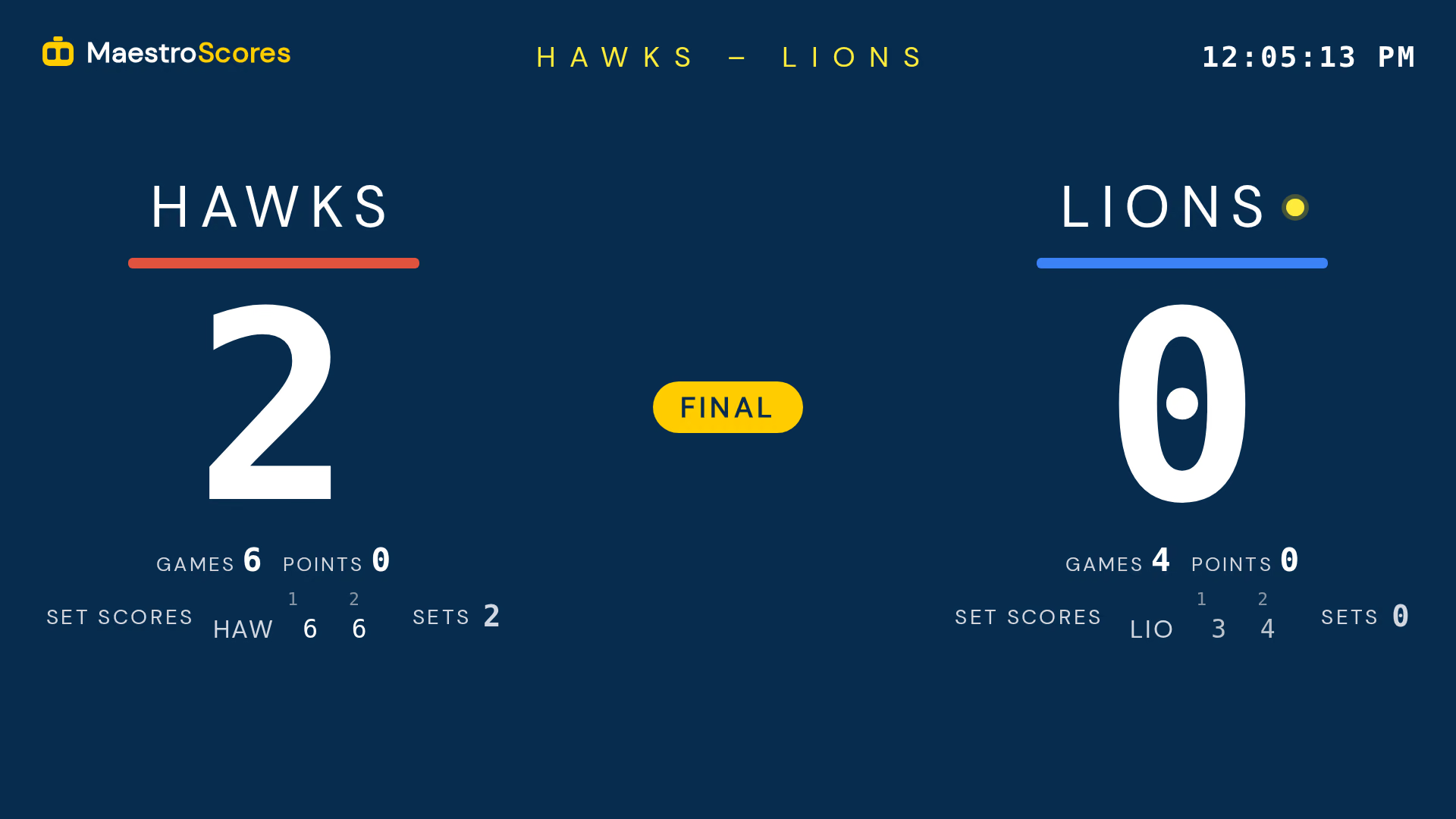

The ruleIn the best of three, the first player to win two sets wins the match.
Time between points and at a change of ends
Play in tennis is continuous. The rules allow at most 25 seconds between points and 90 seconds when the players change ends after a game. After the first game of each set and during a tie-break, the players change ends without a rest. At the end of each set there is a set break of up to 120 seconds.
The board calls each change of ends and times each of these rests: the scorekeeper sees the time left after every point, and the screens show it beside the change of ends and the set break.
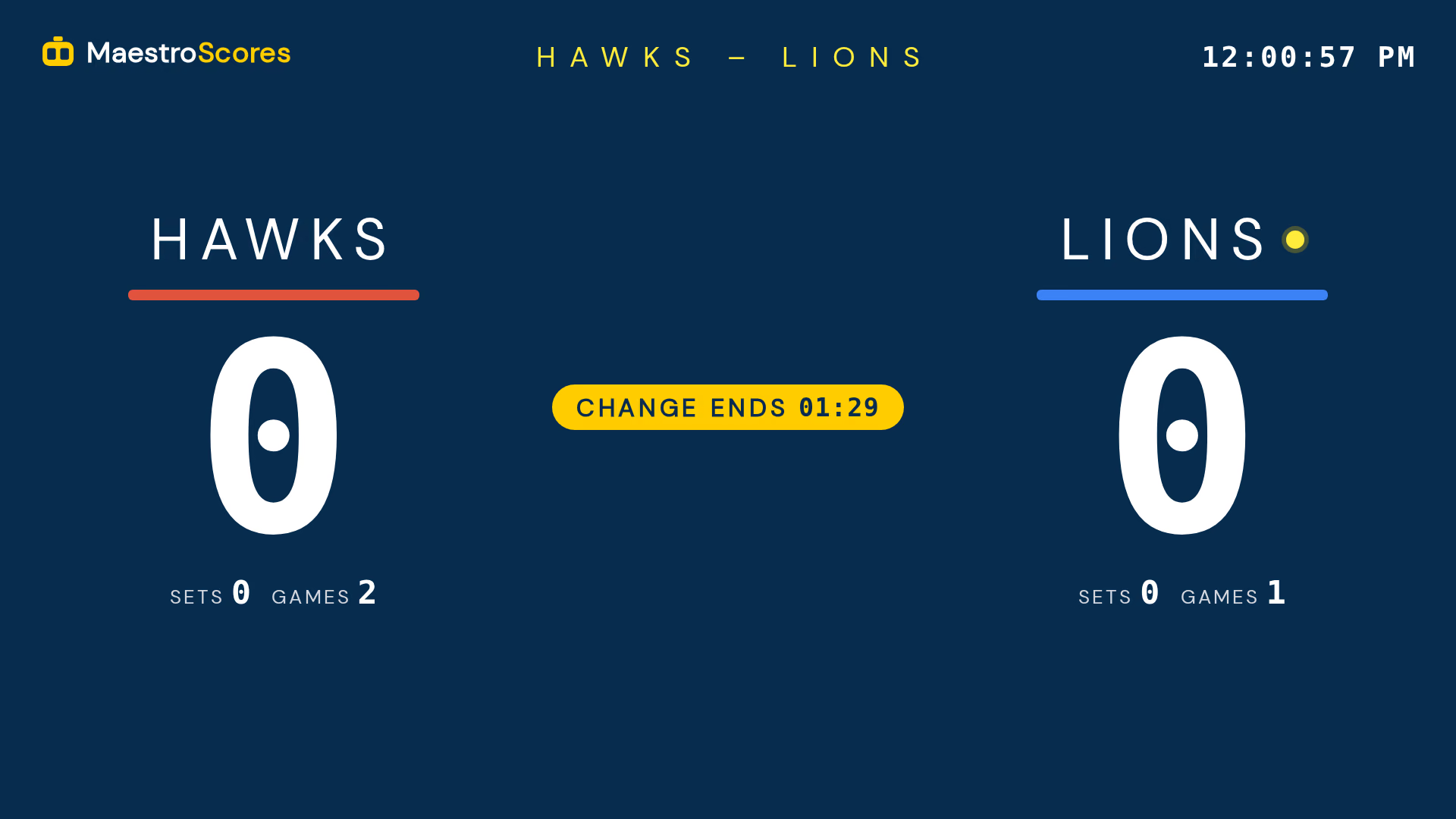

The ruleThe rules allow at most 25 seconds between points and 90 seconds at a change of ends after a game, with no rest after the first game of a set.
Other formats you can choose
Not every event plays this match. When you create a tennis board, you choose its rules: among them two sets and a Match tie-break: A tie-break to 10 points with a lead of two, played at one set all in place of the deciding set. Its winner wins the match. All terms to 10 points instead of a third set, the best of five sets with a 10-point tie-break at six games all in the final set, No-Ad scoring with one deciding point at deuce, short sets to four games, and FAST4: A short format of Tennis Australia: sets to four games, No-Ad games, and a tie-break at three games all. All terms. Some events play an Advantage set: A set with no tie-break: it goes on until one player leads by two games. All terms instead of a tie-break set, in every set or only in the final set: it has no tie-break and goes on past six games all until one player leads by two games, and the board offers it for the final set. A new board starts on the rules usual in your country.
FAQ
How does tennis scoring work?
Points make games, games make sets, and sets make the match. A game is called 15, 30, 40 and game and needs a lead of two points, a set goes to six games with a lead of two, and most matches are the best of three sets.
What happens at 40-40 in tennis?
The score is deuce. A player then needs two points in a row to win the game: the first gives the advantage, and the second wins the game.
Who serves first in tennis?
A toss decides. The winner chooses to serve or to receive, or chooses an end and leaves that choice to the opponent, and after the first game the serve passes to the other player every game.
How many serves do you get in tennis?
Two for each point. If the first serve is a fault, the server serves again from the same half of the court, and a second fault, a double fault, loses the point. A serve that touches the net and lands in the right service court is a let and is served again, and it does not wipe out an earlier fault.
What happens at six games all?
In a tie-break set, a tie-break decides the set. The first player to seven points with a lead of two wins the tie-break, and the set ends 7-6.
Keep tennis score on a board
Create a tennis board, choose the rules you play, and tap the player who won each point on your phone. Open the Scoreboard link on any screen at the court.
Tennis terms
- Advantage
- The point after deuce: its winner wins the game with the next point, and losing that point brings the score back to deuce. Scoreboards show it as Ad.
- Advantage set
- A set with no tie-break: it goes on until one player leads by two games.
- Alleys
- The strips between the singles and the doubles sidelines. In doubles they are in for every shot after the serve.
- Best of three, best of five
- How many sets a match can last. In the best of three the first player to win two sets wins the match; in the best of five, the first to win three.
- Change of ends
- The players swap ends of the court after the first game, the third and every odd game of a set, and after every six points of a tie-break.
- Deciding point
- Under No-Ad scoring, the one point played at deuce. The receiving player or team chooses to receive it in the right or the left half of the court.
- Deuce
- The score when both players have won three points in a game, 40-40. A player then needs two points in a row to win the game.
- Double fault
- Two faults in a row on the same point, which lose the point.
- FAST4
- A short format of Tennis Australia: sets to four games, No-Ad games, and a tie-break at three games all.
- Fault
- A serve that breaks the rules, most often one that does not land in the service court diagonally opposite. After a first fault the server serves again.
- Foot fault
- A fault the server makes with the feet while serving: touching the baseline or the court with either foot before the racket meets the ball, or walking or running.
- Game
- A run of points served by one player, won by the first player to win four points with a lead of two.
- Let
- A serve that touches the net and still lands in the right service court. It does not count and is served again, but it does not cancel a fault served before it.
- Love
- No points, or no games. A game's points are called love, 15, 30 and 40, and love-all is no points each.
- Match point
- A point that wins the match for the player who leads, if that player wins it.
- Match tie-break
- A tie-break to 10 points with a lead of two, played at one set all in place of the deciding set. Its winner wins the match.
- No-Ad
- A way of scoring games without advantage: at deuce one deciding point is played, and its winner wins the game.
- Service court
- The area across the net, diagonally opposite the server, that a serve must land in. It ends at the singles sideline, in doubles too.
- Set
- A run of games, won by the first player to win six games with a lead of two. In a tie-break set, a tie-break decides it at six games all.
- Set break
- The rest the players may take at the end of each set.
- Set point
- A point that wins the set for the player who leads, if that player wins it.
- Tie-break
- One game that decides a set at six games all. Its points are counted one by one, and the first player to seven points with a lead of two wins it and the set, 7-6.
- Toss
- Before the warm-up, a toss decides who serves first: its winner chooses to serve or to receive, or chooses an end and leaves that choice to the opponent.
- ITF Rules of Tennisitftennis.com