Tennis has the most unusual score in sport: points are called 15, 30 and 40, a Game: A run of points served by one player, won by the first player to win four points with a lead of two. All terms at 40-40 goes to deuce, and a Set: A run of games, won by the first player to win six games with a lead of two. In a tie-break set, a tie-break decides it at six games all. All terms can end in a Tie-break: One game that decides a set at six games all. Its points are counted one by one, and the first player to seven points with a lead of two wins it and the set, 7-6. All terms. A tennis scoreboard should do that counting for you. With MaestroScores, the umpire or a player taps who won each point on a phone, and the board shows the point score, the games, the sets and the server on a court-side screen or over a live stream. It runs in the browser, with nothing to install and no account.
This guide explains how the board keeps a tennis score, which match formats you can choose, and how to set up the screens at a club.
How the tennis scoreboard keeps the score
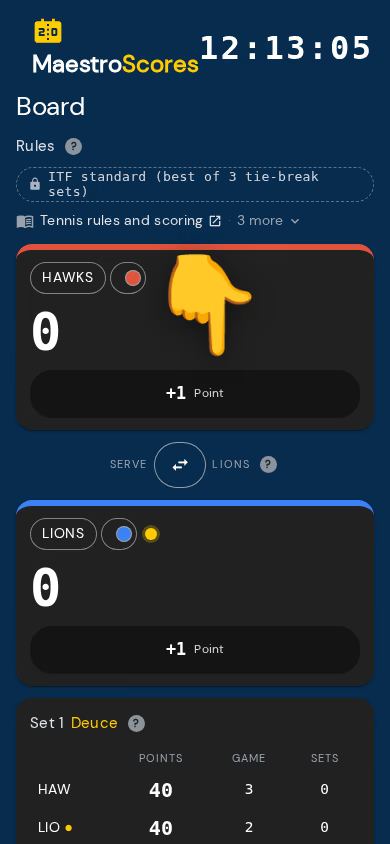
The scorer taps only the player or the team that won the point. The board then calls the point score the tennis way: 0, 15, 30 and 40. At 40-40 it marks Deuce: The score when both players have won three points in a game, 40-40. A player then needs two points in a row to win the game. All terms; the next point shows AD beside the player who won it, and a player needs two points in a row from deuce to win the game. Under the standard ITF rules, a set goes to the first player with six games and a lead of two games, and at 6-6 a tie-break to seven points with a lead of two decides it.
Between points the board works out everything else: which games and sets each side has won, the score of every finished set, when a tie-break starts, and who serves next. The screens mark Set point: A point that wins the set for the player who leads, if that player wins it. All terms, Match point: A point that wins the match for the player who leads, if that player wins it. All terms and the Change of ends: The players swap ends of the court after the first game, the third and every odd game of a set, and after every six points of a tie-break. All terms, so the players and the crowd always know what the next point means.
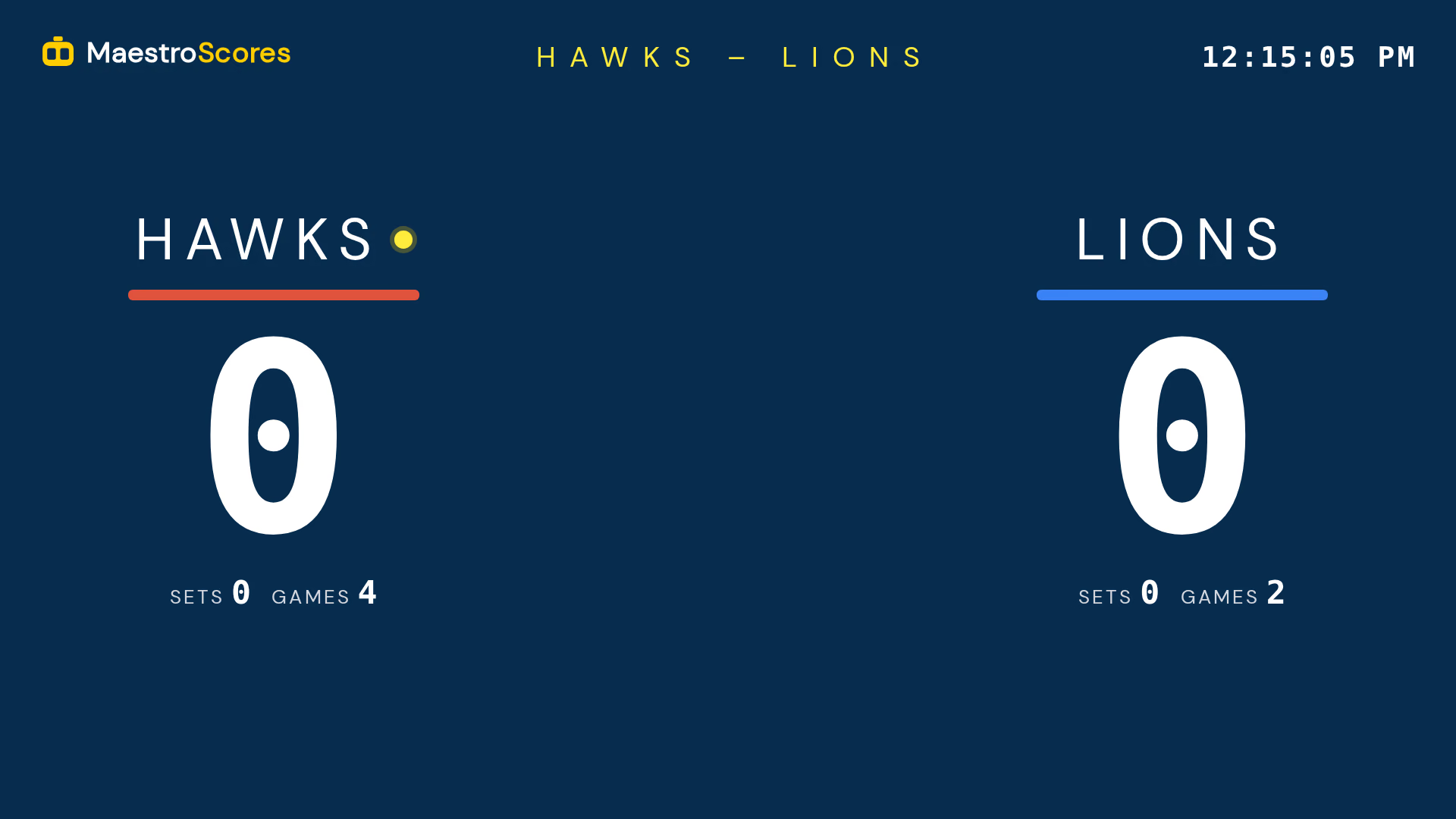

TipFrom deuce a player needs two points in a row to win the game.
Choose the tennis format you play
A new board starts on the format that is usual where you create it: two sets and a 10-point Match tie-break: A tie-break to 10 points with a lead of two, played at one set all in place of the deciding set. Its winner wins the match. All terms in the United States, and the ITF standard of best of three tie-break sets everywhere else. Each format names its rulebook; the ITF standard follows the ITF Rules of Tennis 2026, checked on 20 October 2026. You can choose another format when you create the board:
- ITF standard: Best of three, best of five: How many sets a match can last. In the best of three the first player to win two sets wins the match; in the best of five, the first to win three. All terms sets, each with a tie-break at 6-6
- Grand Slam: a 10-point tie-break at 6-6 in the final set
- Two sets and a 10-point match tie-break in place of a third set
- Tour doubles: No-Ad: A way of scoring games without advantage: at deuce one deciding point is played, and its winner wins the game. All terms games and a match tie-break
- College tennis (ITA): No-Ad games, with singles played as best of three sets
- FAST4: A short format of Tennis Australia: sets to four games, No-Ad games, and a tie-break at three games all. All terms and short sets, for shorter matches
No-Ad scoring and the match tie-break
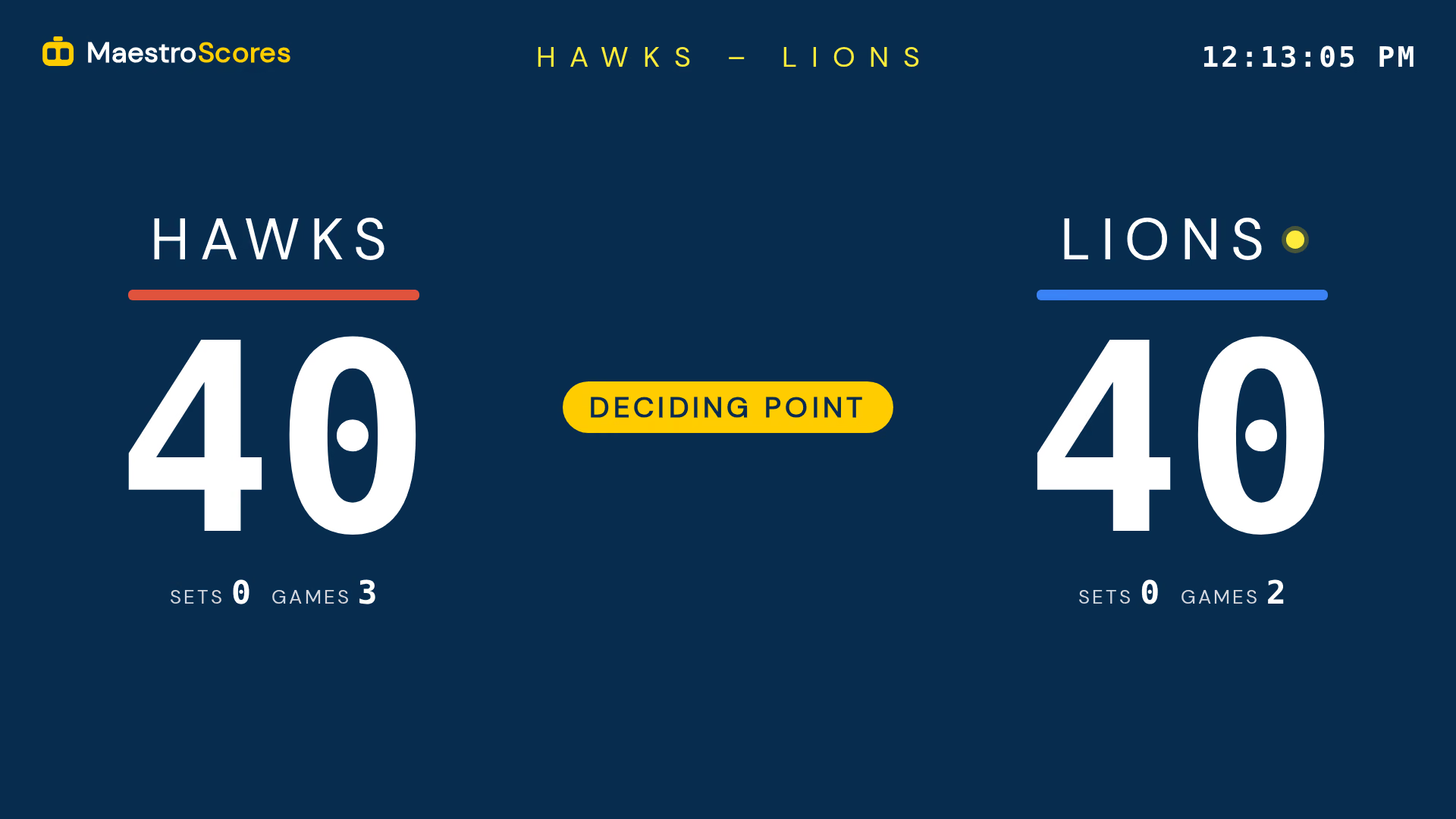
No-Ad scoring removes the advantage: at 40-40 one Deciding point: Under No-Ad scoring, the one point played at deuce. The receiving player or team chooses to receive it in the right or the left half of the court. All terms wins the game. College tennis in the United States uses it for both singles and doubles in Divisions I, II and III and the NAIA, under the ITA rules. A match tie-break is a single tie-break to 10 points that replaces the deciding set, often used in doubles and in club leagues.
On the board, a deciding point shows on the screens as such, and a match tie-break counts points to 10 with a lead of two. The scorer taps the same way in every format; only the rules the board applies change.
Put the tennis score on a court-side screen or a stream
Every board has a Scoreboard screen: open its link on a TV or a tablet beside the court, or connect a laptop to a TV in the clubhouse. It shows the point score, the games of every set and the server. Display links only show the match; nobody who opens one can change the score.
For a live stream, use the Scorebug screen, a small bar on a transparent page. In OBS Studio, add a Browser source and paste the Scorebug link as its URL; the transparent background stays transparent, so only the bar covers the video. The umpire or a player keeps the score on the Scorekeeper page on a phone.
FAQ
How does tennis scoring work?
Points go love, 15, 30, 40 and game, with deuce at 40-40 and a two-point lead needed from there. Under the standard ITF rules a set goes to six games with a lead of two, and a tie-break at 6-6 decides it. A match is usually the best of three sets.
Does the tennis scoreboard handle tie-breaks?
Yes. The board starts the tie-break at 6-6, counts its points, moves the serve, and ends the set when the tie-break is won. It also plays 10-point tie-breaks where the format uses them.
Can I use No-Ad scoring?
Yes. Choose a No-Ad format, such as tour doubles or college tennis, and at 40-40 the board plays one deciding point.
Is there a tennis scoreboard app to download?
No download is needed. MaestroScores runs in the browser on a phone, a tablet, a laptop or a smart TV, and every screen opens its own link.
Is the tennis scoreboard free?
Yes. MaestroScores is free to use, and you need no account to create a board or to open its screens.
Set up your tennis scoreboard
Create a board with tennis already chosen, pick the format of your match, and open the Scoreboard link on a screen beside the court.
Tennis terms
- Advantage
- The point after deuce: its winner wins the game with the next point, and losing that point brings the score back to deuce. Scoreboards show it as Ad.
- Advantage set
- A set with no tie-break: it goes on until one player leads by two games.
- Alleys
- The strips between the singles and the doubles sidelines. In doubles they are in for every shot after the serve.
- Best of three, best of five
- How many sets a match can last. In the best of three the first player to win two sets wins the match; in the best of five, the first to win three.
- Change of ends
- The players swap ends of the court after the first game, the third and every odd game of a set, and after every six points of a tie-break.
- Deciding point
- Under No-Ad scoring, the one point played at deuce. The receiving player or team chooses to receive it in the right or the left half of the court.
- Deuce
- The score when both players have won three points in a game, 40-40. A player then needs two points in a row to win the game.
- Double fault
- Two faults in a row on the same point, which lose the point.
- FAST4
- A short format of Tennis Australia: sets to four games, No-Ad games, and a tie-break at three games all.
- Fault
- A serve that breaks the rules, most often one that does not land in the service court diagonally opposite. After a first fault the server serves again.
- Foot fault
- A fault the server makes with the feet while serving: touching the baseline or the court with either foot before the racket meets the ball, or walking or running.
- Game
- A run of points served by one player, won by the first player to win four points with a lead of two.
- Let
- A serve that touches the net and still lands in the right service court. It does not count and is served again, but it does not cancel a fault served before it.
- Love
- No points, or no games. A game's points are called love, 15, 30 and 40, and love-all is no points each.
- Match point
- A point that wins the match for the player who leads, if that player wins it.
- Match tie-break
- A tie-break to 10 points with a lead of two, played at one set all in place of the deciding set. Its winner wins the match.
- No-Ad
- A way of scoring games without advantage: at deuce one deciding point is played, and its winner wins the game.
- Service court
- The area across the net, diagonally opposite the server, that a serve must land in. It ends at the singles sideline, in doubles too.
- Set
- A run of games, won by the first player to win six games with a lead of two. In a tie-break set, a tie-break decides it at six games all.
- Set break
- The rest the players may take at the end of each set.
- Set point
- A point that wins the set for the player who leads, if that player wins it.
- Tie-break
- One game that decides a set at six games all. Its points are counted one by one, and the first player to seven points with a lead of two wins it and the set, 7-6.
- Toss
- Before the warm-up, a toss decides who serves first: its winner chooses to serve or to receive, or chooses an end and leaves that choice to the opponent.
- Intercollegiate Tennis Association rulebookncaaorg.s3.amazonaws.com
- Browser Source – OBS Knowledge Baseobsproject.com